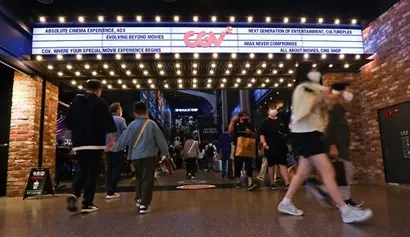
[비즈한국] Last June, Person A booked a ticket for the movie "Wonderland" for 11,000 won using a KT030200 membership discount. According to the reservation details in the membership app, the discount applied to the 15,000 won ticket was 4,000 won. Upon arriving at the CGV Pyeongchon branch in time for the movie, Person A issued the ticket at a kiosk and requested a receipt from the staff. The amount printed on the receipt was 10,500 won, not the 11,000 won that was actually deducted from Person A's card.
In the same month, Person B visited the CGV Beomgye branch. They purchased a 14,000 won movie ticket for 8,500 won after receiving a 5,500 won discount via the SKT membership app. After issuing the ticket on-site, they requested and received a separate receipt. The total amount displayed on the receipt was 7,000 won.
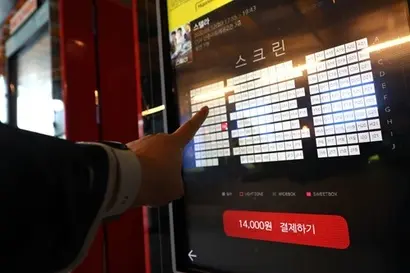
When movie tickets are purchased at a discount through channels such as mobile carrier memberships or KakaoTalk gift functions, a discrepancy occurs between the amount the consumer actually paid and the amount on the receipt issued by the theater. This is a phenomenon rarely seen in other industries. Where did the difference go?
Why filmmakers are demanding theaters disclose the details of the price difference
The discrepancy between the receipts received by the two people mentioned above and the actual payment amounts is essentially a "black box." Neither the theaters nor the mobile carriers are revealing where this price difference arises or how the 500 won and 1,500 won that vanished from the receipts were distributed. Most consumers who receive mobile discounts are not even aware that the amount printed on the receipt is lower than the ticket price they actually paid, as one must specifically request the receipt from on-site staff to check it.
A CGV official stated, "We reflect the portions reimbursed by mobile carriers in our settlements. However, it is difficult to disclose specific details as they are related to contracts with the carriers." A KT official also said, "We cannot disclose the details as they are subject to the contract signed for the membership service." An SKT official commented, "It is not a process provided by us that 7,000 won is displayed for a transaction where a ticket was purchased for 8,500 won after a 5,500 won discount was applied."
Various perspectives have emerged regarding this unusual case. Among them, the possibility that the price listed on the receipt is a "wholesale price" is being raised. An official from the People's Solidarity for Participatory Democracy explained, "We believe that marketing costs were divided according to criteria agreed upon internally by the carriers and theaters regarding cost-sharing. The theaters simply uploaded the wholesale price of the movie tickets they sell to the carriers onto the Korean Film Council's network." They added, "Various interpretations are possible, such as the carrier pocketing the difference, or the theater receiving it back through the carrier or splitting it; however, since only the theaters hold the accessible information, we can only speculate based on limited data."
Kim Bum-jun, a professor of accounting at Catholic University of Korea, also viewed that "the receipt amount, which is lower than the actual payment amount, may possibly be the wholesale price at which the movie theater sold the ticket to the carrier."
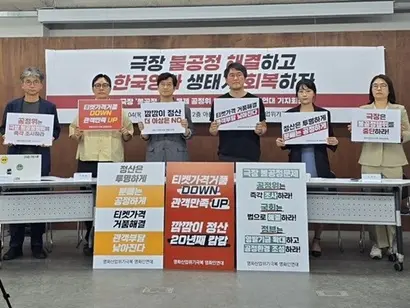
Recently, the Solidarity of Film Professionals, a coalition of 15 groups including the Producers Guild of Korea and the Directors Guild of Korea, along with People's Solidarity for Participatory Democracy and Lawyers for a Democratic Society, raised the issue. On the 4th, they reported the three major multiplex chains to the Fair Trade Commission. They argue that although ticket prices were raised three times during the COVID-19 pandemic, the "average revenue per ticket," which serves as the basis for profit distribution, actually decreased due to unfair practices by theaters. The Solidarity of Film Professionals views the receipts that differ from actual payment records as one piece of evidence for this.
Only theaters and carriers know the movie's 'real price'; production and distribution companies are in the dark
The Korean Film Theater Association, which includes movie theaters, issued a statement on the day of the Fair Trade Commission report, flatly refuting the claims: "The amounts reimbursed by mobile carriers and credit card companies following mobile discounts and various card discounts are being fairly settled and distributed with distributors." The mobile carriers seem to be drawing a line, fearing they will be caught in the crossfire of the conflict between the film industry and theaters. No carrier representatives attended a related National Assembly debate held on the 11th.
Questions remain. The ticket sales price that theaters register on the Korean Film Council's network is the amount listed on the on-site receipt. This amount serves as the basis for the average revenue per ticket (average ticket issuance price), which is the foundation for profit sharing, as well as the calculation for value-added tax and the Film Development Fund. The Film Development Fund is a core resource managed by the Korean Film Council, used for budgets ranging from production and creative support to the Busan International Film Festival, aimed at fostering and developing the Korean film industry.
Choi Chul, a professor of consumer economics at Sookmyung Women's University, pointed out, "When a consumer books a ticket with a credit card, the fact that a transaction occurred for that amount at the time of payment is notified to the National Tax Service. If the amount on the final receipt is different, it raises questions."
Professor Kim Bum-jun noted, "From a business perspective, considering the fixed costs of operating a theater, it is plausible to choose a strategy of selling tickets at a lower price to generate profit rather than leaving seats empty." However, he pointed out, "If the theater receives benefits or kickbacks in exchange for selling tickets cheaply to carriers, it could potentially become an accounting issue."