

[비즈한국] The Pleiades star cluster in the constellation Taurus is a beautiful cluster that can be enjoyed even with the naked eye. The Pleiades, an open cluster teeming with newborn, hot, blue stars, appears as a small, cozy gathering of about six bright stars to the unaided eye. To date, over 1,000 such open clusters have been discovered in our galaxy. This is merely the number discovered so far; astronomers estimate that nearly 10,000 open clusters may be wandering through the disk of our galaxy.
Stars generally do not form in isolation. As a massive molecular cloud contracts all at once, hundreds or thousands of stars of the same age are born together in that region. This is how the star clusters observed today are created. At first glance, one might think that the countless clusters filling our galaxy were born as separate entities within thousands of distinct gas clouds that existed independently.
However, astronomers have recently uncovered a hidden secret about the birth of our galaxy's star clusters. It turns out that these numerous clusters wandering our galaxy were all actually born in the same places! While they were once "village" stars born together in the same spot, their orbits have drifted in various directions over hundreds of millions of years, leading them to exist now as seemingly unrelated, distant clusters.
The European Space Agency's (ESA) Gaia satellite maps the precise spatial distribution of billions of stars in our galaxy. This number accounts for approximately 1% of all stars filling our galaxy. By comparing the subtle positional changes of each star, it also tracks their movements—how fast they are drifting through galactic space and in what direction. Through the ultra-precise map of our galaxy completed by the Gaia satellite, astronomers can now track how the positions of stars in our galaxy change from hundreds of millions of years in the past to hundreds of millions of years into the future.
In this analysis, astronomers mapped relatively nearby clusters located within 3,000 light-years of the solar system. There are 272 such clusters within this range. They then traced the path of each cluster from its birth about 300 million years ago to its current location. The results were astounding. Of the 272 clusters, 155—a staggering 57%—converged to just three birth locations! It appears that these neighboring clusters, born within just three giant molecular clouds, have had their orbits gradually disrupted and scattered in all directions over 300 million years, leaving them distributed across a 3,000-light-year radius around our solar system today.
Based on these three birthplaces, astronomers categorized the clusters into the Collinder 135 group, the Alpha Persei group, and the Messier 6 group. Family clusters "kneaded" in the gas clouds near the Collinder 135 cluster, visible in the southern sky toward the constellation Puppis, include NGC 2547 and IC 2395. Family clusters born together in the gas clouds near the star Alpha Persei include IC 4665 and IC 2602. Family clusters born from the same hometown as the Messier 6 cluster include NGC 3228, IC 2391, Trumpler 10, and NGC 2451A. These clusters now appear to form the distribution of stars we see in Earth's night sky near Taurus and along the Scorpius-Centaurus association.
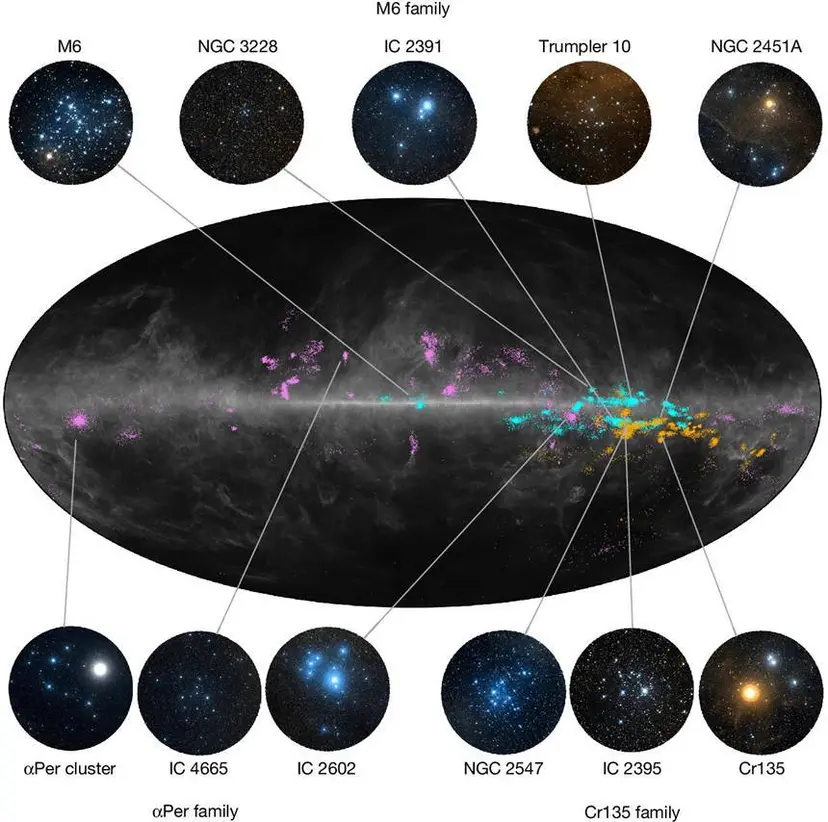
About 600 million years ago, the Alpha Persei group and the Messier 6 group began to form clusters first. A little later, 405 million years ago, clusters in the Collinder 135 group also began to be born one by one. The original gas cloud regions were not very large. The Collinder 135 group region was about 160 light-years wide, the Alpha Persei group region about 290 light-years, and the Messier 6 group region spanned about 250 light-years. Having lived huddled together in narrow regions less than 200 light-years wide, these clusters gradually moved along their respective orbits around the galaxy, scattering their distribution. Today, the clusters are spread across a vast 3,000-light-year range.
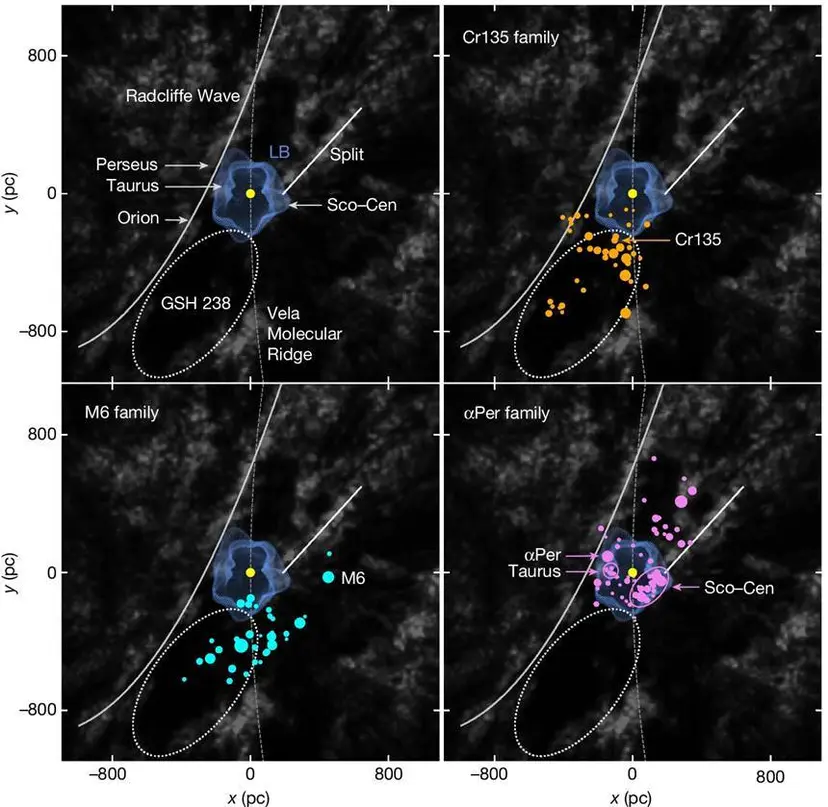
The clusters moved gradually apart while orbiting the galactic disk. It is estimated that nearly 200 supernova explosions occurred within these clusters over time. The shockwaves left by these supernovae swept away the interstellar medium surrounding our solar system. This created a kind of massive, empty bubble—a region where the density of the interstellar medium is observed to be relatively low around our solar system. This is believed to be the Local Bubble, the round, peanut-shaped void around our solar system observed through radio astronomy.
Another massive structure can be found near the Local Bubble. There exists a circular wall-like structure with high density, as if the interstellar medium had been pushed out; this is called the giant shell GSH 238+00+09. According to this analysis, it appears that the nearly 200 supernova explosions that created the Local Bubble around our solar system also created this giant wall.
The process of positional change for each cluster tracked in this analysis has been implemented in great detail as a 3D model.
https://cswigg.github.io/cam_website/swiggum_2024_interactive/fig2_interactive.html
https://cswigg.github.io/cam_website/swiggum_2024_interactive/fig1_interactive.html
Through the links above, you can personally change the viewpoint from various angles to compare how the distribution of clusters around our solar system has changed from the past to the present. By seeing for yourself how stars born in just three limited locations have scattered in all directions, looking as if they are completely unrelated to one another, you can truly feel how dynamic our galaxy is.
As we trace the dynamic history of the clusters around our solar system, one fact feels particularly intriguing: our Sun is standing alone in space, without any other companion stars nearby. This is highly unusual. The Sun likely originated as one of many stars born all at once during the contraction of a giant gas cloud. If so, there should naturally have been many neighbor stars born in a similar place at a similar time. In other words, the Sun should naturally belong to a star cluster. Yet, our Sun is a "lonely" star wandering the universe without belonging to any cluster.
Efforts to find the Sun’s lost sibling stars, which may have been born in the same hometown, are still ongoing. The most reliable way to identify a star’s origins is to compare the chemical composition of its atmosphere. If a star is discovered nearby with a chemical makeup very similar to our Sun’s, it can be assumed that it is likely a sibling star born from the same gas cloud long ago using similar materials.
So far, dozens of stars suspected to be the Sun’s lost siblings have been discovered. Among them is the star HD 162826, located about 110 light-years away in the direction of Hercules. This star is about 15% more massive than the Sun—a "big brother" of sorts. More recently, the star HD 186302, located about 185 light-years away in the direction of Pavo, has also been suggested as a lost sibling. However, some argue that this is unlikely based on its dynamic history, as its current orbit deviates significantly from the Sun’s path around the galaxy. At one point, there was analysis suggesting the Messier 67 cluster might be the Sun's birthplace, but recent precise observations have greatly reduced that possibility.
Unfortunately, it has not been exactly determined where the Sun was born before it became a wanderer living alone in the universe. Astronomers are still tracking the Sun's true hometown. How did our Sun end up in this solitary state? And why is this question important?
Tracking the Sun's exact birth cluster goes beyond simply solving the secret of its birth; it could provide unexpected answers about the origins of Earth and life itself. Perhaps it is because our Sun is not part of a cluster that it has been able to harbor planets capable of supporting life stably for such a long time? In other words, could the Sun's lonely reality be an unexpected stroke of luck that allowed a treasure trove of life like Earth to exist beside it? Furthermore, perhaps life-sustaining materials were created throughout the Sun's original hometown cluster and delivered to our Earth, leading to the world we have today. In short, if we find the hometown cluster where the Sun was born, we might more easily find traces of extraterrestrial life there.
If the hometowns of the countless star clusters filling our galaxy converge to just two or three locations, couldn't our Sun also be a star born in one of those places? As we gain the ability to trace the birth process of our galaxy, I look forward to the day when we can trace back to the moment the Sun—and perhaps life itself—was born, finally unveiling the secrets of the Sun's birth.
Reference
https://www.nature.com/articles/s41586-024-07496-9
About the author, Ji Ung-bae: He loves cats and the universe. After watching 'Galaxy Express 999' as a child, he dreamed of sharing the beauty of the universe. Currently, he researches galaxy evolution through galactic interactions at the Center for Galaxy Evolution and the Near-Cosmology Laboratory at Yonsei University. He is active in various science communication activities, including lectures and writing. He has authored books such as 'The Observatory of Relationships', 'Thinking About the Universe All Day', and 'Stars, the Science of Light'.