

[비즈한국] Line 8 originated from Seongnam City's urban development plan. In the 1960s and 1970s, the Park Chung-hee administration planned to clear unauthorized shanty towns in Seoul, resulting in the creation of a massive complex for 100,000 people in the Sujeong-gu and Jungwon-gu districts of Seongnam, to which the urban poor were relocated. However, upon arrival at the Gwangju Complex, the relocatees were forced to live in tents on undeveloped land, lacking basic facilities such as heating, toilets, and water and sewage systems, as well as adequate transportation to Seoul.
Under these circumstances, when the Gyeonggi Provincial Office imposed excessively high land prices, the residents, pushed to their limits, expressed their anger, leading to the Gwangju Complex Incident. The government promised to unconditionally accept the demands of the relocatees to calm the situation. After the incident, the Gwangju Complex area was promoted to Seongnam City, jobs such as factories were created, basic facilities like water and sewage systems were installed, and transportation connecting Seoul and Seongnam began to be established.
The Seoul Metropolitan Government constructed Jamsil Bridge, Songpa-daero, Heolleung-ro, and Galma Tunnel as transportation means for Seongnam residents, and simultaneously planned a new subway line connecting Seoul and Seongnam. Initially, Line 5, consisting of the Cheonho-Jamsil-Seongnam section, was planned as the rail link between Seoul and Seongnam. However, this plan ultimately remained just a campaign promise.
In the 1989 Second Subway Plan, Line 8, connecting Amsa to Seongnam, was finally planned. Line 8 and the Bundang Line, which also passes through Seongnam, were planned at the same time; the Bundang Line was built to provide a fast connection between Seoul and the Bundang New Town, while Line 8 was designed to pass through the original urban center of Seongnam, which the Bundang Line bypassed, to complement each other. The Jamsil-Moran section of Line 8, passing through Seongnam, began construction in 1990, and the Amsa-Jamsil section started in 1992. The Jamsil-Moran section opened in November 1996, and the Amsa-Jamsil section opened in July 1999 following construction delays. In December 2021, Namwirye Station was added between Bokjeong Station and Sanseong Station.
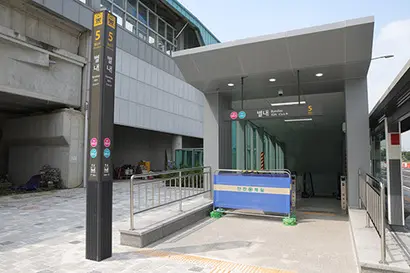
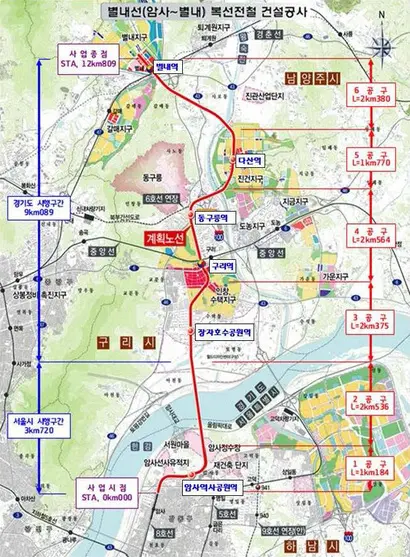
Gyeonggi-do announced that the Byeollae Line extension of Subway Line 8 (Amsa Station to Byeollae Station), connecting Byeollae Station in Namyangju to Amsa Station in Seoul, will open on August 10. The Byeollae Line (Amsa-Byeollae) is a 12.9km route connecting a total of 6 stations from Amsa Station in Gangdong-gu, Seoul, the existing terminus of Line 8, to Byeollae Station in Namyangju. This marks the opening eight years after construction began in 2016. Trains on the Byeollae Line consist of 6 cars per train, running at intervals of approximately 4.5 minutes during rush hours, 8 minutes during off-peak hours, and at a maximum speed of 80 km/h.
When the Byeollae Line opens, the travel time from Byeollae to Jamsil will be 27 minutes, and transfers will be available to Line 2 (Jamsil), Line 3 (Garak Market), Line 5 (Cheonho), Line 9 (Seokchon), the Suin-Bundang Line (Bokjeong, Moran), the Gyeongui-Jungang Line (Guri), and the Gyeongchun Line (Byeollae).
With the Byeollae Line directly connecting to Seoul Subway Line 8 toward Gangnam, access from Namyangju and Guri to Gangnam will become much more convenient. Currently, to get to Gangnam from Guri or Namyangju, residents have to take the Gyeongui-Jungang or Gyeongchun line to Sangbong Station, transfer to Line 7, and then transfer again to Line 2 at Konkuk University Station. Starting August 10, the opening of the Byeollae Line will significantly reduce travel time to Jamsil Station (Line 2) and Seokchon Station (Line 9) using Line 8.
The extension of the Byeollae Line will also be a major boost for existing new towns like Byeollae and Dasan New Towns, as well as Bogeumjari Housing Districts and the 3rd New Town project, Wangsuk New Town. It will also aid redevelopment projects such as the Inchang-Sutaek New Town in Guri and the Jigeum-Donong New Town in Namyangju. It will also have a positive impact on redevelopment projects in Seoul's Gangdong-gu and Songpa-gu and in Seongnam, which are already near existing Line 8 stations.
In particular, since it passes directly through Inchang-dong, Sutaek-dong, and Topyeong-dong—the most densely populated areas of Guri—it is expected that Guri citizens will be the most frequent users. It is also expected that many residents of Dasan New Town will utilize the line. In addition to residents of Byeollae New Town, it is anticipated that residents of Galmae-dong in Guri, where Toegyewon-eup and the Galmae district are located, as well as residents of the Yangwon district in Jungnang-gu, Seoul, will use the line.
In summary, the extension of Line 8 will play a key role in improving transportation issues in the Seoul and Seongnam regions. This is because Line 8 allows for transfers to various major lines, making it easier for users to move to other routes.
The extension of Line 8 is expected to contribute to the rise in real estate value and the revitalization of commercial districts near major stations. In particular, the economic activation of surrounding areas is anticipated once the extended section opens. Another advantage is that increased use of public transportation, such as subways, can reduce car usage and help curb road congestion. This is why one should keep a close eye on the areas benefiting from the Line 8 extension.
Kim Hak-ryul, head of the Smart Tube Real Estate Research Institute, known by the pen name "Pasyong," previously served as a team leader at the Real Estate Research Division of Gallup Korea. He operates the Naver blog "Pasyong's World Tour" and the YouTube channel "Stew TV." He is the author of books including "Absolute Principles of Seoul Real Estate (2023)," "The Future of Incheon Real Estate (2022)," "Kim Hak-ryul's Absolute Principles of Real Estate Investment (2022)," "Future Map of South Korean Real Estate (2021)," "From Now On, Only Places That Will Rise, Will Rise (2020)," and "User Manual for South Korean Real Estate (2020)."