

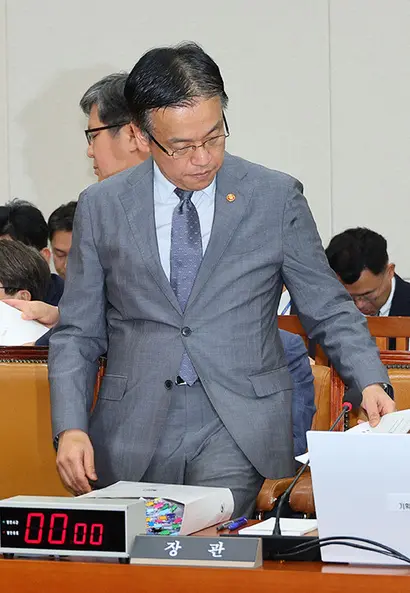
[비즈한국] Due to worsening corporate performance, national tax revenue collected through May of this year has fallen by more than 9 trillion won compared to the same period last year. Considering that last year saw the largest tax revenue shortfall in history, the situation this year is looking equally grim. Deputy Prime Minister and Minister of Economy and Finance Choi Sang-mok also acknowledged that a tax revenue deficit is likely to occur again this year, stating, "It seems the tax revenue situation will not be very good this year either."
Despite the expected revenue deficit, the ruling party, which has been advocating for fiscal soundness, is considering extending various tax credits, while the opposition party, which had attacked the administration over the revenue shortfall, is also focusing on expanding tax credits. Both the ruling and opposition parties, which previously blamed each other for the tax deficit, are now racing to introduce bills that would further fuel it. Concerns are rising that the combination of tax revenue holes and the competitive tax-cutting measures by both parties will lead to increased national debt and threaten fiscal stability.
In his report to the 22nd National Assembly's first Strategy and Finance Committee meeting on July 8, Deputy Prime Minister Choi Sang-mok said, "We are also taking the tax and fiscal conditions very seriously," adding, "We will strengthen monitoring and take measures as much as possible regarding these areas." According to the Ministry of Economy and Finance, national tax revenue from January to May totaled 151 trillion won, a decrease of 9.1 trillion won compared to the same period a year ago.
This decline in national tax revenue was largely driven by a reduction in corporate tax. From January to May of this year, corporate tax revenue stood at 28.3 trillion won, down 15.3 trillion won from the same period last year. In particular, the tax revenue progress rate against the budget is 41.1%, which is lower than both the recent five-year average (47.0%) and last year's rate (46.6%), during which the largest tax revenue hole in history (56.4 trillion won) occurred.
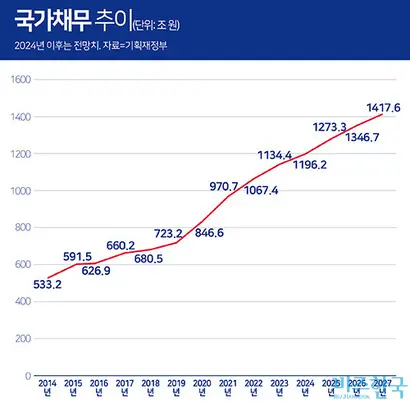
As tax revenue falls short, the national debt is rising, and fiscal health is steadily deteriorating. According to the Ministry of Economy and Finance, the national debt is projected to reach 1,196.2 trillion won this year, a 2.2-fold increase compared to 2014 (533.2 trillion won) ten years ago. National debt is forecast to grow to 1,417.6 trillion won by 2027.
The ruling and opposition parties are shifting the blame onto each other for the lack of revenue that is undermining fiscal soundness. The Democratic Party of Korea criticizes the Yoon Suk-yeol administration's tax-cutting policies, which are weighted toward conglomerates and tax breaks for the wealthy, for triggering the revenue shortfall. In contrast, the People Power Party maintains that the cause lies in the profligate fiscal spending during the Moon Jae-in administration. While shifting responsibility for the revenue shortage, both parties are preoccupied with drafting bills that will further exacerbate the deficit rather than tightening their belts.
As of the 12th, since the opening of the 22nd National Assembly, 1,525 out of the 1,582 bills submitted to the National Assembly were proposed by individual lawmakers. The most frequently submitted bills by lawmakers are "Partial Amendments to the Restriction of Special Taxation Act," which focus on cutting various taxes; 40 such bills were proposed in just over a month since the 22nd National Assembly opened. Notable examples include an amendment (proposed by Representative Yoo Dong-soo) to provide a credit card income deduction for communication expenses with a limit of 1 million won per year during year-end tax settlements, and an amendment (proposed by Representative Ahn Do-geol) to make permanent the income deduction deadline (end of 2024) for rental business owners who reduce commercial rent.
Likewise, 29 and 25 "Partial Amendments to the Restriction of Local Taxation Act" and "Partial Amendments to the Income Tax Act" were also proposed to extend tax credit periods or reduce taxes, respectively. Among the amendments to the Income Tax Act, noteworthy bills include those that incorporate telephone charges into tax credits (proposed by Representative Jo Seung-rae), increase the education expense tax credit to a maximum of 5 million won per child annually (proposed by Representative Park Sung-jun), and provide tax benefits to wage earners and their spouses who use sports facilities (proposed by Representative Seo Young-kyo).
Not only lawmakers but also political parties are focusing on drafting tax-cutting bills. On June 30, the People Power Party, the government, and the Presidential Office held a high-level consultative meeting and decided to extend the "Kind Landlord" tax credit support period from the end of this year to the end of next year to ease the rent burden on small business owners. On June 29, the Democratic Party decided at its general meeting of lawmakers to push as party platforms an amendment to the Income Tax Act (proposed by Representative Ahn Do-geol) to include fees for elementary school arts and physical education academies in the education expense tax credit, and an amendment to the Higher Education Act (proposed by Representative Jeong Eul-ho) to expand the "1,000-won breakfast" project.