

[비즈한국] Amid the prolonged conflict between the government and the medical community, attention is naturally turning toward the role of the 22nd National Assembly. Health and welfare bills proposed so far include the Nursing Act, which stipulates regulations regarding nursing; bills for establishing public health and medical schools and training regional doctors to bridge regional healthcare gaps; and bills concerning the adjustment of work scopes among healthcare professionals. The Nursing Act was proposed by both the ruling and opposition parties, while the bills for public medical schools, regional doctor training, and partial amendments to the Healthcare Personnel Support Act were initiated by the opposition. However, the situation remains precarious as medical associations continue to voice opposition, including registering mass objections during the legislative notice period.
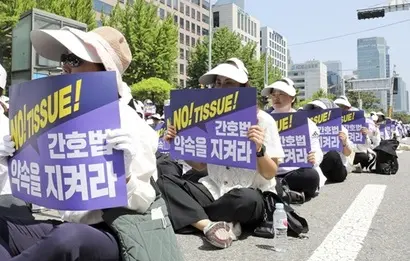
Ruling Party Proposes "Abolishing Nursing Assistant Education Requirements," Opposition Pushes for "Excluding Nurses from Medical Technician Tasks"
With both ruling and opposition parties adopting the Nursing Act as their party platform, the enactment is gaining momentum once again. The government has also expressed its intention to pursue it. There are three bills currently subject to legislative notice: one proposed by the ruling party and two by the opposition. All ruling party lawmakers have put their names on their party's bill. The bills differ in content, such as the scope of nursing tasks and educational requirements for nursing assistants. Examining common ground, the term "local community" in Article 1—which was controversial for implying the possibility of independent practices by nurses—has been deleted. Instead, it has been changed to "healthcare institutions, schools, industrial sites, home care, and various social welfare facilities, etc." The bills also include content regarding the establishment permits and cooperation obligations for nursing organizations, such as the Korean Nurses Association and the Korean Nursing Assistants Association.
The areas where the ruling and opposition parties diverge are primarily: △the scope of nursing tasks, △educational requirements for nursing assistants, and △the integrated nursing and care service system. The "Nursing Act" representative-proposed by People Power Party lawmaker Choo Kyung-ho specifies that nurses and advanced practice nurses may perform tasks related to "medical support based on a physician’s comprehensive guidance or delegation" after a physician’s professional judgment regarding examination, diagnosis, treatment, medication, and procedures is made. Conversely, the "Nursing Acts" proposed by Democratic Party lawmakers Kang Sun-woo and Lee Soo-jin limit the scope to "medical assistance performed under the guidance of a physician" and "duties necessary for patient care such as injections and treatments performed under the guidance or prescription of a physician," respectively. The provision excluding nurses from performing medical technician duties is included only in the bills proposed by Kang and Lee.
Regarding nursing assistant education requirements, both bills show a move toward relaxation, though they differ slightly. Rep. Choo Kyung-ho's bill adds a clause recognizing those who "have acquired an educational level equivalent to items 1 through 6 in accordance with Presidential Decree." In contrast, the bills by Reps. Kang and Lee merely modify the requirement to "high school graduate or higher," adding the phrase "or higher." The integrated nursing and care service system is also included only in the bills of the two opposition lawmakers. These bills newly introduce content stating that nursing services provided to patients requiring such care must be delivered "under the responsibility of a nurse."
Provisions regarding the number of patients per nurse and nursing assistants (caregivers) vary regardless of party lines. Reps. Choo Kyung-ho and Lee Soo-jin specify that the state must establish and support policies to reduce the number of patients per nurse working in hospital-level medical institutions, whereas Rep. Kang Sun-woo's bill contains no such content. Regarding caregivers, Rep. Choo’s bill includes a plan to operate a nursing personnel support center to include caregivers in nursing staff and support long-term retention, while Rep. Lee’s bill includes "caregiving personnel" in the definitions of nurses and nursing services. In comparison, Rep. Kang’s bill does not mention "nursing assistants" or "caregiving personnel."
Will the Nursing Act Pass Alongside Amendments to the Healthcare Personnel Support Act?
Two bills aimed at bridging regional healthcare gaps have been proposed by the opposition. These are the Bill on the Establishment and Operation of Public Health and Medical Schools, representative-proposed by Rep. Park Hee-seung, and the Regional Doctor Training Bill, representative-proposed by Rep. Kim Won-i. Both bills are designed to strengthen regional healthcare and share commonalities in addressing mandatory service for physicians. The differences are that the public medical school bill targets "medical schools, graduate medical schools, and graduate schools of public health," while the regional doctor bill covers "universities that operate medical, dental, and oriental medicine educational curricula."
Regarding student selection, the public medical school bill mandates that at least "60%" of admissions be reserved for local talent. Requirements are stricter than for regional doctors, such as requiring graduates from local high schools where the university is located and residency in that region during high school. Both bills provide support for admission fees, tuition, textbook costs, and dormitory fees. Provisions for discontinuing and returning support in cases of dropping out, failing the national licensing exam within 3 years, or revocation of medical licenses during mandatory service are identical. However, the public medical school bill does not impose a duty to return funds for failing to complete mandatory service.
Both bills set the mandatory service period at 10 years. The public medical school bill makes failure to fulfill service a condition for license revocation, while the regional doctor bill makes mandatory service a condition for license issuance. Both provide support for job training and career development, but the public medical school bill also includes housing support. Additionally, public medical schools must establish affiliated hospitals if practical training facilities are insufficient, while for regional doctors, local clinical training processes may be added.
Recently, the partial amendment to the Healthcare Personnel Support Act pushed by Democratic Party lawmaker Kim Yoon has become a major point of interest in the medical community. This is because organizations belonging to the Health, Welfare, and Medical Alliance, excluding the Korean Medical Association, have participated in an advisory committee formed by Rep. Kim. The bill includes the establishment of a "Healthcare Personnel Work Coordination Committee" to adjust work scopes for each healthcare profession. There is also a green light for the passage of the Nursing Act. The Health, Welfare, and Medical Alliance played a decisive role in opposing the Nursing Act last year. Since those same groups are participating in the Democratic Party's advisory committee, many believe that not only the partial amendment but also the Nursing Act will likely pass.
The public medical school bill was previously scrapped in 2020 due to strong backlash from the medical community. If the public medical school and regional doctor bills pass this time, the possibility of resident doctors returning to work will become even more remote.
Physician organizations, including the Korean Medical Association (KMA), oppose all six bills. They argue that the Nursing Act only represents the rights and interests of a specific profession and causes problems such as encouraging illegal medical practices by advanced practice nurses, violating the constitutional principle against comprehensive delegation, and promoting the opening of illegal medical institutions by nurses. In a statement, the KMA declared, "Our medical system is based on a single act where the Medical Service Act comprehensively regulates all medical personnel. The reason only nurses are obsessed with enacting a 'Nursing Act' is precisely to expand their scope of practice, which they call 'nursing care,'" and "We strongly urge the cessation of discussions on the Nursing Act, which only causes exhaustive conflict, and call for efforts to improve working conditions for all healthcare personnel."