

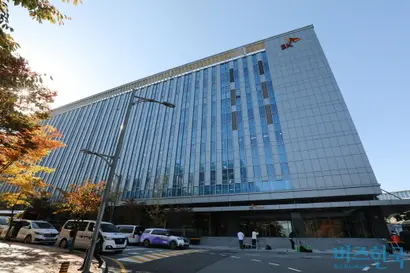
[비즈한국] Following the Kakao035720 outage, the issue of the harmful effects of platform monopolies has spread widely, causing the government's policy stance to shift from self-regulation to intervention and strengthened regulations.
This is because the paralysis of the Kakao platform, caused by a fire at the SK C&C data center in Pangyo, Gyeonggi Province, on the 15th, has led to national chaos, prompting a flood of demands for measures to prevent a recurrence.

On the 24th, during the comprehensive audit of the Ministry of Science and ICT by the National Assembly's Science, ICT, Broadcasting, and Communications Committee, Kakao Group founder Kim Beom-su, Naver035420 Global Investment Officer (GIO) Lee Hae-jin, Kakao CEO Hong Eun-taek, Naver CEO Choi Soo-yeon, SK Group Chairman Chey Tae-won, and SK C&C CEO Park Sung-ha appeared as witnesses and repeatedly bowed their heads in apology for the Kakao outage.
In particular, Center Head Kim Beom-su, who was heavily criticized at last year's audit for encroaching on small local businesses, faced intense questioning over the outage. With this incident, attention is growing on where the change in policy stance toward the platform industry will lead.
Shortly after its inauguration this June, the Yoon Suk-yeol administration declared a policy stance to provide necessary support for the capacity building of platform operators like Naver and Kakao, while striving to establish guidelines for self-regulation. The market interpreted this as an expression of the new government's will to continue the platform industry promotion stance established by the Moon Jae-in administration as one of the cornerstones of the 4th Industrial Revolution.
However, a change in the government's stance is being detected due to the Kakao outage. On the 17th, President Yoon Suk-yeol declared his will to regulate, stating, "If the market is distorted by excessive monopoly, the state can intervene for the benefit of the public."
Following the president's declaration, the Fair Trade Commission (FTC) has been empowered to strengthen surveillance and investigation into platform operators. The FTC had previously held the position that strict Fair Trade Acts should be applied to platform operators. The FTC has decided to finalize screening guidelines for platform monopoly regulation by the end of the year.
It is expected that the brakes will be put on the excessive, octopus-like business expansion of platform operators, which have received looser regulations compared to offline conglomerates.
Despite being heavily criticized at last year's national audit for encroaching on local commercial districts, Kakao continues its octopus-like expansion. As of August this year, the number of domestic subsidiaries reached a staggering 134. There has also been ongoing controversy over "trickery," where the parent company, Kakao, spins off business units through methods like physical division and lists companies like Kakao Games293490, KakaoBank, and Kakao Pay377300, allowing major shareholders to enjoy the benefits.
The Kakao outage has also given momentum to the enactment of the "Online Platform Fairness Act" (On-Platform Act), which mainly aims to regulate the "gapjil" (abuse of power) by platform operators against hosted vendors. Since a consensus has been reached between the ruling and opposition parties on the enactment of the On-Platform Act and discussions are underway, the possibility of the law being enacted and passing the National Assembly has increased.
The voices of small business owners calling for the enactment of the On-Platform Act are also growing stronger. According to a survey by the Korea Federation of Micro Enterprise (KFME), since the 17th, small business owners who relied on Talk Channels (48.24%), Kakao T (33.82%), Kakao Pay (34.38%), Kakao Map (13.04%), and Gifticon payments (12.15%) have suffered significant damage due to the Kakao outage.
On the 25th, the KFME issued a statement expressing regret that "Kakao, a large platform conglomerate operating a messenger used by the entire nation, has not presented a clear solution for the damage suffered by small business owners after the incident," and urged Kakao to fulfill its social responsibility, stating, "Companies that generate profit using user data must fulfill corresponding responsibilities and obligations."
The KFME further emphasized, "We strongly request the National Assembly and the government to enact the On-Platform Act, which is the minimum safety device that can protect small business owners from the tyranny of giant platforms."
In the wake of this incident, the issue of expanding government intervention to strengthen the management of private Data Centers (IDC) is being reignited. This is because critics point out that platform operators failed to respond properly, worsening the incident by relying on IDC run by private companies rather than building their own data centers.
The need for government-level management emerged following the fire at the KT Ahyeon branch communication tunnel in 2018. In 2020, there was an attempt to designate IDCs as national disaster management facilities under the Telecommunications Basic Development Act, but it fell through due to criticisms of excessive government intervention. However, with the Kakao incident, discussions on whether to designate IDCs as national disaster management facilities are being revisited. The main point is to allow the government to take strong measures, such as direct implementation orders, when disasters occur for IDCs and platform operators.
Kim Beom-su, head of Kakao's Future Initiative Center, who attended the national audit on the 24th, apologized repeatedly for the incident. He said, "I sincerely apologize for the inconvenience caused to users of a service used by the entire nation," adding, "Because I knew the importance of the data center, I made investment decisions related to it starting in 2018, but it took 4-5 years, so we were not fully prepared."
Regarding damage compensation, Kim promised, "Since there is no global precedent for free services, we will try to prepare a compensation plan by forming a consultative body that includes affected users or their representative groups as soon as we receive reports of damage cases," and added, "We will mobilize all possible means and methods, including lump-sum payments, to help with damage recovery."
At the audit, Naver GIO Lee Hae-jin apologized, saying, "Our employees restored it according to the manual, but there were various inconveniences. I am sorry." However, since Naver's service disruption was less severe than Kakao's, the criticism from lawmakers was relatively mild.
SK C&C CEO Park Sung-ha stated, "Regarding compensation, we intend to engage in active discussions even before the cause of the accident is identified." SK Group Chairman Chey Tae-won also appeared late on the day of the audit and emphasized, "I feel a lot of responsibility regarding this incident and express my apologies to the public. The entire SK Group is trying its best to handle this situation."