

[비즈한국] Acting Prime Minister (Deputy Prime Minister and Minister of Economy and Finance) Hong Nam-ki and Bank of Korea (BOK) Governor Lee Ju-yeol, the leaders of the two pillars of the Korean economy, have been emphasizing day after day that mid-3% growth is achievable this year. Their confidence stems from the recent upward adjustments of Korea’s growth forecast to the mid-3% range by the Organization for Economic Cooperation and Development (OECD) and the International Monetary Fund (IMF). However, when compared to other countries, particularly those in the Group of 20 (G20), Korea’s growth forecast remains on the lower end. Furthermore, these projections are predicated on the assumption of a return to normal life and economic recovery through the mass administration of COVID-19 vaccines.
In a government questioning session at the National Assembly on the 20th, Acting PM Hong stated regarding this year's growth rate, "We believe growth in the mid-3% range is possible as the recovery trend continues," adding that "the global economy is seeing a significant recovery due to the impact of vaccine distribution." Previously, Governor Lee Ju-yeol also said on the 15th, "I believe an annual economic growth rate in the mid-3% range is possible," noting that "looking at the movements over the past few months since the first quarter, the mid-3% range is a perfectly achievable figure." This follows efforts to calm public concerns over the prolonged pandemic and a subsequent slowdown in economic recovery due to the government's failure to secure COVID-19 vaccines early. Notably, the 'mid-3% growth' target voiced by Acting PM Hong and Governor Lee is higher than the official growth forecasts released by the Ministry of Economy and Finance (3.2%) and the Bank of Korea (3.0%).
The reason Acting PM Hong and Governor Lee are pushing for mid-3% growth, despite the sluggish economic recovery and forecasts from their own institutions, is the upward adjustment by the OECD and IMF. The OECD raised Korea's growth forecast from 2.8% in December last year to 3.3% this past March, an increase of 0.5 percentage points. The IMF also raised its forecast for Korea from 2.9% in October last year to 3.6% this past April, an increase of 0.7 percentage points.
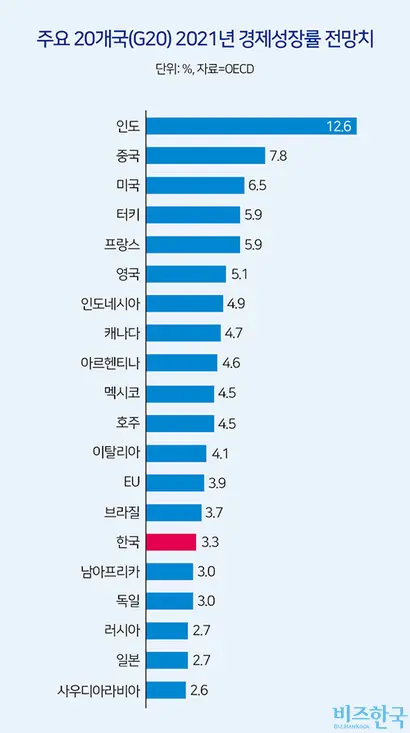
However, the OECD and IMF growth forecasts for Korea remain low compared to other countries. According to the OECD's G20 growth forecast, Korea's projected growth rate (3.3%) ranks 15th among G20 nations. Only five countries have lower growth forecasts than Korea: South Africa (3.0%), Germany (3.0%), Russia (2.7%), Japan (2.7%), and Saudi Arabia (2.6%). Among G20 nations, India's growth forecast hit 12.6%, and China was projected at 7.8%. The U.S. growth rate was also expected to reach 6.5%. Most notably, Korea's growth forecast is only about half the G20 average of 6.2%.
The situation is even worse in the IMF's growth forecast. Among G20 nations, only three countries—Japan (3.3%), South Africa (3.1%), and Saudi Arabia (2.9%)—have lower growth forecasts than Korea (3.6%). Unlike the OECD, the IMF projected that Russia's growth (3.8%) would outpace Korea's this year, with Germany (3.6%) remaining at a similar level. The IMF also predicted that India would achieve the highest growth in the G20 at 12.5%, followed by China (8.4%) and the U.S. (6.4%).
Not only is Korea's growth forecast in the bottom tier of the G20, but the scale of the upward adjustment is also smaller than in other G20 countries. The OECD raised the average growth forecast for G20 nations from 4.7% in December last year to 6.2% this past March, a 1.5 percentage point increase—three times the magnitude of Korea's adjustment (0.5 percentage points). This is a stark contrast to the U.S., a developed nation already showing signs of economic stagnation, whose growth forecast was more than doubled from 3.2% to 6.5% during the same period. Similarly, while the IMF raised Korea's forecast by 0.7 percentage points from 2.9% to 3.6%, it more than doubled the U.S. forecast from 3.1% to 6.4%. This is attributed to the rapid pace of COVID-19 vaccinations in the United States.
Another issue is that the OECD and IMF forecasts are based on the premise that life will return to normal through vaccinations, leading to increased production and consumption. In its March forecast, the OECD stated, "While vaccine rollout is uneven, it is gaining momentum, and government stimulus measures will support economic activity." The IMF also noted, "We now have several vaccines that can reduce the transmission of the virus, and the path out of the health and economic crisis is becoming increasingly visible." Consequently, countries that are slow to secure vaccines face the risk of downward adjustments to their growth forecasts. Indeed, the OECD warned, "If vaccine programs are not fast enough to reduce infection rates, consumer and business sentiment will be hit." According to 'Our World in Data,' created by researchers at the University of Oxford, as of the 21st, 40.20% of the U.S. population has received at least one vaccine dose, whereas in Korea, that figure stands at just 3.71%.