

[비즈한국] Amid ongoing criticism from experts regarding the serious carbon emissions generated by Bitcoin mining, Tesla founder Elon Musk and Twitter founder Jack Dorsey have sparked controversy by agreeing with the opinion that "Bitcoin incentivizes renewable energy." They argue that the situation could change if Bitcoin miners partner with renewable energy companies. Experts have described these moves as a "cynical attempt to greenwash Bitcoin."

Mining, the process of creating new Bitcoins, involves using high-performance computers to solve complex mathematical equations, a process that releases large amounts of carbon. Inner Mongolia, known as a hub for Bitcoin mining in China, announced last month that it would halt cryptocurrency mining to reduce energy consumption, and a study released earlier this month suggested that China might fail to meet its carbon reduction targets due to Bitcoin mining.
The BBC reported on the 22nd (local time) that Jack Dorsey stated on Twitter that "Bitcoin incentivizes renewable energy," to which Elon Musk replied, "True." The tweets appeared shortly after the publication of a white paper by Dorsey’s digital payment company, Square, and global asset management firm ARK Invest.
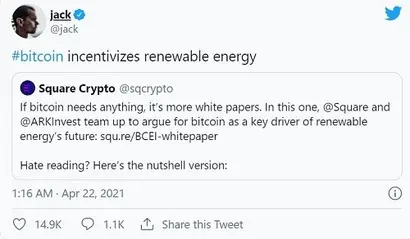
Titled "Bitcoin as a Key to an Abundant, Clean Energy Future," the white paper argues, "Bitcoin miners are unique energy buyers. They provide flexibility, can purchase energy with cryptocurrency, and can operate from anywhere with an internet connection."
The core of the white paper is the 'promotion of renewable energy.' It explains that "by combining miners with renewable energy and storage projects, the returns for project investors and developers can be improved, allowing more solar and wind projects to reach profitability."
David Gerard, author of the book "Attack of the 50 Foot Blockchain," criticized the paper, calling it "a cynical exercise in Bitcoin greenwashing." In an interview with the BBC, Gerard explained, "In reality, Bitcoin runs on coal. You can take the example of an accident at a coal mine in Xinjiang, China, which caused a region-wide blackout. This incident coincided with a recent drop in Bitcoin prices."
Meanwhile, researchers at the University of Cambridge recently stated that cryptocurrency consumes 121.36 terawatt-hours (TWh) per year, and that electricity consumption is unlikely to drop unless the currency's value falls. This is more electricity than the total annual consumption of Argentina.
Under these circumstances, criticism is also mounting that Tesla’s decision to heavily invest in Bitcoin is harming the environment. Bitcoin expert Phil Geiger also pointed out that "Bitcoin mining provides the most profit to the most energy-efficient miners."