

[비즈한국] The Korea Fair Trade Commission (KFTC) is facing difficulties regarding the designation of 'de facto heads' (heads of large business groups). With requests for changes to these designations coming from 10 corporate groups, including Hyundai Motor Group005380 and Hyosung Group004800, and new groups like Coupang being added to the designation list, the KFTC is struggling because the concept of a 'de facto head' is ambiguous and the criteria for designation are unclear. In particular, the case of Coupang is drawing significant attention, as Chairman of the Board Bom Kim is a U.S. citizen, raising the possibility of the unprecedented designation of a foreign national as a corporate head.
Background and Issues of the 'De Facto Head' System
According to the Monopoly Regulation and Fair Trade Act, corporate groups with total assets of 5 trillion won or more are classified as "business groups subject to disclosure," and those with 10 trillion won or more are "business groups subject to restrictions on cross-shareholding," with the head of the group referred to as the "de facto head" (dongil-in). The system was first introduced on December 31, 1986.
In South Korea, many business groups emerged as the government provided focused support to a small number of companies. Corporate groups face issues regarding the hereditary succession of management and the concentration of economic power in the hands of individuals. To address this, the KFTC introduced the 'de facto head' system to designate and regulate the individuals who effectively control these groups, aiming to mitigate the concentration of management and economic power.
Every May, the KFTC announces the business groups subject to disclosure and cross-shareholding restrictions, along with their respective 'de facto heads.' Depending on who is designated, the scope of the following varies: restrictions on establishing holding companies, prohibitions on cross/circular shareholding, the scope of affiliated companies, and regulations on providing unfair benefits to specially related persons. Furthermore, once designated as a head, one must disclose the shareholding status of affiliates held by relatives within the 6th degree of blood and 4th degree of marriage, and if self-dealing is detected, sanctions and prosecution procedures follow.
However, critics point out that there are no clear criteria for determining the head, leaving the decision of who is the "effective controller" up to the KFTC's judgment. In May 2019, then-KFTC Chairperson Kim Sang-jo stated in a radio interview, "I believe we need to improve the designation process to align with reality. We will strive to make decisions that better reflect reality by gathering opinions from the business community."
At the time, Hanjin Group Chairman Cho Won-tae and former Vice President Cho Hyun-ah were engaged in a management battle, and the KFTC designated Cho Won-tae as the head before the conflict was resolved. The head was effectively chosen by the KFTC's judgment even before the internal power struggle concluded. Two years have passed since then, but there has been no fundamental improvement in the designation process.
KFTC and Large Corporations 'Walking on Eggshells' Over Changes
According to the KFTC on the 13th, about 10 corporate groups, including Hyundai Motor Group and Hyosung Group, have requested changes to their designated heads. Historically, the KFTC has only allowed changes when the existing head passed away or was unable to participate in management due to illness. Although the chairmen of Hyosung and Daelim groups changed in 2017 and 2019 respectively, their official 'de facto head' designations remained unchanged. This is because the KFTC argued that the previous heads could still exercise indirect control over management even after handing over the chairmanship.
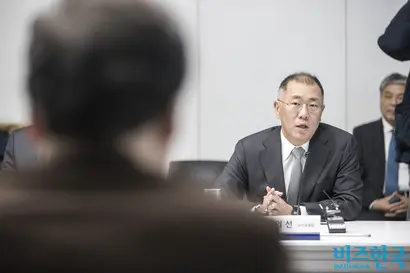
Of the 10 groups that requested changes, it is reported that the KFTC will only grant changes for Hyundai Motor Group and Hyosung Group. In the case of Hyosung, while Chairman Cho Hyun-joon and his younger brother, Vice Chairman Cho Hyun-sang, are practicing brotherly management, their stakes in the holding company are similar (21.94% and 21.42% respectively). Although the potential for a management dispute remains as the succession of shares from Honorary Chairman Cho Suck-rai has not been clearly completed, the KFTC determined Cho Hyun-joon to be the effective controller. It is understood that Chairman Cho Hyun-joon sought this change to solidify his position.
Regarding Hyundai Motor Group, it is reported that after much deliberation, the KFTC decided to designate Chairman Chung Eui-sun as the head. While Chung Eui-sun holds management authority, the KFTC considered the potential for his father and the largest individual shareholder, Honorary Chairman Chung Mong-koo, to still exert indirect influence. The KFTC moved forward with the change, noting that Hyundai Motor's decision-making structure has shifted toward a board-centric model, with Chung Eui-sun serving as the board chair. The fact that Honorary Chairman Chung Mong-koo has stepped down from his position as a registered director at Hyundai Mobis012330 was also a factor.
Once Chung Eui-sun is designated as the head, Sampyo Group, run by his father-in-law Chairman Chung Do-won, will likely be incorporated as an affiliate of Hyundai Motor Group. Sampyo Group has faced constant controversies over "tunneling" (work funneling) to facilitate management succession, but because it is a mid-sized company with total assets under 5 trillion won, it has not faced direct sanctions from the KFTC. However, with this change, issues could officially be raised for both Sampyo Group and Chung Eui-sun.
In the business community, there is a consensus that "The reason Hyundai Motor Group pushed for the change, despite the burden of potential management succession issues and tunneling at Sampyo Group, is to allow Chung Eui-sun to solidify his role as the effective controller without burdening his father, Honorary Chairman Chung Mong-koo."
'Coupang' Does Not Want the Designation
The "hottest potato" in this year's KFTC designation process is Coupang. As of the end of last year, Coupang's total assets exceeded 5 trillion won, making it subject to the designation. The point of interest is whether Bom Kim will be designated as the head. Originally, the KFTC was not planning to designate him because there has been no precedent for designating a foreign national as a head. Previously, the KFTC designated the Korean subsidiaries of S-Oil010950 (Aramco) and GM Korea (General Motors) as their own corporate heads because the largest shareholders were foreigners. In the interest of fairness, it was predicted that Coupang's Korean entity would be designated as the head instead of Kim.

However, controversy over preferential treatment has arisen, led by civic groups and labor unions. On the 7th, the Citizens' Coalition for Economic Justice (CCEJ) pointed out, "Bom Kim is the effective controller and head, holding 10.2% of Coupang's shares (76.7% in terms of voting rights). If the KFTC designates the group without naming an individual head, it is tantamount to providing Coupang with preferential treatment for self-dealing. The KFTC must explain if there is any legal basis for claiming foreigners cannot be designated as heads."
Some argue that because there are no clear criteria and the law was created in the 80s to prevent family-run management and the concentration of economic power, it is detached from today's global business environment. If Bom Kim is designated, he could face double regulation in both the U.S. and Korea, which could discourage foreign investment. The KFTC is in a dilemma over whether to designate him. The KFTC placed the issue of the Coupang board chair's designation on the agenda for the plenary meeting convened on the 21st. Regardless of what choice the KFTC makes, the controversy is expected to continue.
Kim Woo-chan, a professor of business administration at Korea University, explained, "For domestic companies like Hyundai Motor, designation is inevitable, so they are making the best possible decisions within the given environment. However, Coupang operates in a way that is different from traditional domestic business models, making them sensitive to this issue. Beyond the legal problems, we need a solution that reflects the reality of changing corporate policies."