

[비즈한국] Apple held its first event of 2021 in the early hours of the 21st. Apple's spring events usually take place in March, but this year it was delayed by about a month. The release of major new products announced on this day, such as the Mac and iPad, has also been scheduled for late May, a month later.
The stars of the event were the iMac and the iPad Pro. While one is a computer and the other a tablet—or in a broader sense, both are part of Apple's computer lineup—the gap between the two has narrowed significantly. This is because both products are powered by the same processor.
iMac Gets a New Look, the First 'Truly' M1 Mac
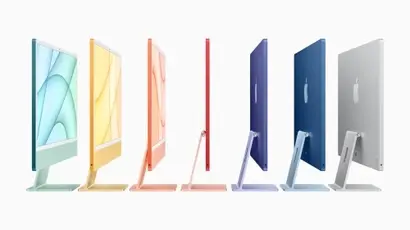
The iMac has undergone a complete redesign for the first time in seven years since 2014. It is so thin that it brings a monitor to mind, and aside from the rounded corners that are a signature of Apple design, the focus on straight lines is striking. The logo on the invitation, made of colorful lines, appears to represent the colors of this new iMac.
The new iMac's display measures 24 inches with a resolution of 4480x2520 pixels. Since the width is nearly 4,500 pixels, Apple refers to it as a 4.5K display. This model replaces the previous generation's 21.5-inch model. The display characteristics are largely the same. The 21.5-inch model has a 4K resolution of 3840x2160 pixels, and both products share a pixel density of 218ppi. Essentially, the pixel count has increased to accommodate the larger screen.
The thickness is 11.5mm, and the volume has been reduced to about 50% of the previous generation. The reason lies in the processor. The new iMac is powered by Apple's own M1 chip, the same processor found in the MacBook Air, MacBook Pro, and Mac mini announced last year.
Apple was able to reduce the thickness of the iMac because this chip provides sufficient performance to run macOS and applications while generating less heat. This allows for a smaller cooling system, eliminating the need for a bulky back. Additionally, because the chip integrates the CPU, graphics processor, memory, and controllers into one, the size of the logic board itself has shrunk. Apple used the expression "hiding the computer," as the device is so thin that it is barely distinguishable from a standard monitor, concealing its nature as an all-in-one computer.
Redesigning the iMac through M1: Balancing Performance and Cooling

What makes the new iMac worth noting is its design. Beyond aesthetics, it embodies the anticipation of a dramatic change in computers from an engineering perspective. This product is the first Mac with a new design to use the M1 processor. The three Macs announced last year followed the designs of their previous Intel-based predecessors, but the iMac is a product designed from the ground up to take full advantage of the M1.
Modern computer design is heavily influenced by semiconductors. The core of computer advancement is performance, and boosting performance usually comes with higher power consumption and heat. Overcoming this requires fine-process manufacturing and more powerful cooling, but the current consensus is that simply pushing clock speeds and manufacturing processes has reached its limit. While other solutions are being explored, Apple has addressed this with an integrated processor. By isolating intensive tasks—such as graphics and AI—from the CPU-centric environment, efficiency is improved. The unified memory architecture, where all components share the same memory, also plays a significant role.
Ultimately, the M1 allows Apple to achieve the desired performance while fundamentally reducing heat. With the MacBook Air, Apple gained confidence in computers that don't need cooling fans because they generate so little heat, and with the MacBook Pro, it redefined the role of the cooling fan: rather than just cooling, it’s about enabling high performance to be sustained for longer periods.
Apple then designed the iMac to fully utilize these characteristics. By minimizing the size of the logic board and cooling system, the company drastically reduced the footprint of the all-in-one PC. This is only possible because of the new processor. Similarly, the reason Apple was able to release the MacBook Air in 2008 was that Intel created a low-power processor that reduced heat and energy consumption.
iPad Pro Also Moves to M1
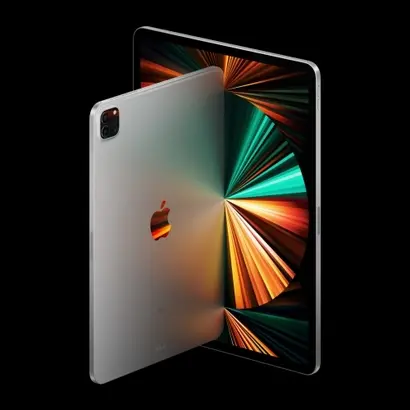
The second star of this announcement is the iPad Pro, which can be seen as the 5th generation. The core of this product, too, lies in its processor. In the introduction video, Apple showed a spy sneaking into Apple Park, dismantling a MacBook Air, stealing the M1 processor, and installing it into an iPad Pro. Although the video was made for entertainment, it clearly explains the nature of the new iPad Pro.
The iPad Pro has always emphasized higher performance compared to regular iPads, especially in graphics. Previously, the iPad Pro used 'X' series processors, which featured more graphics cores and higher performance. While models like the A12X provided differentiation, the 5th generation iPad Pro has adopted the M1 processor entirely.
The M1 processor's performance and power efficiency have already been verified through the Mac. For Apple, this decision not only ensures the M1 delivers sufficient power but also instantly validates the "PC-level performance" that the company has long touted for the iPad. Apple claims this results in a 50% boost in CPU performance and a 40% increase in GPU performance compared to the previous generation.
Furthermore, from an engineering standpoint, the M1 solves many of the iPad Pro's challenges at once. The chip is essentially a high-performance processor based on the A-series, specifically the A14. Using this chip in an iOS or iPadOS device is a very natural technical step. Additionally, utilizing the M1 processor makes it easy to improve external input controllers. Apple has indeed upgraded the iPad Pro's USB-C port to Thunderbolt 4 and USB4. This doesn't require a separate chip but is a basic feature of the M1 controller. USB-C has been the key to turning the iPad into a computer, and by increasing transfer speeds, limitations on external storage and other peripherals have been removed. Now, the only difference between a Mac and an iPad Pro is the OS tailored to the device's characteristics.
Naturally, production and supply efficiency also increase. Instead of creating a separate category for the A14X specifically for the iPad Pro, sharing the M1 simplifies processor production and supply. This also relates to cost. With just the M1 processor, Apple has effectively "cast a spell" that explains the new iPad Pro without needing to say much more.
Introduction of Mini-LED, Innovation in Display
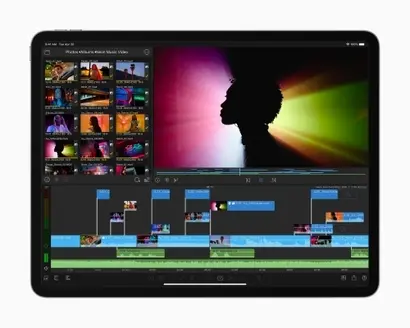
Another area where the new iPad Pro stands out is the display. The 12.9-inch iPad Pro features a mini-LED display. Mini-LED is a next-generation technology that advances LCD. Much of the limitation of LCDs comes from the backlight. The previous iPad Pro screen was illuminated by 72 large LEDs, but the new display uses 10,000 LED backlights. Each LED is said to be 1/120th the size of the previous ones.
The iPad Pro groups these 10,000 LEDs into sets of 4, dividing the screen into 2,500 zones where the brightness of each LED can be adjusted individually. It lowers the brightness of LEDs in dark areas and increases them in bright areas, providing much more granular control. The difference between 72 zones and 2,500 zones is immense. It achieves the hallmark of OLED—bright highlights and deep blacks. This display has a maximum brightness of 1,000 nits, which is more than twice as bright as the previous display, and can reach up to 1,600 nits instantaneously when needed. Regarding brightness, it is on par with OLED, while avoiding the burn-in and durability issues associated with it.
Although the method is slightly different, it adopts a structure similar to Apple's high-performance Pro Display XDR. Apple has named this screen "Liquid Retina XDR." This mini-LED display is in its early stages of deployment, and it is expected to be used in more devices in the future.
Both products will be available for order starting April 30th in the U.S., with actual shipping beginning in late May. It seems the overall schedule is slightly delayed compared to previous releases. The domestic launch date in Korea has not yet been announced.