

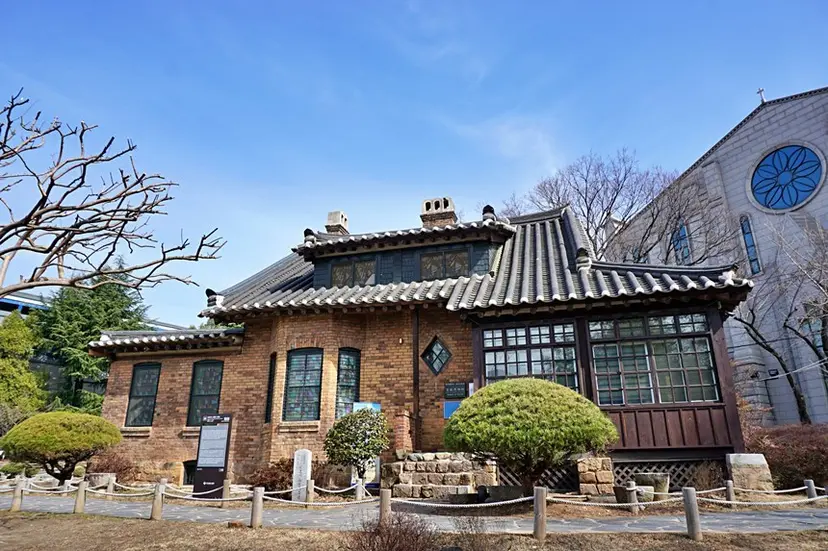
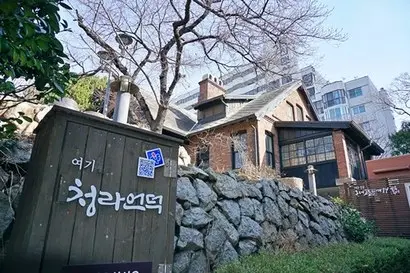
[비즈한국] ‘Cheong’ (靑) for blue and ‘Ra’ (蘿) for ivy. In spring, Cheongna Hill in Daegu, draped in lush green ivy, was home to a group of cozy old red brick houses. Though they seem similar, each house boasts its own distinct charm, standing as modern cultural heritage sites over 100 years old. While there were once more houses, only three remain today. All of them were built by American missionaries who came to Daegu around the turn of the 20th century.
American Missionaries Settling on a Cemetery Hill
American missionaries began arriving on the Korean Peninsula in earnest following the signing of the United States–Korea Treaty of 1882. Missionaries who reached Daegu via the open port of Busan settled on Cheongna Hill. It is said that this location was originally a place where the poor were buried when they could not afford proper funeral rites. Because of this, the foreigners were able to settle in and build their homes without much local opposition. The name "Cheongna Hill" is also said to have originated from the ivy vines that these missionaries planted all over the hill.
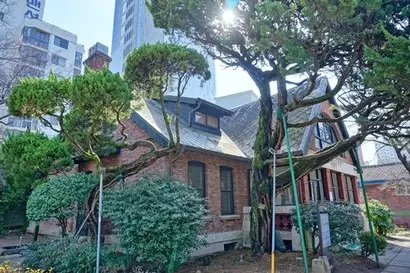
As you climb the hill from Dalgubeol-daero, the first building you see is the Blair House. It was built around 1910 as a residence for the missionary Blair, who arrived on the Korean Peninsula in 1901. Utilizing concrete, a cutting-edge construction technique at the time, they laid a foundation, created a basement, and erected a two-story brick house with a tall chimney. Particularly eye-catching is the semi-circular stained glass window that occupies most of the second-story gable. This window serves to draw natural light into the sunroom located on the second floor. The large window is, of course, also beneficial for ventilation.
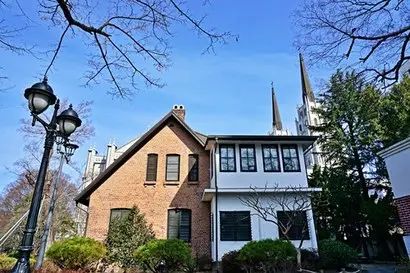
A short distance from the Blair House is the Chamness House. This place was home not only to the missionary Chamness but also to Reiner, the principal of the school established by the Northern Presbyterian Church of the U.S. (now Gyesung Middle and High School), and Moffett, the director of the hospital (now Keimyung University Dongsan Medical Center). The bungalow-style house, which was popular in Southern California at the time, creates a unique atmosphere by blending the red brick building with an '人'-shaped gabled roof and a white building with a flat roof. Thanks to this, it is said to be popular not only as a filming location for movies and dramas but also as a subject for architectural research papers.
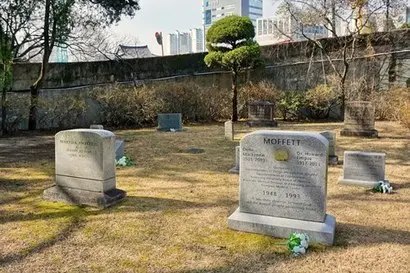
Below the Chamness House lies the Grace Garden, which is bathed in sunlight throughout the seasons. The remains of 14 people, including missionaries who lived on Cheongna Hill and their families, are buried here. Among them is Barbara, the young daughter of missionary Chamness. Born in 1927, Barbara was called to God at just three months old. It is said that the Chamness couple, who engaged in missionary work while teaching farming and livestock raising to the locals, visited this place every day until they were expelled by the Japanese colonial government in 1941. The sunny Grace Garden remained warm even in winter.
Walking Through the Modern Culture Alley Along the March 1st Movement Road
The Switzer House, located northeast of Grace Garden, was the home of female missionary Martha Switzer. The red brick building topped with a traditional Korean tiled roof represents a harmonious blend of Korean and Western styles. It is also worth noting that the foundation was built using stones salvaged from the demolition of the Daegu Eupseong (walled city) in 1907. Around the house, one can see the third-generation tree of the first Western apple trees brought by the missionaries, as well as the bell tower commemorating the 100th anniversary of the Dongsan Medical Center. Missionary Switzer, who lived a single life and dedicated 18 years to educational missionary work, also rests on Grace Hill.
Today, these houses are used as museums showcasing the modern history of Daegu. The Blair House became the Education History Museum, the Chamness House the Medical Museum, and the Switzer House the Missionary Museum, but unfortunately, they have all been closed indefinitely since the spread of COVID-19.
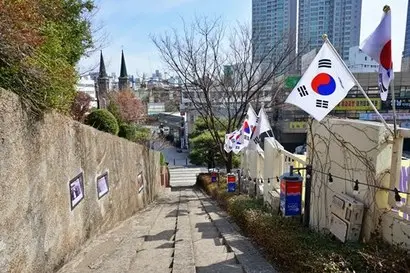
Cheongna Hill, which embraces the modernity of Daegu, is also the starting point of the 'Modern Culture Alley,' the second course of the Daegu Jung-gu Alley Tour. About 100 years ago, the pine grove path on Cheongna Hill served as a secret route for students participating in Daegu's March 1st Movement to move while avoiding the surveillance of the Japanese colonial police. Although the pine grove path is now paved, it continues to convey the spirit of that day to future generations under the name 'March 1st Movement Road.'
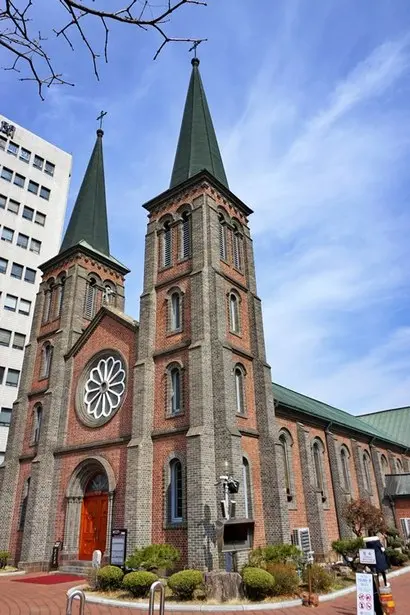
Descending Cheongna Hill along the March 1st Movement Road, you will encounter Gyesan Cathedral, which is famous for its two pointed spires. It was completed in 1902, about 8 years before the missionary houses. When the original hanok cathedral, which opened in 1899, was destroyed by fire, it was rebuilt as a Western-style building in the Gothic style. It is said that Father Robert, who was active in Daegu at the time, designed it himself and brought materials from France to construct it. Since then, it has undergone several expansions and is currently used as the cathedral church representing Daegu Catholicism.
<Travel Memo>
Cheongna Hill
△ Location: Dalgubeol-daero area, Jung-gu, Daegu
△ Inquiries: 053-424-6407
△ Hours: 24 hours, open year-round
Gyesan Cathedral
△ Location: 10 Seoseong-ro, Jung-gu, Daegu
△ Inquiries: 053-254-2300
△ Hours: Main hall can be visited except during Mass times
The author, Gu Wan-hoe, majored in history at university and worked as a journalist for publications such as 'Woman Joongang' and 'Friday.' As the Travel Publishing Team Leader at Random House Korea, he oversaw travel guide book series such as 'Going to the World' and 'Enjoy 100 Times.' He is currently raising two children and writing stories about history and travel that he wants to tell them.