

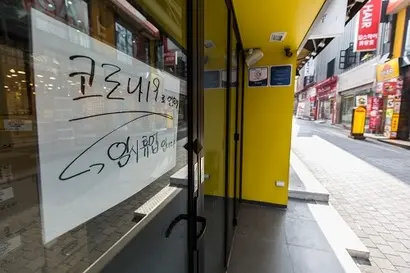
[비즈한국] The livelihoods of the self-employed are being threatened by COVID-19. As social distancing leads to a reduction in outdoor activities and consumption, an increasing number of self-employed individuals are experiencing a sharp decline in revenue. According to the National Emergency Committee for Self-Employed Business Owners responding to COVID-19, the average revenue decline for 1,545 businesses nationwide last year reached 53.1%. In this situation, the government and local authorities are drawing criticism for setting support criteria based solely on a business's simple revenue figures.
"Seeking Close Contacts": Disaster Alerts Name Businesses, Leading to Lost Customers and Zero Compensation
Mr. B operated a sushi restaurant in Hwaseong, Gyeonggi Province. The restaurant was well-known locally, and its 30-pyeong (approx. 100 square meter) space was always crowded with customers. Even on weekdays, 30 to 40 groups would wait, and on weekends, the line would reach up to 70 groups, with monthly revenue exceeding 100 million won. However, the atmosphere shifted after a COVID-19 patient visited the restaurant last summer. Currently, the sushi restaurant is in the process of closing down due to financial difficulties.
On June 21 of last year, a customer who dined at the sushi restaurant was confirmed to have COVID-19. However, identifying the close contact who sat next to the patient proved difficult because they had used an anonymous card. To prevent further spread, the city of Hwaseong sent out a disaster alert specifying the name of the sushi restaurant while searching for the contact. They actively sought the individual by posting articles in online media outlets. Public interest became so intense that the restaurant's name even appeared on real-time search trends.
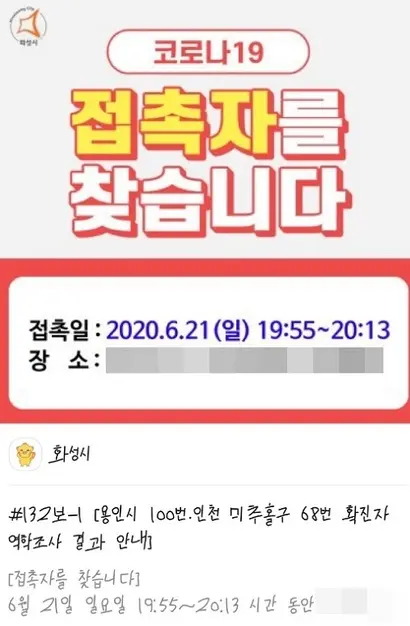
Fortunately, the close contact was found just one day after the disaster alert was sent. However, it became difficult for the sushi restaurant to operate normally. Mr. B lamented, "Our business name was in the top five real-time search trends, and posts about our store flooded local 'Mom Cafes' (online communities). They disclosed the name of our restaurant in disaster alerts and news articles without any consultation with me, the owner. Even if they are focusing on quarantine, shouldn't they get the owner's consent for such measures? When I protested, the only answer I got was, 'We are just following quarantine guidelines.'"
Cleaning up the aftermath after finding the close contact was also entirely Mr. B's burden. He tried to alleviate public anxiety by replying to every post on local online communities with the news that "the close contact has been found." He even contacted various online news outlets, begging them to "take down the articles because the contact has been found."
Although he managed to sort things out and resume business, revenue dropped to one-tenth of its original level. Mr. B said, "The rumors had already spread throughout the region, and it was impossible to return to the situation before the patient visited. If they use a store's name without consent and ruin a successful business overnight, shouldn't they provide at least some level of compensation? But I received no compensation at all."
Why Delivery-Only Shops Receive Subsidies While Failed Businesses Get Nothing
To help self-employed individuals whose livelihoods are threatened by COVID-19, the government and local authorities have introduced various support measures. The Ministry of SMEs and Startups provides up to 5 million won in disaster relief funds, known as "Buoyancy Funds Plus," for businesses under gathering bans, business restrictions, or general categories. Local governments are also providing consolation money to self-employed individuals affected by these restrictions.
However, the limitation is that most of these subsidies are only available to those who meet the criteria for a "small business owner." One must satisfy conditions such as an annual revenue of 1 billion to 12 billion won or less (1 billion for food/accommodation, 5 billion for wholesale/retail, 12 billion for manufacturing) and have 5 or fewer regular employees. If a business has an annual revenue over 1 billion won or more than 5 employees—like Mr. B's—it is excluded from being considered a small business.
A Hwaseong city official explained, "Since the budget is limited, most of the 31 local governments focus on supporting small business owners under gathering bans and business restrictions. There is currently no support for larger businesses. This is because we believe small business owners are in more difficult situations than larger, successful establishments."
Mr. B countered, "People think a 100 million won monthly revenue makes you a big success, but it's an empty shell. 40 million won goes out every month just for rent and labor costs, and after taxes and ingredient costs, the net profit is only a few million won. In a year of business, I've only made about 10 million won. Only my debts have increased."
Some business owners have criticized the government and local authorities for policies that fail to understand the reality of the self-employed, arguing that it is difficult to grasp the financial difficulties of a business based solely on revenue. For example, a delivery-only restaurant in Hwaseong generates an average monthly revenue of 30 million won with a profit of 20 million won. Even when Mr. B's sushi restaurant was denied support because its revenue was too high, the delivery shop consistently received subsidies. Because of the nature of delivery businesses, they are less affected by COVID-19 as customers don't visit the store, yet they qualify for subsidies based on simple revenue standards.
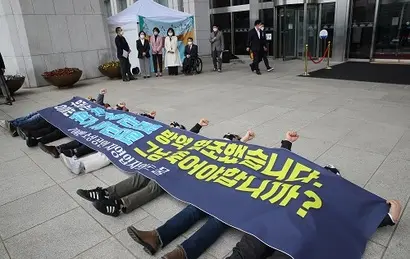
Self-employed individuals' complaints about the "Buoyancy Fund Plus" currently being distributed by the Ministry of SMEs and Startups are along similar lines. The fund, which began its first round of rapid payments on March 29, was problematic because it only targeted businesses whose 2020 revenue decreased compared to 2019. A significant number of businesses were excluded simply because their 2020 revenue increased. Consequently, the second round decided to select businesses by comparing half-year periods, such as the first/second half of 2019 versus the first/second half of 2020. If revenue decreased during either half, they become eligible.
However, small business owners are still fiercely protesting. Since it is nearly impossible for a business opened in the second half of 2019 to have revenue higher than its first year in the second half of 2020, most of those owners were excluded from payment.
One self-employed individual who started their business in the second half of 2019 said, "Why do they selectively pay subsidies when we are all equally under business restrictions for quarantine? My revenue increased slightly only because I moved up opening hours and significantly increased delivery app advertising. My actual profit has decreased, but I was excluded from the subsidy. It feels unfair to be penalized for working hard."
An official from the Ministry of SMEs and Startups explained, "We have no choice but to base it on revenue. We cannot verify data related to operating profits, as that is a private matter. The margin of profit is a personal business decision and not something caused by government administrative measures. The core of the Buoyancy Fund Plus is to compensate for a portion of the losses incurred by business restrictions."
The official continued, "There are business owners who started in the second half of 2019 and did receive subsidies. Most of those who didn't are those whose 2020 revenue increased compared to their 2019 revenue extrapolated for the full year. If we have to pay everyone, it would mean universal payments. It seems like the retroactive loss compensation currently being discussed in the National Assembly will need to be decided first."