

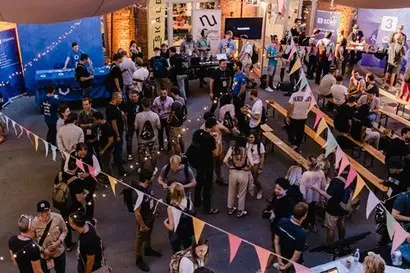
[비즈한국] COVID-19 struck just as I moved into Factory Berlin, the mecca of Berlin startups. The networking events I had looked forward to were canceled or moved online, and the courtyard in front of Factory, which never slept, turned dark. The ball pit, the most beloved rest spot at Factory, was closed for sanitary reasons, and a "barrier" of masks appeared between the people who used to greet each other and share tea time. Above all, the space lost its vibrancy as the daily limit on the number of visitors was implemented.
Amidst this, Factory carried out various experiments to revive networking, the space's core function. Factory Berlin’s internal community channel on Slack became more active than ever. Various communication channels suitable for the times, such as #-discuss-corona_rescue, were created to share information on startup support during the pandemic, allowing the community to find its own ways to thrive together. The management team also launched diverse programs, including 1-on-1 online meetings by sector, mentor-mentee matching, VR-based product demonstrations for startups, and virtual exhibitions combining art and technology.
I built my network one by one, participating in as many online events at Factory as possible. I reached out individually to people in my fields of interest via Slack messages to get to know them. Then, I noticed a company called "newcomers Nota AI" at the Factory entrance. Seeing that their headquarters address was in Daejeon, I realized it was the Korean startup "Nota" that I had heard had recently entered Berlin, and I happily made contact.
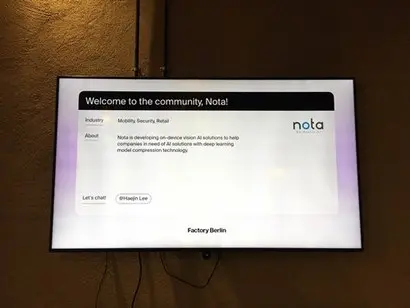
Nota is a company that began in 2015 as a venture project at KAIST under the philosophy of "making life more convenient and enriched through artificial intelligence." Since the match between AlphaGo and Lee Sedol, AI has become the ultimate trend. Among them, Nota, a deep-tech AI startup, provides On-Device AI solutions based on deep learning model optimization technology.
Simply put, most existing AI-based services and products rely on high-performance servers or clouds due to the complex and massive computational requirements of AI. This makes it difficult to run them on individual devices like smartphones or small IoT gadgets, increases operating costs, and can lead to privacy issues as data must be processed via the cloud. Nota has secured core technology for AI model optimization, allowing it to reduce the size of models without performance loss, even when running in low-power, low-spec environments.
In 2020, the company successfully attracted Series A investment from Samsung Venture Investment, LG CNS, Stonebridge Ventures, and LB Investment, reaching a cumulative investment of approximately 10 billion KRW. It drew significant attention as the first in Korea to receive strategic investments from both the Samsung and LG groups simultaneously. Since then, it has been expanding its business globally by establishing subsidiaries not only in Berlin but also in the United States. How and why did Nota come to Berlin?
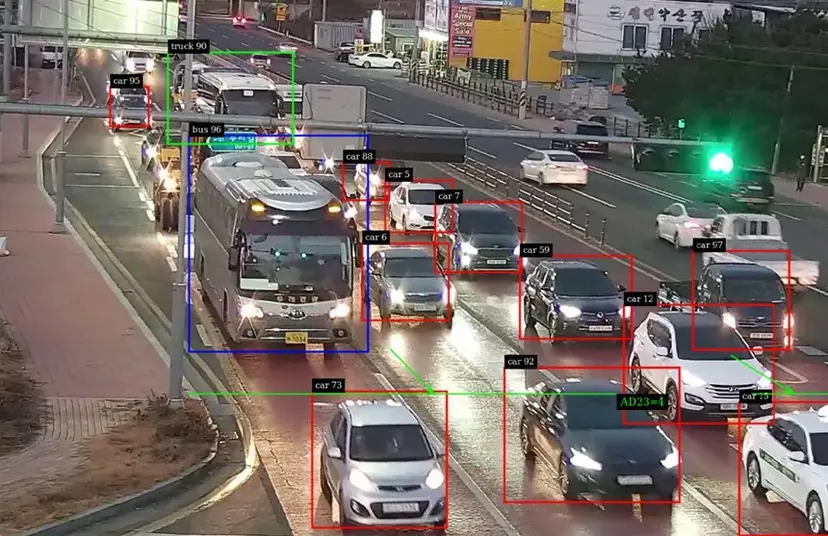
Nota CEO Chae Myung-soo believed from the very beginning that the company's technological prowess had a strong chance of success in overseas markets. Having participated in the BMW Open Innovation program in 2019, the company had already received favorable reviews from global corporations. Thus, it was Chae’s plan to aggressively enter the overseas market and build a track record of collaboration with global firms simultaneously.
"Although we are a startup that started in Korea, the moment we clarified our identity as a 'startup doing Edge AI' rather than just a 'Korean startup,' entering the overseas market became a natural step. We paid particular attention to the European market. Europe has a high demand for personal data protection and regulates and encourages it through laws and policies, so we judged it as a perfect market to target with Nota's On-Device AI solutions."
CEO Chae shared his concerns during the initial stages of entering Berlin. Nota chose Berlin as its overseas business hub after participating in an acceleration and local market entry program supported by KIC Europe, an organization under the Ministry of Science and ICT. Although they debated between Amsterdam and Berlin when establishing their corporate entity, they chose Berlin for its national standing as Germany and the diverse AI-related support available. Since then, they have been operating out of 'Hubraum,' a startup support space run by Deutsche Telekom, Germany's largest telecommunications company.
Lee Hye-jin, the manager who handles all the practical operations of the German subsidiary, was a strong advocate for moving into Factory Berlin. "We thought the biggest advantage was that it is the most important hub for the Berlin startup scene and hosts large enterprises like Siemens, McKinsey, and Porsche." Indeed, she noted that it was impressive to see Factory Berlin's management facilitate meetings between Nota and other companies, or actively support networking through matching managers whenever relevant industries or companies were mentioned.
Nota initially handled vision-based AI in the mobility, security surveillance, and retail sectors before launching the optimization platform 'NetsPresso.' Through this, it operated an Intelligent Transport System (ITS) pilot project with Pyeongtaek City in Gyeonggi-do, and is currently in discussions with various municipalities in Germany that have smart city plans, including Hamburg, which is the most advanced city in this field. Thanks to these active efforts, within less than a year of establishing its German subsidiary, Nota was listed on the German federal government's AI startup map and is actively engaged in the German AI sector as a member of the Digital Hub Mobility in Munich and the Digital Hub in Karlsruhe.
CEO Chae Myung-soo mentioned that as many offline channels closed due to COVID-19, it became somewhat difficult to demonstrate technology and discuss it as closely as before. Previously, he would go on business trips every two months to meet companies in person and demonstrate technology, but because everything has recently been done online, he feels the role of intermediaries like Factory Berlin has grown even larger, especially since German companies tend to be relatively conservative.
The sight of Nota, a Korean startup that has firmly established its identity as an "AI technology startup" in Berlin while taking full advantage of various support policies, is no longer unfamiliar. The sentiment I once felt—that feeling of national pride when seeing a "Samsung" billboard or a "Hyundai" car while traveling in Europe—has evolved to a level where we can now nod and say, "Of course we're ahead in technology!" I am very much looking forward to the future journey of Nota as a 'Factorian' and a Berliner.
The author, Lee Eun-seo, studied in Berlin, returned to Korea, and eventually moved back to Berlin, unable to overcome homesickness. She works with various startups, primarily guiding Korean companies trying to enter the German market and German companies aiming to capture the Korean market.