

[비즈한국] It has been confirmed that Tesla is gaining significant popularity in the electric passenger vehicle sector, while low-emission vehicle purchase subsidy programs, including those for electric and hydrogen cars, are being carried out under the leadership of local governments. However, as the application rate is currently only 15% of the total and the government has stepped in due to concerns over imported cars monopolizing subsidies, Tesla's market share is expected to fluctuate.
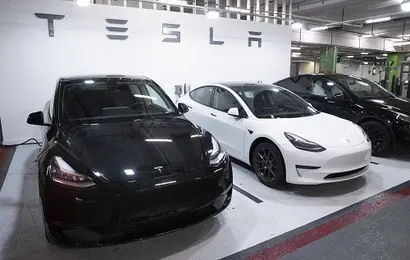
The low-emission vehicle purchase subsidy program is a project that provides subsidies by adding state and municipal funds to purchasers of electric or hydrogen vehicles. It is implemented through each local government. Applicants must enter into a purchase contract with an electric vehicle seller or manufacturer, and then submit an application to the electric vehicle purchase subsidy system. Local governments select subsidy recipients among those without disqualifying factors in the order of application receipt.
Once the vehicle is delivered, the seller or manufacturer must apply for the subsidy to the local government within 10 days. The local government then makes the payment after final document review. However, even if selected as a recipient, there are variables, such as cancellation of selection or reassignment to a waiting list if the vehicle is not delivered within 2 months.
Total Application Rate at 15%… Gyeonggi Province Has the Most Applications, Sejong City Has the Highest Rate, While Rural Counties See a 6% Rate
Bizhankook requested information from local governments nationwide regarding the status of electric passenger vehicle subsidy applications and disbursements by vehicle model for the first quarter. Summing up the data provided by each local government, the total number of applications for electric passenger vehicles in the first quarter was 7,133. Given the national projection of 45,810 vehicles eligible for subsidies, this represents an application rate of approximately 15%.
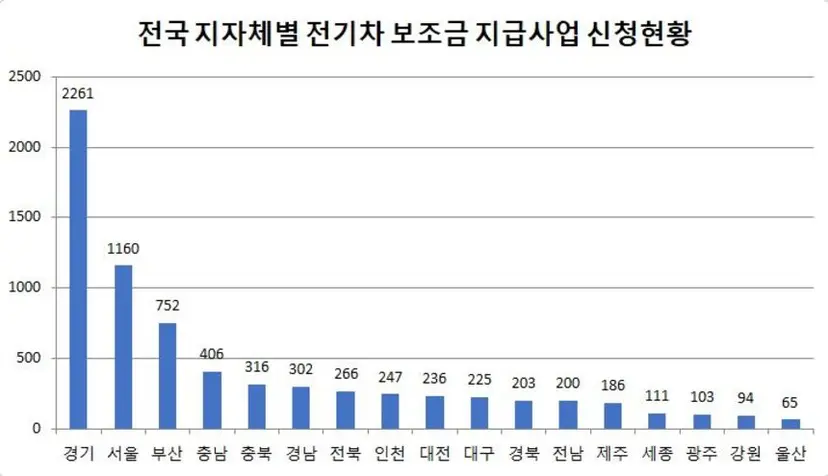
By region, Gyeonggi Province had the highest number of applications with 2,261, followed by Seoul (1,160) and Busan (752). In terms of application rate, Sejong City was the highest. With 111 applications out of 300, the application rate reached 37%. Sejong City and Busan City (33%) are the only local governments with an application rate of 30% or higher.
While subsidy programs are actively operated mainly in city-level local governments, the application rate in county-level (gun) local governments was found to be low. The total number of subsidy applications in counties nationwide in the first quarter was 317, which is only 6% of the 5,245 vehicles targeted for the total county-level announcements. However, it is analyzed that this result may also be due to some county-level governments not having implemented the subsidy program at the time of the information disclosure request.
Tesla Leads Early Subsidy Payouts… Hyundai and Kia Fight Back with Kona Electric and Niro EV
As of the first quarter, the number of vehicles for which subsidy payments were completed was 2,254. Among these, the Tesla Model 3 was the most common. According to the data, a total of 964 Tesla Model 3 vehicles had completed subsidy payouts, accounting for 42% of all completed subsidy disbursements.
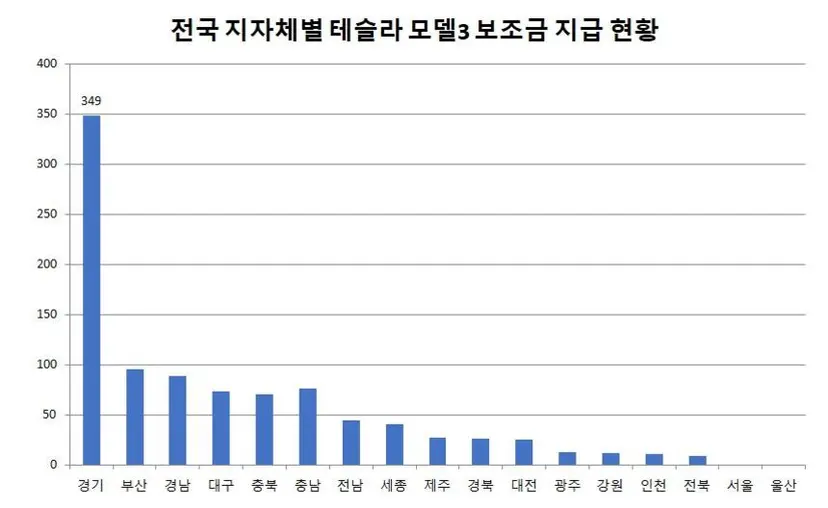
Within the Model 3 lineup, demand was concentrated on the 2021 Long Range trim. This appears to be the result of Tesla discounting the price of the 2021 Model 3 Long Range trim from 64.79 million won to 59.99 million won in February. The price difference with the one-step lower 2021 Model 3 Standard trim (54.79 million won) is only 5.2 million won. 194 units of the Model 3 Standard trim received subsidies.
Tesla was mainly supplied in metropolitan cities or city-level local governments. Of the 964 vehicles, 937 were delivered in city-level jurisdictions. In the case of Sejong City, 41 out of the 62 vehicles that received subsidies were Model 3s. This is likely because competition for subsidy applications is relatively fiercer in cities than in counties. Concerns had spread through electric vehicle enthusiast communities that one might not receive a subsidy if they waited for the delivery of Hyundai Motor's 005380 Ioniq 5 or Kia's 000270 EV6.
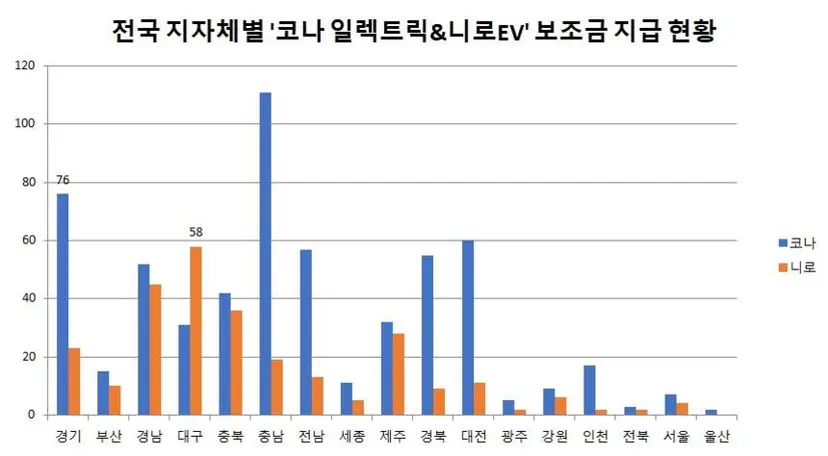
Hyundai and Kia, which are preparing for mass production of new cars, are keeping Tesla in check with sales of existing models. Hyundai Motor's completed subsidy payouts reached 585 units for the Kona Electric and 2 for the Ioniq. For Kia, the Niro EV recorded 278 units and the Soul EV recorded 18. Among the vehicles that received subsidies, Hyundai accounted for 26% and Kia for 13%.
The Kona showed a tendency to be distributed evenly nationwide, including South Chungcheong (19%), Gyeonggi (13%), Daejeon and South Jeolla (10%), and North and South Gyeongsang (9%). The Niro was concentrated in Daegu (21%), South Gyeongsang (16%), North Chungcheong (13%), and Jeju Island (10%).
Subsidy Program Just Beginning… Ministry of Environment: "State Subsidies Will Be Allocated Monthly"
Although Tesla has secured a fairly high market share from the start of the subsidy program, it is unclear whether it will be able to maintain its lead until the end of the year, as the Ministry of Environment has decided to actively respond to the monopolization of subsidies by imported cars.
The Ministry of Environment explained, "We have already secured the subsidies to be paid for pre-orders of newly released electric vehicles such as the Ioniq 5. We are allocating state subsidies to local governments on a monthly basis, and local governments are securing local funds and sequentially announcing the number of subsidy payouts. We will execute the entire state budget for electric vehicle subsidies by reallocating subsidies by region and vehicle type according to actual demand."
As a result, it is highly likely that Hyundai and Kia will increase their market share, particularly in county-level local governments where the application rate is low. An official from a county-level local government said, "Seeing as the application rate is low currently even though Tesla could be purchased, we expect there are people waiting for the release of new vehicles from Hyundai and Kia."