

[비즈한국] Any party entering into a contract (including preliminary contracts) to transfer or establish ownership or surface rights for land within a land transaction permit zone, or wishing to modify any previously permitted terms, must jointly obtain permission from the mayor, county governor, or district head.
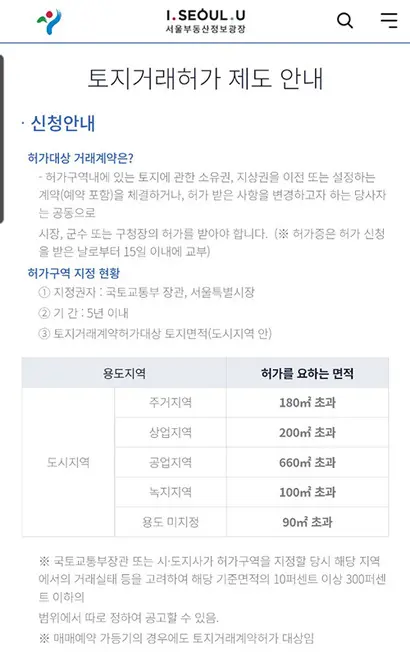
The authority to designate land transaction permit zones lies with the Minister of Land, Infrastructure and Transport or the head of a metropolitan local government. In Seoul, designations can be made by either the Minister of Land, Infrastructure and Transport or the Mayor of Seoul. The designated period for permits is set for up to 5 years. The land area subject to land transaction permits is as follows.
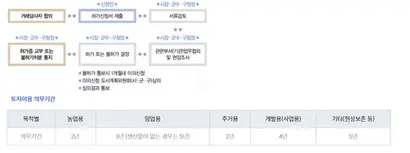
In principle, applications for land transaction permits must be filed jointly by the contracting parties (seller and buyer); however, it is also possible for an agent with a power of attorney to apply. The procedures and mandatory utilization periods for land transaction permits are as follows.
There are cases where a land transaction permit is not required. These include inheritance or gifts without consideration, land below the area subject to permits, acquisitions, expropriations, or usage through consultation under the 'Act on Acquisition of and Compensation for Land, etc. for Public Works,' acquisitions through auctions, disposition of state-owned property via general competitive bidding, disposition of public property via general competitive bidding, sales of reserve land in housing supply projects, and the sale of buildings.
If a contract is signed without obtaining a land transaction permit or a modification permit, or if a permit is obtained through fraudulent means, the offender faces imprisonment for up to 2 years or a fine of up to 30% of the land price at the time of the contract (based on the individual officially assessed land price). Furthermore, a 3-month grace period for compliance is granted, and an enforcement fine (compulsory fine) is imposed annually, up to 10% of the acquisition price (declared actual transaction price), until the mandatory use period ends.
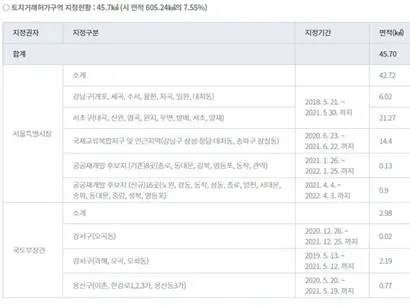
The current status of land transaction permit zones in Seoul is as follows.
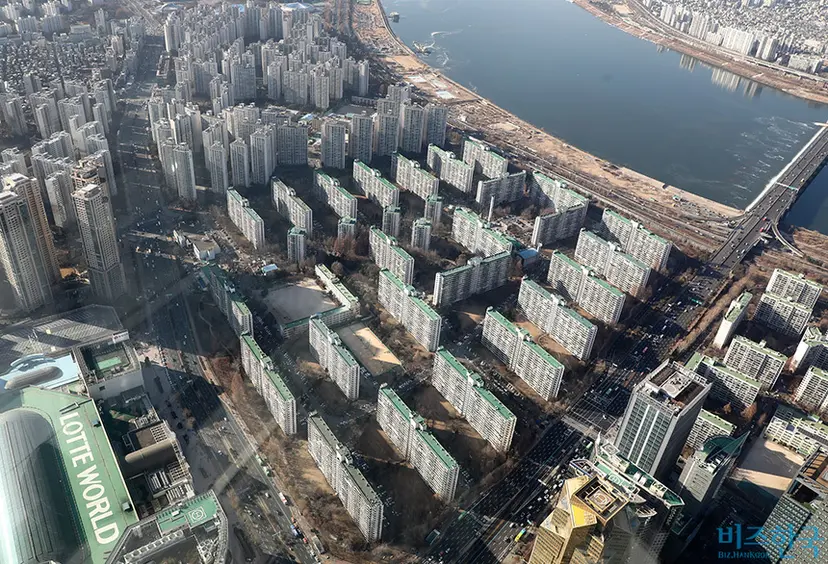
Land transaction permit zones gained widespread attention in the media in June 2020, when the International Exchange Complex and surrounding areas—Samseong-dong, Daechi-dong, Cheongdam-dong in Gangnam-gu, and Jamsil-dong in Songpa-gu—were designated. Because Daechi-dong and Jamsil-dong are densely populated with apartments, almost all apartments were subject to these permits. After the designation, those who already owned one or more homes were prohibited from purchasing additional properties in these areas.
As a result, transaction volume plummeted. However, market prices did not drop. Transactions continued steadily, albeit at a low level, and record-high prices have continued to be set. In February 2021, a 35-pyeong unit at Jamsil Jugong Complex 5 in Songpa-gu traded at a record high of 2.681 billion won. In March 2021, a 33-pyeong unit at Els traded at a record high of 2.45 billion won.
Mayor Oh Se-hoon was elected in the Seoul mayoral by-election on April 7. Reconstruction apartment complexes along the Han River, which had been actively pushed about a decade ago, began to attract attention. These include Hyundai Apartments in Apgujeong, Gangnam-gu, Yeouido apartments in Yeongdeungpo-gu, and Jamsil Jugong Complex 5 in Songpa-gu. Actual listings decreased, and the remaining properties were sold off.
In response, Seoul Mayor Oh Se-hoon expressed concern over rising prices in major reconstruction complexes and reportedly instructed officials to immediately review the designation of land transaction permit zones. He explained that price stability is important, even if the pace of reconstruction is slowed. Consequently, he ordered an immediate review of such designations and the creation of measures to prevent real estate market disruptions. He also stated that he would consider extending the existing permit zones in Samseong-dong, Daechi-dong, Cheongdam-dong, and Jamsil-dong, which were set to expire on June 22. The reasoning is that since the ultimate goal of the "speedy supply" policy pushed by the Seoul Metropolitan Government is the downward stabilization of the real estate market, it would be contradictory to allow this policy to cause price hikes.
I sighed while watching the Seoul Metropolitan Government's announcement. If this is what you were going to do, why did you criticize the Moon Jae-in administration's real estate policy so intensely for the past four years? If the policy is the same, the results will only be the same. Delaying the pace of supply because of short-term price increases is the same as previous policies. This is because the real estate market cannot be stabilized with short-term policies; it requires medium- to long-term policies.
Are Jamsil Jugong Complex 5 and Els hitting new record highs because they are NOT in land transaction permit zones? The reason for the existence of land transaction permit zones is, quite literally, to curb the entry of short-term speculative forces. The buyers paying record prices now are end-users. They are buying despite knowing the prices are high because these regulations are making them anxious. Shouldn't we be focusing on how to speed up the supply, rather than designating more land transaction permit zones?
I hope that the government and the Seoul Metropolitan Government will pursue medium- to long-term policies for the stabilization of the real estate market, different from the short-term policies of previous administrations.
Kim Hak-ryul, the director of Smart Tube Real Estate Research Institute, known by his pen name "Pashong," previously served as the team leader of the Real Estate Research Division at Gallup Korea. He operates the Naver blog and YouTube channel, 'Pashong's World Tour.' His books include 'Future Map of South Korean Real Estate' (2021), 'Only Places That Will Rise Will Rise from Now On' (2020), 'User Manual for South Korean Real Estate' (2020), 'Tour of Prime Real Estate in the Metropolitan Area' (2019), 'Places That Will Rise Even If It's Not Seoul' (2018), 'There Are Still Apartments to Buy' (2018), 'Investing in South Korean Real Estate' (2017), and 'The Future of Seoul Real Estate' (2017).