

[비즈한국] The mass production of new Baekdu reconnaissance aircraft, designed to monitor North Korea’s nuclear weapons and missiles as well as neighboring countries, is entering full swing. According to military officials, the proposal for additional production of the new Baekdu aircraft will soon be submitted to a subcommittee of the Defense Acquisition Program Promotion Committee (DAPPC), with plans for final approval by the committee during the first half of the year.
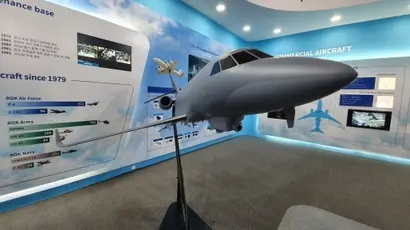
Known as "Project 701," or the Baekdu System Capability Enhancement Project, two of these new reconnaissance aircraft were built and have been in military operation since late 2018. The four additional units will replace the aging Baekdu signal reconnaissance aircraft introduced in the 1990s, in preparation for the transfer of wartime operational control. The new Baekdu reconnaissance aircraft was modified and developed based on the "Falcon 2000S" business jet from France's Dassault Aviation. Key onboard equipment was developed through a collaboration between the Agency for Defense Development (ADD), LIG Nex1, and Hanwha Systems272210. Development of the onboard systems began in 2010 and was completed in 2018.
It is reported that over 400 billion won was invested in the development of the onboard equipment. LIG Nex1 developed the communication interception system, the electronic signal collection system, and the "Fisint" (Foreign Instrumentation Signals Intelligence) system, which serves as a nuclear and missile monitoring system. Hanwha Systems was responsible for the data link system that handles transmission and reception between the aircraft and the ground. The first unit underwent conversion at L3 Technologies located at the TSTC Airport in Waco, Texas, while the conversion of the second unit was handled by Korean Air003490. The new Baekdu reconnaissance aircraft completed its maiden flight in the U.S. in 2016, and the first unit arrived in Korea in 2017. Testing and evaluation confirmed that the new aircraft achieved 100% of the military's required performance criteria.
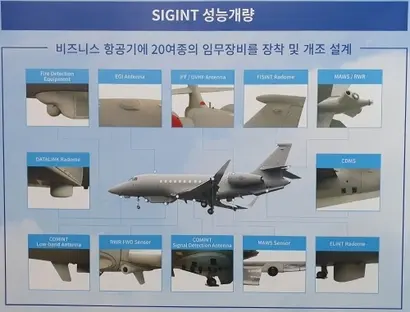
In particular, it has become possible to analyze the latest digital signal intelligence from North Korea and neighboring countries. Furthermore, thanks to the Fisint capability, the military can now detect movements prior to a North Korean missile launch and perform plume detection and tracking after the launch. Because of this, the military considers it to have world-class reconnaissance capabilities. Satisfied with its performance, the military included the "Baekdu System Capability Enhancement Phase 2 Project"—which involves the additional mass production of these aircraft—in the 270 trillion won 2019–2023 Mid-term Defense Plan announced in January 2019, under the category of counter-measures against nuclear and WMD (Weapons of Mass Destruction) threats.

Unlike the first two, the four additional units will utilize the Falcon 2000LXS business jet, as the Falcon 2000S is no longer in production. Additionally, Korea Aerospace Industries (KAI)047810 is expected to enter the competition against Korean Air for this production phase. During the "KAI CEO Investor Day" held on March 29 for major domestic and international institutional investors and analysts, KAI CEO Ahn Hyun-ho stated that the company plans to focus on special mission aircraft conversion development alongside the mass production of the KF-X fighter and the domestic development of military transport aircraft.