

[비즈한국] The marketing strategy of 'Jeongyookgak,' a startup that has generated 20 billion KRW in annual revenue with its strategy of selling only fresh pork slaughtered within 4 days, is causing controversy. The company posted an advertisement on Instagram comparing the color of grease rendered from its own pork belly to that of regular pork belly. However, experts point out that there is no meaningful scientific difference between pork slaughtered within 4 days and that slaughtered later.
Jeongyookgak is an online meat distribution startup founded in 2016 by CEO Kim Jae-yeon, a KAIST graduate. The CEO gained significant attention last October after appearing on the tvN show 'You Quiz on the Block' due to his academic background and unique story. The company was selected as a "Baby Unicorn" by the Ministry of SMEs and Startups last June, and was also chosen as one of the '1,000 National Representative Innovative Companies' in November, garnering much interest.
"Does freshness mean cleaner grease?" Ad removed due to potential for misunderstanding
The controversial advertisement featured a person in a white lab coat comparing the color of grease from the company's so-called "ultra-fresh pork belly" with that of "regular pork belly." In the photo, the grease from the "ultra-fresh" pork belly appears significantly clearer and brighter to the naked eye, while the grease from the regular pork belly looks dark and cloudy.

Many experts have criticized the ad as excessive, stating that such results are impossible to replicate under normal conditions. Moon Jung-hoon, a professor at the Department of Agricultural Economics and Rural Development at Seoul National University, criticized it by saying, "It seems like the cooking temperature was too high or the grill wasn't clean," adding, "Conducting an experiment without proper controls is an act of deceiving consumers." Choi Nak-eon, a renowned food engineer and CEO of Pyeonhan Food Information, also stated, "If the meat is normally distributed under refrigeration, there is no scientific basis for the color of the grease to differ based on the time elapsed since slaughter under the same conditions."
In response, Jeongyookgak explained, "(The meat used in the experiment) was chilled pork belly (100g, 3,100 KRW) from company D purchased at another online commerce site, and the advertisement compared the grease obtained after cooking on the same grill for the same amount of time." They added, "We decided to pull the advertisement because customers pointed out that it could lead to the common misconception that 'fresh (ultra-fresh) meat results in clear grease,' going beyond the point that grease from Jeongyookgak pork belly is clean."
Is pork truly tastiest within 5 days of slaughter?
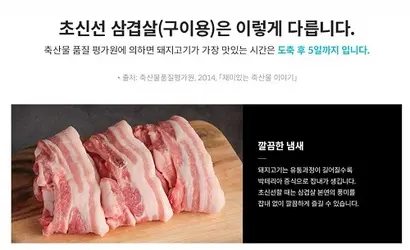
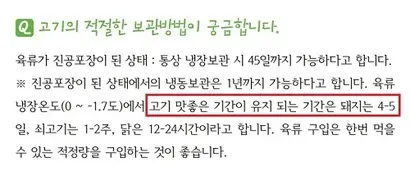
The controversy over exaggerated advertising has shifted to 'ultra-fresh,' Jeongyookgak's core marketing message, raising questions about the company's fundamental marketing direction. Jeongyookgak claims on its website that pork is tastiest within 5 days of slaughter. Their primary evidence is an explanation of meat storage methods from the 'Fun Livestock Product Stories' booklet published by the Korea Institute for Animal Products Quality Evaluation (KAPE) in 2014. Jeongyookgak cites a section that states, "When meat is vacuum-packed, it can generally be refrigerated for up to 45 days, and the period during which the meat maintains good flavor at meat refrigeration temperatures (0 to -1.7°C) is 4–5 days for pork, 1–2 weeks for beef, and 12–24 hours for chicken."
Jeongyookgak also provided supplementary evidence regarding methods to tenderize meat. The cited section states, "It is generally better to cook and eat meat after 7–14 days for beef, 1–2 days for pork, and 8–24 hours for chicken at temperatures around 4°C." However, this can be interpreted differently depending on one's perspective. Originally, this section emphasizes the importance of aging, explaining that this period is necessary for rigor mortis to dissipate so the meat becomes tender. In other words, it suggests that the meat needs at least this much time to become soft enough to eat.
Regarding this, the Korea Institute for Animal Products Quality Evaluation explained, "The section quoted by Jeongyookgak is being used in a completely different sense than intended in the booklet. It is an explanation of storage methods, referring to how long the taste remains unchanged when a consumer stores pork in a regular refrigerator rather than a meat refrigerator after purchase." In short, the expression "good flavor" is closer to meaning "not tasting bad" rather than "delicious." The agency stated, "We are looking into what actions to take regarding the fact that they identified the source despite not quoting the book's content accurately."
In fact, reading the booklet reveals many sections that emphasize the importance of aging. It explains that meat's taste and tenderness improve through the aging process, and that the flavor is best when there is a high content of IMP, which is produced as ATP—the muscle's energy source—decomposes.
There is also an explanation of rigor mortis. It clearly states, "Rigor mortis is the phenomenon where muscles become hard and tough, and tenderness and water-holding capacity decrease over time after cattle or pigs are slaughtered," and adds, "Cooking meat in a state of rigor mortis is not only very tough but also lacks flavor, making it unappetizing." Furthermore, it states, "Aging improves tenderness, water-holding capacity, and flavor, resulting in better meat taste; the aging period is about 10 days for beef, 2–3 days for pork, and 1–2 days for chicken and duck."
What is the typical meat distribution process? According to the industry, pork undergoes about a day of cooling after slaughter to prevent spoilage. It then goes through deboning, trimming, and portion packaging before being delivered to distributors, which usually takes 2–3 days. After that, pork handled by marts or butcher shops, especially popular pork belly, is said to be completely sold out within 1–2 weeks of slaughter.
Seol Guk-hwan, a researcher at the National Institute of Animal Science, said, "Taste is subjective, so it's hard to make a definitive statement, but there are research results showing that preference generally increases after aging," adding, "This is because aging increases tenderness, making the meat softer, and as proteins break down, amino acids and other components related to flavor are released."
Dr. Seol noted, "Generally, it takes about 2–3 days for commercially distributed pork to reach the market, and if the distribution process—involving wholesalers and retailers—is complex, it takes about a week." He explained, "Regarding when pork is tastiest after slaughter, it is generally considered to be about a week."
CEO Kim Jae-yeon: "No problem with marketing direction; customers keep coming back because it's tasty"
Most experts agree that pork within 5 days of slaughter, as advocated by Jeongyookgak, is fresh and has its own distinct flavor. However, whether it is the "tastiest" is a matter of personal preference. Many experts also argued that, assuming proper refrigeration during distribution, there is no significant scientific difference in taste between pork slaughtered 5 days prior (sold by Jeongyookgak) and pork slaughtered 7–10 days prior (sold via regular channels like marts and restaurants).
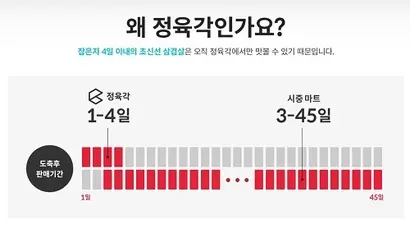
The problem is that Jeongyookgak's marketing implies that other pork sellers offer relatively less tasty meat. Kim Sung-ki, CEO of Morning Farm, argued, "The taste of meat based on the time since slaughter is merely a matter of preference," adding, "Jeongyookgak's marketing method is no different from fraud that creates anxiety among consumers." Kim Young-jun, author of 'The Alley War,' also pointed out, "A method that differentiates itself by making the existing industry—which has no problems—appear as if it does, is the worst kind of marketing," adding, "It leads to consumer distrust and ends up setting the entire market back."
However, Kim Jae-yeon, CEO of Jeongyookgak, disagrees. In a phone call with Bizhankook, he expressed frustration, saying he doesn't see why he needs to provide such explanations. He countered, "I 100% agree that both fresh meat and aged meat are delicious, assuming both go through perfect storage processes," but added, "However, pork has disadvantages during the distribution process, such as the development of odors as the distribution time lengthens, which outweigh the benefits gained from aging."
CEO Kim added, "I don't think there is any problem with Jeongyookgak's marketing direction. Emphasizing 'ultra-fresh' is our unique selling point, and customers keep coming back because they feel the same way," he said. "We have a clear point of view on taste, and I believe there is sufficient scientific basis for it."
Regarding the controversial advertisement, he explained, "We pulled the ad because we agreed with the customers' points. We wanted to convey the message that Jeongyookgak pork is delicious; we didn't want to convey the message that fresh pork is unconditionally delicious."