

[비즈한국] The ‘Korea Art Promotion Project,’ the first of its kind in the history of the Korean press, has entered its seventh season. This project, which discovers talented artists, promotes them, and facilitates their exhibitions, is now recognized by the art world as a full-fledged program for unearthing new talent. Over the course of six seasons, about 140 artists have been introduced through this project, and many have successfully established a foothold in the art scene. Furthermore, they have formed an association called the ‘Korea Art Promotion Project Association (KAUP)’ and have begun activities that are bringing a breath of fresh air to the art world. As we begin this season, we hold the belief that this will serve as a small light toward an exit in our current reality, which still feels like being inside a tunnel.
Is it possible to paint the inside of one’s mind where thoughts grow? In the early 20th century, Italian artist Giorgio de Chirico left his mark on Western art history by bringing such an unconventional idea to life through painting. This is known as ‘Metaphysical Art,’ a term coined by Guillaume Apollinaire, who was considered a mentor of new artistic movements at the time.
Chirico expressed the space within his mind by depicting the squares of European cities where ancient ruins stood. It is said that he was inspired by images of the city where he spent his childhood, which remained in his subconscious. He shocked the art world by bringing a specific area of the brain—where thoughts grow and reside—into a concrete form through urban imagery.
Kim Yu-kyung, who has been painting traditional ink wash paintings, is an artist gaining attention for exploring ideas similar to Chirico's in her own unique way. She draws the space within her mind by borrowing from the fundamental philosophies of Eastern painting. One of the highest goals in Eastern painting since ancient times has been to capture the ‘Qi’ (vital energy) inherent in nature.
It is the force that moves nature, and it has long served as a source of inspiration for artists. In the East, it was captured in landscape paintings as ‘Qi,’ while in the West, it was embraced in Romantic landscape paintings as ‘energy.’ However, the nuances of ‘Qi’ and ‘energy’ are slightly different. The difference lies in where the focus is placed, and that difference reflects the distinct ways in which the East and the West view landscapes.
The ‘Qi’ in the landscapes viewed by Easterners hides an emotional code. It means adding humanistic elements to the mountain ranges, clouds, wind, rain, or snow that create a spectacular view. In other words, nature is treated as a living entity, which is how images like the mountain spirit (Sansinryeong) came to be. By representing nature this way, landscape paintings have remained beloved and relevant for over 2,000 years.
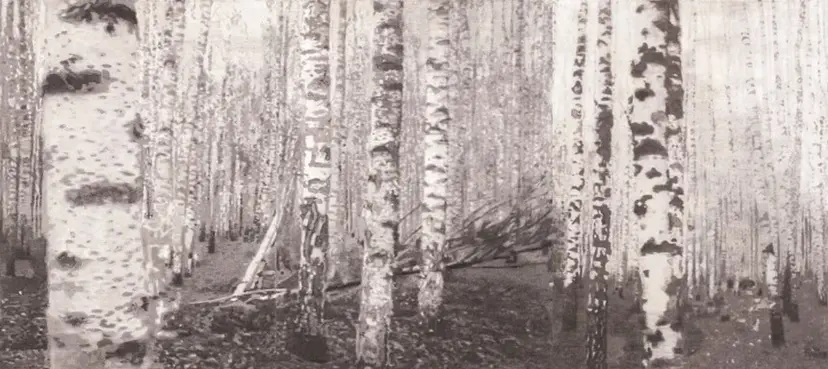
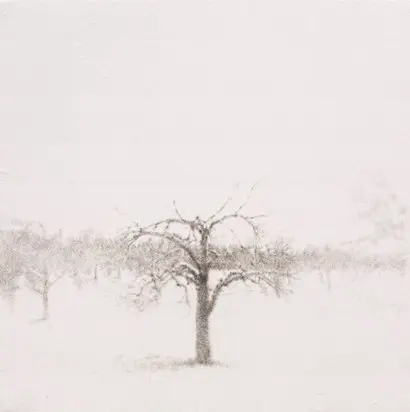
Kim Yu-kyung also paints the landscapes she has seen. She paints the landscapes engraved in her heart, adding a humanistic code of memory. She interprets these landscapes as traces of thoughts that are stored in the mind as memories and then gradually scatter.
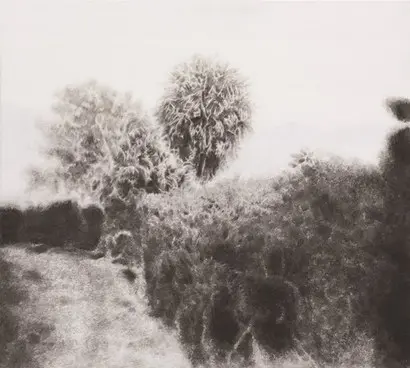
She works exclusively with ink, a traditional material. However, it looks as though it were drawn with pencils, charcoal, or Conté, which are basic materials for Western painting. This is a technique developed by the artist and, at the same time, her own expressive language for conveying her ideas. Without any preliminary sketches, she begins on a blank sheet of mulberry paper (Hwaseonji), layering countless dots while adjusting the density of the ink until the piece is complete. This technique itself is how Kim Yu-kyung paints her thoughts.
We see a landscape and engrave it in our hearts. If it is a landscape infused with our own unique experiences, it remains even deeper within us. However, as time passes, these lingering images in our hearts slowly fade away. Kim Yu-kyung’s paintings are an act of transferring the moment when thoughts evaporate onto the canvas through countless ink dots. Through this, she wants to convey that our lives are a collection of memories we have experienced and accumulated.