

[비즈한국] "Expand nursing staff and resolve the caregiving crisis!" "Anyone can become a patient. It is late, but the state must step in now!"
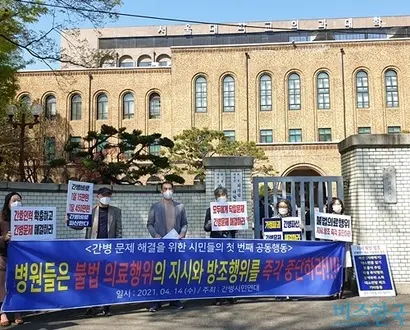
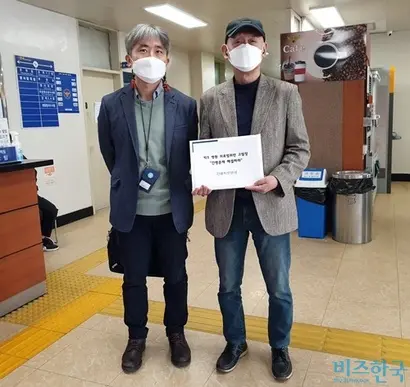
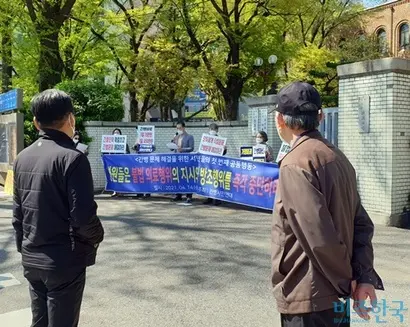
On the morning of the 14th, in front of Seoul National University Hospital in Jongno-gu, Seoul, seven civic groups, including the Caregiving Solidarity, raised their voices. They demanded an immediate stop to hospitals' practices of instructing and aiding caregivers in illegal medical procedures. During the press conference, it was argued that patients are being harmed due to unlicensed medical activities performed by caregivers with the hospital's tacit approval. Immediately after the press conference, the Caregiving Solidarity submitted a complaint to the Hyehwa Police Station against the hospital directors of the "Big 5" hospitals (Seoul National University Hospital, Asan Medical Center, Sinchon Severance Hospital, Samsung Medical Center, and Seoul St. Mary's Hospital).
"Nurses scolded caregivers for not administering medication properly"
When patients are hospitalized, caregivers are hired as support staff. Caregivers, who are essentially "ghost workers" without legal qualifications, must be found directly by the guardians. In many cases, hospitals introduce agencies that dispatch caregivers. The cost of hiring a caregiver is substantial. It is at least 100,000 won per day, and recently, as it has become difficult to find caregivers, the price has risen to 120,000–150,000 won. This is because the majority of caregivers are ethnic Koreans from China (Joseonjok), many of whom returned to China due to COVID-19. One must pay 3 million to 4.5 million won per month just for caregiving costs. This is the reason why the term "caregiving bankruptcy" has emerged.
Joint caregiving does not necessarily ease the burden. Depending on the ward—whether it is a 4, 6, or 8-bed room—the cost for joint caregiving ranges from 600,000 to 1.8 million won. According to a survey conducted by the Caregiving Solidarity from February 26 to April 6 targeting 113 patients and guardians who had received inpatient treatment at domestic hospitals, 63% of those who used individual caregivers spent more than 100,000 won per day. In the case of joint caregiving, the most common daily cost was 50,000 to 100,000 won, reported by 55% of respondents.
"Family caregiving" is also significant. According to the survey, 34% of respondents found caregivers through agencies, while 29% provided care themselves. Activist Kim In-gyu stated, "Over five years since 2015, I spent about 40 million won on hiring at least 25 caregivers. I even had to quit my job to provide care myself due to the financial burden." The medical expenses paid by patients upon hospitalization include inpatient fees, which cover medical management, nursing management, and hospital management. This means the cost of patient care, including medical rounds, disease treatment, and diagnostic assistance, is already being paid. Activist Park Si-young, met on the 13th, pointed out, "In reality, patients and guardians are paying additional money to hire caregivers on top of that."
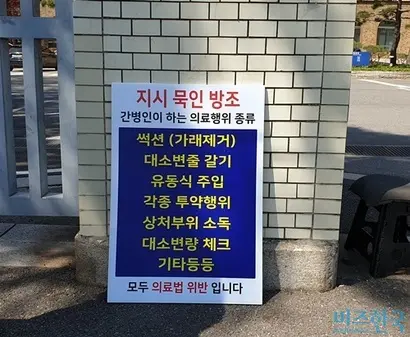
However, the quality of caregiving services cannot be guaranteed despite the high costs. This is because "unlicensed medical activities" by caregivers—such as suctioning (clearing blocked airways), changing urinary catheters, administering various medications, and disinfecting wounds—are being carried out with the hospitals' tacit approval. It is said that caregiver referral or dispatch agencies often provide training on medical procedures, and doctors or nurses on-site even ask caregivers, "Why didn't you check that?" The complaint also captures the voices of guardians regarding the medical activities of caregivers at Big 5 hospitals.
"Caregivers performed suctioning, catheterization, and gastrostomy tube disinfection; they did it all."
"Did the doctors know about all of this?"
"Yes. Because even while they were treating patients, if suctioning was needed, I would perform it."
"Did nurses or doctors request that [caregivers] do it [the suctioning, etc.]?"
"They bring the supplies to the caregiver. They say caregivers receive suction training when they get caregiving education. My father couldn't eat, so he had an L-tube (a tube inserted from the nose to the stomach). Medication is administered through the L-tube, and one time the tube got clogged because the caregiver didn't grind the medication fine enough. When the nurse discovered this, she scolded the caregiver. Administering medication is a medical act, and when my brother strongly demanded that the nurse do it, she said she understood. It’s absurd."
All of this is a violation of the Medical Service Act. Article 27, Paragraph 1 of the Medical Service Act states that no one other than medical personnel may perform medical acts. Paragraph 5 stipulates that one must not allow unqualified persons to perform medical acts, nor allow medical personnel to perform medical acts outside the scope of their license. Violations are punishable by up to 4 years in prison or a fine of up to 50 million won. Related medical institutions may face cancellation of their operating permit or an order to close. While these punishment regulations were implemented through the amended Medical Service Act last March, lawyer Lim Ja-woon stated that medical acts performed before then could still be prosecuted as unlicensed medical acts under Article 27, Paragraph 1, and as instigation or aiding and abetting under Articles 31 and 32 of the Criminal Act.
Even if a medical accident occurs due to a caregiver's illegal medical act, neither the hospital nor the caregiver takes responsibility. Activist Yoo Hee-kyung, met on the 13th, revealed, "I once hired a caregiver to look after my father who suffered from Alzheimer's. There was an incident where the caregiver blocked his airway while injecting food. The hospital didn't respond properly, saying it 'happens all the time.' In many cases, they even make you sign a disclaimer stating that it is not the hospital's responsibility if a fall accident occurs."
Nursing and caregiving integration service reduced to 'empty promises'
At the press conference that day, voices of frustration regarding the current state of caregiving poured out. In particular, it was pointed out that the "Nursing and Caregiving Integration Service" has been reduced to a "pretty but useless" system. The system was introduced in 2013 with the intention of reducing the financial burden of caregiving by having nursing staff directly care for inpatients without the need for guardians or caregivers to stay in the room. The National Health Insurance Service subsidizes part of the cost. However, as of last year, the domestic adoption rate of the nursing and caregiving integration service is reportedly only around 20%. It is also said that patients with severe illnesses are excluded from the system due to hospitals' refusal to accommodate them.
Activist Kang Ju-seong emphasized, "The caregiving problem can strike anyone. We need mechanisms in the new system where patients and families can receive care without worry." Lee Na-geum, director of the Patient Rights Research Institute (mother of the late Kwon Dae-hee), who attended the press conference, stated the reason for reporting the five major hospitals for violating the Medical Service Act, saying, "By offloading medical tasks onto non-medical caregivers and family members, hospitals and medical staff are posing a serious threat to patient safety. We intend to sound an alarm regarding this."
Meanwhile, the Caregiving Solidarity is a civic group launched in November last year to resolve caregiving problems, including the improvement of the financial burden. It is composed of former Health World Network representative Kang Ju-seong, 4–5 other activists, and about 180 members. It was formed as a 3-year project organization. This complaint is the group's first step. Their goal is to fully expand the nursing and caregiving integration service and bring caregiving costs within the scope of health insurance. They believe that ways to separate the roles of nurses and caregivers by establishing legal qualifications for caregivers should also be discussed. To this end, the Caregiving Solidarity plans to continue with second and third rounds of complaints and campaigns in the future.