

[비즈한국] The officetel market in the Seoul Capital Area is heating up. Sales transactions in the first quarter of this year increased by 40% compared to the same period last year, and prices have been on an upward trend since the third quarter of last year. Although tax benefits for residential officetels effectively disappeared due to the July 10 real estate measures last year, they are still considered to be freer from regulations such as housing subscriptions and loans compared to the housing market in the capital region.
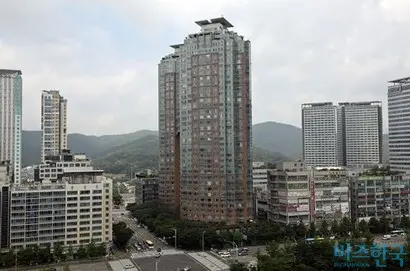
Rise in Sales Prices and Transaction Volumes for Capital Region Officetels in Q1 2021
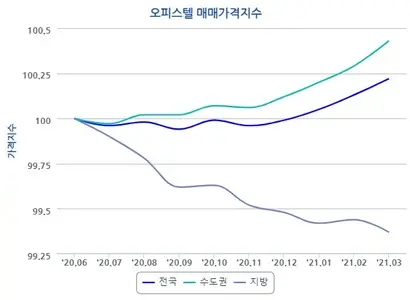
Officetel prices in the capital region have been on an upward trend for the third consecutive quarter. According to an officetel price trend survey released by the Korea Real Estate Board on the 1st, the sales price of officetels in the capital region, including Seoul, Incheon, and Gyeonggi, rose by 0.31% in the first quarter of 2021 compared to the previous quarter. By region, Incheon remained flat at 0%, while Seoul and Gyeonggi led the price increase at 0.22% and 0.53%, respectively. The fluctuation rate of sales prices in the capital region has been increasing: -0.7% in Q1 last year, -0.26% in Q2, 0.02% in Q3, 0.1% in Q4, and 0.31% in Q1 of this year.
The transaction volume of officetels in the capital region increased by 40% compared to last year. According to the Ministry of Land, Infrastructure and Transport's real transaction price disclosure system, there were 9,965 officetel sales transactions in the capital region in the first quarter of 2021, an increase of 2,852 (40.1%) compared to the same period last year. Transaction volumes by region were 4,219 in Gyeonggi (an increase of 1,594 or 60.8%), 4,310 in Seoul (an increase of 908 or 26.7%), and 1,436 in Incheon (an increase of 348 or 32%). Since housing sales transactions must be reported within 30 days of the contract, the statistics for the first quarter (March) may increase by the end of April.
An official from the Korea Real Estate Board explained, "In the Seoul area, demand flowed into mid-to-large sized officetels, which are substitutes due to the overall rise in housing prices, causing officetel prices to rise in tandem. In the Gyeonggi region, as apartment price increases continued, prices rose centered on areas like Gwangmyeong, Goyang, and Bucheon, which are cheaper than Seoul and have excellent transportation conditions."
Residential Officetels Subject to Increased Acquisition Tax, But Subscription and Loan Merits Remain
Following the July 10 real estate measures last year, the officetel market in the capital region was expected to shrink. At the time, the government decided to include residential officetels in the count of homes when applying the increased acquisition tax for multi-home owners. Originally, residential officetels were only included as housing when calculating capital gains tax and comprehensive real estate tax.
Starting August 12 of last year, when the amendment to the Local Tax Act took effect, owners who purchase an officetel exceeding 100 million KRW in tax base and use it for residential purposes face increased acquisition taxes if they purchase additional homes. Currently, the acquisition tax rate for purchasing one home is 1–3% depending on the value of the house, but it is increased to 8% for two homes and 12% for three or more homes.
However, the officetel market is still relatively freer from regulations than housing in the capital region. When buying an apartment in a speculative zone like Seoul, one can receive a mortgage loan of up to 40% of the home price, whereas up to 70% is possible for officetels. When applying for a housing subscription, residential officetels are not considered housing, so non-homeowner status can be maintained. Officetel purchase rights are also not yet included in the housing count when applying increased acquisition and capital gains taxes.
Jang Jae-hyun, head of research at Real Today, analyzed, "As the sales and jeonse (charter rent) prices of apartments in the capital region have risen significantly, demand seems to have shifted to relatively cheaper residential officetels. Although they have fewer regulations compared to apartments, the living conditions such as community facilities and floor area are inferior, so there are likely more people buying them for investment purposes than for actual residence."
Jo Hyun-taek, a researcher at the Commercial Real Estate Information Institute, added, "While officetel prices in regional areas are falling, the capital region's officetel market is maintaining a good atmosphere. Because there are relatively fewer regulations than apartments, there is increasing demand from non-homeowners looking for actual residency or trying to save up seed money before buying an apartment. If housing regulations are not lifted, this trend is expected to continue for the time being."
Tax Savings Possible, But Residential Usage Without Move-in Notification Leads to Back Taxes
An officetel is not a dwelling under the Housing Act. It is a business facility (quasi-housing) that can be used as a residential facility. When acquired, it is treated as a business facility—its use on the building ledger—for tax purposes, as it is not yet determined whether it will be used for residential or commercial purposes. If its residential use is confirmed later through move-in reports, etc., residential property taxes are imposed, and it is added to the total number of homes. The acquisition tax rate for business facilities is 4% (4.6% including rural development tax and local education tax).
Tax-saving techniques utilizing the characteristics of officetels are also developing. Before acquiring or selling a new home, converting a residential officetel into a business facility can help avoid increased taxes for multi-home owners. This is done by having the owner or tenant living in the officetel move out and finding a business operator to rent it out for office use. If one plans to purchase one residential officetel and one apartment, purchasing the apartment first can help avoid increased acquisition taxes. Some people do not file a move-in report for residential officetels to avoid tax increases, but this is a form of tax evasion subject to retrospective taxation and requires caution.
Won Jong-hoon, a tax accountant and head of the WM Investment Consulting Department at KB Kookmin Bank, pointed out, "Due to the July 10 measures last year, tax benefits for residential officetels have virtually disappeared. However, there are cases where owners use an officetel as a residence but do not register their move-in, or prevent tenants from registering their move-in to exclude it from the housing count. Tax authorities can verify the usage if they choose to, so caution is needed. A home seller who received an exemption from capital gains tax for owning one home could suddenly find themselves subject to back taxes."