

[비즈한국] “There are people who proudly put ‘married’ or ‘FWB’ (Friends with Benefit) in their profiles. You also frequently see photos showing their naked bodies or sexual preferences. When I felt uncomfortable and tried to report them, there was no option for ‘married person’ in the reporting categories, so I had to select ‘others.’ It made me feel even worse because it felt like the app didn't even consider it a problem in the first place.”

As the trend toward non-face-to-face interactions accelerates, the number of people explicitly looking for extramarital partners through certain dating apps is on the rise. Critics point out that some apps, which advertise the ability to meet "neighborhood friends," are essentially encouraging infidelity by failing to actively sanction the use of their services by married individuals. Industry insiders have testified, saying, “Dating apps and social discovery apps should be categorized differently,” and adding, “Actively sanctioning married users would directly lead to a decrease in revenue.”
‘Make casual neighborhood friends’… Even if you’re married?
According to the industry, the dating app market grew more than fourfold from 50 billion won in 2015 to approximately 200 billion won in 2019. Last year, in particular, growth gained momentum due to the increase in non-face-to-face demand caused by COVID-19. The number of users spending money on dating apps is also steadily increasing. According to App Annie, domestic consumers spent approximately 83 billion won on dating apps last year.
It goes without saying, but married individuals are not the intended audience for dating apps from the start. According to the terms of service of the popular dating app ‘Noon Date’ (Jung-o-ui Date), the company may not approve membership applications or may terminate service contracts if it is confirmed that the applicant ‘is in a relationship or is married.’ The dating app ‘Amanda,’ an abbreviation for ‘I don’t meet just anyone,’ also states in its terms of service that users cannot become members if they ‘have a significant other or are married.’
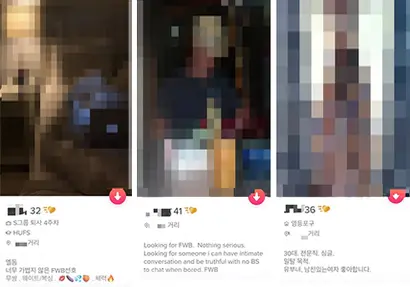
However, apps that advertise the ability to make ‘casual’ friends are different. Nowhere in their terms of service, help guides, or reporting categories is there any content sanctioning the use of the app by married people. In the case of ‘Wippy,’ which uses the advertising slogan ‘an app to make friends rather than lovers,’ the rules for sanctioning members do not explicitly mention such content. Instead, they vaguely state that they prohibit ‘acts that violate public order and morals, such as information, sentences, or graphics that request or solicit sexual or obscene material or prostitution.’ The global social discovery app ‘Tinder’ also has no terms of service that sanction married users.
Nevertheless, users reported experiencing discomfort when married people explicitly asked about their marital status or sent sexual messages regardless of the app's intended purpose. A 23-year-old woman, ‘A,’ expressed her frustration, saying, “Dating apps are used to find romantic partners, but they are also used to make neighborhood friends. However, neither purpose includes married people. Since the apps that promote making neighborhood friends don’t sanction this, I receive messages from people who openly or subtly reveal they are married and ask to meet up.”
A 29-year-old man, ‘B,’ also said, “I have consistently used dating apps, and it is certainly true that you see many married people on apps meant for finding neighborhood friends, like Tinder. The problem is that many of them indicate they are married in their profiles and seek dating partners. The female friends I’ve met on Tinder complain that there are many married men. I’ve even heard from a married man in his 40s at work that he often goes on dates and has one-night stands through various dating apps.”
Why allow them to emphasize ‘FWB’ and ‘married’ while claiming they are just friends?
An official from a dating app stated, “Apps with a clear identity as a dating app manage their members actively, from registration to the reporting system. However, for apps that emphasize neighborhood friends like ‘Tinder’ and ‘Wippy,’ there is an ambiguous aspect. Personally, I think it’s a play on words to distinguish between friends and lovers within the scope of ‘dating apps.’ But if you look at the essence, it’s related to the physiology of the apps. It’s highly likely that older men are the ones spending money while using the apps, and strictly separating married people would essentially be targeting them.”
Another industry insider pointed out, “Although it varies by dating app, some VIP male users spend anywhere from 70 million to 100 million won on the app in a single year. Even if the app’s purpose is to make friends, there should be a system to automatically filter out words that imply sex-centered encounters, such as married or FWB. But for app operators, what matters most is ‘how much money is spent.’ Consequently, they don’t actively sanction beforehand and end up voluntarily taking on the stigma of being an ‘infidelity platform.’”
A representative from Tinder’s PR team said, “While there are protections for minors, there is no special device to filter out married people. We are making efforts to prepare safety and protection measures to prevent use for negative purposes.”
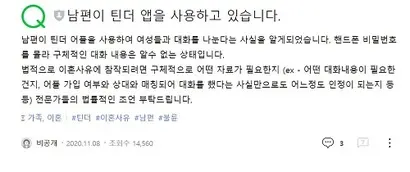
Divorce disputes caused by dating apps are also increasing. On online blogs and counseling sites, it is easy to find questions asking whether a spouse’s use of dating apps is grounds for divorce. One divorce lawyer explained, “As the methods of meeting online through hobby clubs, online cafes, and dating apps have diversified, divorce counseling related to this has also increased. Even if it is a dating app intended for meeting neighborhood friends, if it explicitly specifies sexual intercourse or infidelity and continues to meet with others, it can sufficiently be grounds for divorce.”
Bae In-koo, a lawyer at the law firm Logos, stated, “I have had a case where a wife consulted about whether it was grounds for divorce after she saw a dating app on her husband’s phone and they fought. While it depends on each case, it can serve as direct evidence.”