

[비즈한국] OK Savings Bank achieved its best-ever performance last year. While it marginally increased performance bonuses, the bank significantly cut base salaries and welfare benefits, drawing attention to the reasons behind this move.

According to the Financial Supervisory Service's Data Analysis, Retrieval and Transfer System (DART), OK Savings Bank recorded its highest-ever performance last year with operating revenue (sales) of 995.42 billion KRW. This is an 11.9% increase compared to the previous year's 889.28 billion KRW. During the same period, operating profit reached 243.52 billion KRW, a staggering 61.1% increase from the previous year's 151.07 billion KRW.
This success is attributed to a strategy that reinforced market dominance through face-to-face operations. This is because a significant portion of customers who primarily use secondary financial institutions are middle-aged or older, and they tend to prefer in-person services. OK Savings Bank has an overwhelmingly larger number of employees (1,078 as of the end of December 2020) compared to its competitors, such as SBI Savings Bank (599) or Welcome Savings Bank (776).
Although the company achieved excellent results by hiring a large number of employees, it remains questionable whether OK Savings Bank is providing appropriate compensation. Amidst record-high profits, both the average salary and welfare benefits per employee actually shrank. The average salary per person at OK Savings Bank last year was 59.08 million KRW, a 0.6% decrease from the previous year's 59.44 million KRW.
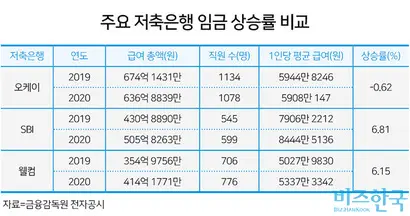
In contrast, competitors SBI Savings Bank and Welcome Savings Bank recorded salary increase rates in the 6% range. The average salary per person at SBI Savings Bank last year was 84.44 million KRW, an increase of 6.81% from the previous year's 79.06 million KRW. Welcome Savings Bank reached 53.37 million KRW, a 6.15% increase from the previous year's 50.27 million KRW.
OK Savings Bank did slightly increase performance bonuses for employees last year, paying out 14.7 billion KRW, which is 1.2 billion KRW more than the previous year. However, because welfare benefits were slashed by 35%—from 13.02 billion KRW the previous year to 8.46 billion KRW—the situation resembles "robbing Peter to pay Paul."
OK Savings Bank explained, "Since the actual amount received by employees is the sum of annual salary and bonuses, there may be a difference between the increase or decrease in total salary reported in financial statements and the actual amount received by employees." They added, "The reduction in welfare benefits appears to be a cost-saving effect resulting from the suspension of offline welfare activities due to COVID-19."
A business industry insider noted, "Recently, companies have been putting a lot of thought into employee salaries and welfare to attract talent," adding, "If the perception spreads that a company is not sharing its earnings with employees, it may become difficult to recruit competitive talent. In the long term, this could lead to the exodus of internal talent, so the trend is moving toward finding rational ways to share profits with employees."