

[비즈한국] A, a 71-year-old resident of Seoul, did not receive her city gas bill in January of this year. Other households in the same villa received theirs. Thinking, "Perhaps someone took it by mistake," A took no action, assuming the bill would arrive the following month along with a payment reminder.
The bill did not arrive the following month either. A, finding this strange, mentioned it to her son who lives with her, but he also said, "If it's urgent, (Seoul City Gas017390) will contact us."
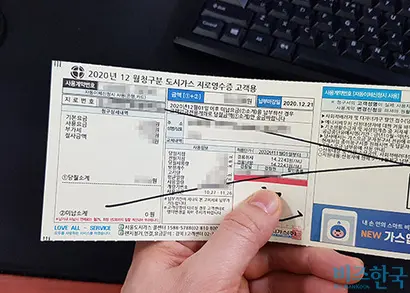
When the bill still didn't arrive for A's house in March, her son, worried about late fees, logged into the Seoul City Gas website, entered their customer number, checked the charges for January and February, and paid via a virtual account. However, it was extremely inconvenient for A to ask her son to search the website and pay the bill every time.
When the bill failed to arrive in April, they finally inquired with the Seoul City Gas customer center. The response from the center was absurd. They claimed that they had already sent a text message informing customers that they would switch to text message (electronic) billing instead of paper bills. When A asked, "Did I ever agree to that?"—given that she never received such a text and never consented to it—the representative replied, "We instructed that if you wanted to continue receiving paper bills as before, you should press 1."
According to Seoul City Gas, the switch to electronic billing happened because A did not explicitly express her wish to continue receiving paper bills. A never received notice about the electronic billing, nor did she consent to it. Her consent was automatically assumed simply because she took no action.
Looking at the city gas bills A had kept, the recipient was listed under her son's name. She asked her son if he had received any text messages from Seoul City Gas, but he said he hadn't received anything either. Furthermore, her son had changed his name years ago, but the old name was still listed as the recipient. It was questionable whether the electronic billing notification text had even been properly delivered to his mobile phone. The method used by Seoul City Gas, which considers "no objection as consent," is irrational.
In response, Seoul City Gas stated, "Regulations changed last year, and we decided to prioritize electronic billing. This information was also noted on the paper bills." However, when asked about cases like A's, where customers might not receive the notification text at all, they replied, "We were also concerned about such issues. We excluded those over 65 because electronic billing could be inconvenient for them. Additionally, we decided not to impose late fees on customers who failed to receive their paper bills during the transition process."
Seoul City Gas was indeed anticipating cases where people would not receive the notification text or would have their paper bills unilaterally discontinued without expressing a preference. Seoul City Gas explained, "It is difficult to manage customer information with 100% accuracy, unlike banks. There are many cases where people don't update us when their names or contact information change, or when they move," adding, "We are currently working on improving the accuracy of our customer information."
Regarding this, attorney Ryu Ha-kyung explained, "Paying gas bills is a type of contract under civil law. Both the execution of a contract and any changes to its terms must be made with the explicit consent of the parties involved. The method of receiving bills is part of the contract's content; if gas users did not provide consent, the change to the contract terms could be considered invalid."