

[비즈한국] An intriguing scene appears in the tvN drama 'Start-Up', which concluded last year. The AI-based startup 'Samsan Tech,' founded by the protagonist Nam Do-san and his colleagues, failed to gain attention from any investors. Later, after Samsan Tech wins first place in a global AI image recognition competition, investors swarm their office. However, those who welcomed them were not investors, but developers disguised as investors to steal their technology.

Korea has a relatively favorable environment for founders to receive investment compared to other countries. According to the Korea Venture Capital Association, there were 165 registered domestic venture capital firms in 2020 alone. There are also 1,076 operating funds. The amount of new investment and the number of funded companies are steadily increasing every year. Despite the investment atmosphere cooling down due to the impact of COVID-19 last year, new investments reached 4.3045 trillion KRW. The number of newly invested companies in the same year was 2,130, with an average new investment size of about 2 billion KRW.
However, statistics alone don't reveal the hardships startup CEOs face during investment rounds. One startup CEO said, "In the early stages of a startup, funds are always scarce. If you don't receive investment at the right time, you might face bankruptcy instead of business expansion. That is why meeting each and every investment manager is so precious. But while going through the investment rounds, I realized that there are people who take advantage of our situation. The situation that appeared in the drama is just the tip of the iceberg."
Famous Investment Firm? Then Avoid the 'Newbie'
There is an investment manager that multiple startup CEOs share a common wariness toward: the 'newbie' investment manager. They have no investment experience and are unfamiliar with the current industry landscape. In short, they lack experience in every respect. While every investment firm provides training for new hires, it is merely theoretical. To actually apply it, they must go out into the field.

For newbies hungry for experience, cash-strapped startups are prime prey. CEO A of a startup said, "I was thrilled to be contacted by a famous investment firm first, so I prepared and presented at the IR (Investor Relations) session. However, whether it was due to lack of business viability or a poor presentation, it didn't lead to investment." He added, "A year later, I accidentally met that investment manager again at an investors' gathering. At that meeting, they confessed that they had been a newbie at the time. They were in a position that couldn't participate in the investment. They had contacted me regardless of the investment just for their own experience."
Another startup CEO, B, confided, "There was an investment manager who approached me three months ago, saying they were interested in our company. But the data they requested was a bit strange. They didn't ask for data on our business model, but for information on industry status, market trends, and history. Since it was a request, I sent the data after pulling an all-nighter. But eventually, it didn't lead to investment. A while later, I realized that this investment manager had used me for their own studies."
Not Even Investing... Demanding Compensation
Some investment managers make excessive demands of startups suffering from financial difficulties. Their methods are varied, such as interfering with management before the investment is even made, demanding excessive equity, or expecting discounts on the startup's goods or services.

CEO C of a startup explained, "An investment manager suggested that we should merge with another company in the same industry to receive investment. Since the CEO of that company and I had joked about a merger before, I took this opportunity to make a serious proposal, and we actually merged and are still operating the service today. But perhaps because the investment manager didn't think we would actually merge, they were caught off guard, and it ultimately didn't lead to investment."
CEO D of a startup lamented, "Quite a few investment managers ask for service usage rights at a discounted price compared to regular members. There are also quite a few cases where they buy products on sale at a lower price. Perhaps word got out, but one investment manager openly demanded equity. They were more interested in personal gain than the investment itself."
Power Trips You Can't Avoid Even When You Know... Communities Evaluating Investment Managers Emerge
Is there no way to filter out such investment managers from the start? Unfortunately, startup CEOs agree that "experience is the only solution." CEO A mentioned earlier said, "It's impossible to have the insight to find good investors from the very beginning. You have to learn it as you go through the investment rounds." He added, "After meeting my first newbie investment manager, I started carefully checking the references of not just the firm, but the individual manager as well. I focus on whether the firm provides feedback after IR, how fast the investment timing is, and whether they have plans post-investment."
CEO B says they check the quality and quantity of the requested data. "In the past, I mistakenly thought that the more data they requested, the higher the chances of getting investment. After meeting nearly 100 investment managers, I've found that top-tier managers only request data that cuts to the core. You just need to do your best for those people," said B.
CEO D agreed with B's opinion but added, "However, just because they request a lot of data, you can't completely filter them out. Even if you realize, 'Ah, they're a newbie, I've been had,' you still have to show sincerity. This is because you need investment funds to expand your business, and the industry is so small that news travels fast."
He continued, "The same goes for demanding compensation. At first, I would give them everything they wanted because I was afraid that refusing them would lead to investment failure. Recently, I only fulfill an investment manager's demands when the investment money actually arrives. For follow-up investments, I have no choice. In the end, it comes down to experience," he said with bitterness.
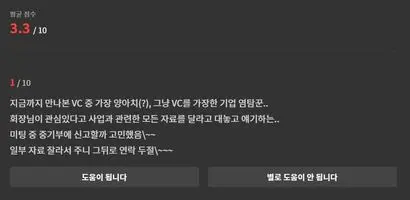
In light of this reality, a community site called 'Nugu Money' has emerged. Nugu Money was created to bridge the information asymmetry between startup founders and investment firms. Founders can leave reviews of investors on this site. It was created with the purpose of using collective intelligence to filter out unscrupulous firms or investment managers in advance.
CEO D said, "Since every startup CEO has different tendencies, you can't say it's 100% reliable, but if the same criticism or praise continues for a single investment manager, the story changes. I think that is the appeal of collective intelligence. It will be somewhat helpful for prospective founders to learn about investment firms or managers before receiving funding."