

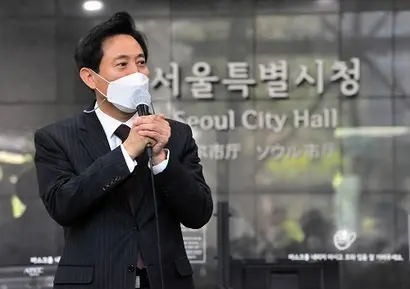
[비즈한국] As Seoul Mayor Oh Se-hoon takes office, the “Han River Renaissance” project is receiving renewed attention. This is because some of the Mayor’s key real estate pledges originated from the Han River Renaissance. The real estate market is buzzing with the expectation that a second ‘Raemian Caelitus’ could emerge.
Revisiting Mayor Oh Se-hoon’s ‘Han River Renaissance’ Project
During the election period, Mayor Oh Se-hoon showed a strong will to deregulate, stating, “I will lift reconstruction regulations within one week of taking office.” He expressed confidence in stabilizing Seoul’s housing prices through deregulation policies, such as abolishing the 35-story limit and easing floor area ratios. The deregulation policies brought forward by Mayor Oh are part of the ‘Han River Renaissance’ project, which he focused on during his previous term. The project, which was scrapped in 2011 after the late former Mayor Park Won-soon took office, is set for a revival after 10 years.
The Han River Renaissance project was promoted as a core policy during Mayor Oh’s term from 2006 to 2011. Various projects were carried out with the intent of using the Han River as a springboard for creating economic value. Having served as a member of the Korean Bar Association’s Environmental Issues Research Committee, an auditor for the Seoul Green Citizens Committee, and a central executive committee member of the Korea Federation for Environmental Movements, Mayor Oh was known as an ‘environmental expert’ when he was elected in 2006. The Han River Renaissance project also started with this character.
The first phase of the Han River Renaissance, announced on September 26, 2006, included policies to make the Han River eco-friendly. It was designed to make the Han River more accessible to citizens by dividing it into five areas: ecological restoration, improved accessibility, creation of cultural and tourism infrastructure, waterfront landscape improvement, and activation of water usage.
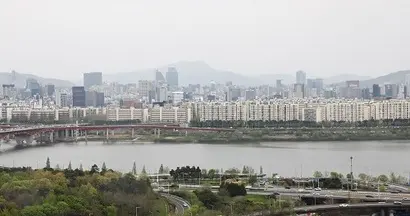
In 2009, full-scale efforts were made to restore the public nature of the Han River. The core aspect was to transform the riverside into a space for citizens and change the riverside skyline. The relaxation of apartment floor limits was also a policy that emerged at this time. At the time, Mayor Oh announced, “I will transform the riverside, which has been privatized, into a space for citizens and drastically change the skyline of the Han River.” The intention was to return the river view to the citizens—who were previously blocked by low-to-mid-rise apartments—by allowing slender, high-rise apartment complexes.
The Seoul Metropolitan Government divided the riverside into three zones: ‘strategic maintenance zones,’ ‘guided maintenance zones,’ and ‘general management zones.’ Strategic maintenance zones such as Seongsu, Hapjeong, Ichon, Apgujeong, and Yeouido were to actively implement changes in land use, while guided maintenance zones such as Mangwon, Dangsan, Banpo, Jamsil, and Jayang were planned for medium-to-long-term, small-to-medium-scale development. Other areas were left as general management zones with no major changes.
Building heights were also categorized into ‘height relaxation zones,’ ‘height guidance zones,’ and ‘height management zones.’ Height relaxation zones (Yeouido, Apgujeong, Jamsil, etc.) had no maximum floor limit, with residential areas allowed to reach around 50 floors, and an average floor count of around 40. In height guidance zones (Seongsu, Ichon, Banpo, Guui-Jayang, Dangsan, etc.), areas without view obstructions were allowed up to 50 floors, with an average of around 30 floors.
Cooperation with Government and Seoul City Council Urgent for a Second ‘Raemian Caelitus’
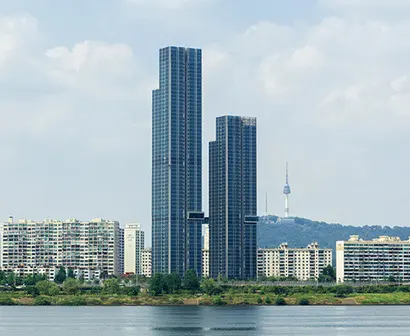
Raemian Caelitus, located in Ichon-dong, Yongsan-gu, Seoul, is the only apartment complex to have benefited from the Han River Renaissance project. Raemian Caelitus, which stands at a maximum height of 56 stories along the Han River, was completed in 2015 after reconstructing the 15-story Rex Mansion Apartments.
The Rex Apartments were originally planned for reconstruction at a maximum of 36 floors and 496 units, but were instead rebuilt to a height of 56 stories under Mayor Oh’s policy to restore the public nature of the Han River. At the time, the Seoul Metropolitan Government decided that if developers building apartments along the Han River donated 25% or more of the site as a public contribution, it would compensate for the reduced building area by increasing the floor area ratio.
The Rex Apartment Reconstruction Union was allowed to build high-rises in exchange for giving the Seoul Metropolitan Government 7,726 square meters (about 2,341 pyeong) of land for free, which is 25% of the total site of 30,903 square meters (about 9,364 pyeong). The floor area ratio was significantly increased from the original 190% to 330%.
While other reconstruction complexes had high expectations after seeing the Rex Apartment case, the Han River Renaissance project was completely nullified when Mayor Oh Se-hoon resigned in 2011. Residents who expected high-rise apartments were deeply disappointed. In particular, the Wanggung Apartments, located 10 meters away from the Rex Apartments, pushed for reconstruction into 47-story apartments during Mayor Oh’s term, but were limited to 15 floors, causing strong opposition from residents.
Currently, apartments along the Han River are subject to a 35-story limit. If Mayor Oh Se-hoon revives the Han River Renaissance project and eases the limit to 50 floors, it is highly likely that second and third Raemian Caelitus-style buildings will emerge. However, there are many hurdles. The Han River Renaissance project previously stuttered due to Seoul’s financial difficulties and caused conflict by neglecting the collection of resident opinions.
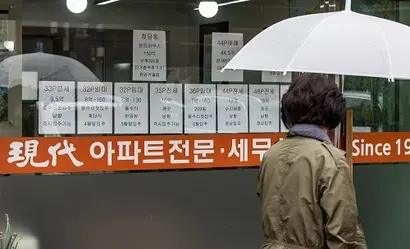
As of now, coordination with the central government is the most urgent issue, as there are not many reconstruction regulations that can be lifted solely by the authority of the Seoul Mayor. Lee Eun-hyung, a senior researcher at the Korea Institute for Construction Policy, advised, “Since it is expected that there will be some consultation with the government regarding the easing of the 35-story rule and the increase in floor area ratios, there is room for adjustment. However, we need to avoid automatically allowing high-rise buildings just because the 35-story rule is broken. The allowed limits should be adjusted after a detailed review of various conditions within a range that does not harm the urban landscape.”
Seo Jin-hyung, President of the Korea Real Estate Society (Professor at Kyung-in Women’s University), also observed, “While existing real estate is expected to stabilize due to the supply signal, I believe that the upward trend will be maintained for reconstruction and redevelopment due to expectations of deregulation. For the various deregulations, the consent and resolution of the Seoul City Council are important. It will be necessary to achieve deregulation through cooperation with the council.”