

[비즈한국] On March 25, the Republic of Korea Space Strategy Report was held at the Naro Space Center in Goheung, Jeollanam-do. President Moon Jae-in delivered a commemorative speech, and one specific remark caught interest.
“We will also conduct a feasibility study and establish an exploration plan for the Apophis asteroid, which will approach Earth in 2029.”
It drew attention because the head of state mentioned a very specific and specialized celestial body by name—'Apophis'—rather than making vague statements like "we will strive for space development" or "we, too, will go to the moon."
Originally, Apophis is the name of a terrifying evil god in Egyptian mythology who opposes 'Ra', the sun god. Legend says that day and night occur because the sun god Ra and the darkness god Apophis chase each other in a game of tag every day. This fits perfectly as a nickname for this celestial body: it is the name of one of the most threatening asteroids that might collide with Earth in the near future.
Surprisingly, however, South Korea is currently establishing a large-scale exploration plan to send a probe to the asteroid when it brushes past Earth in 2029. Going beyond mere blueprints, various preparations for the Apophis exploration project are actually underway among domestic researchers. Will Apophis really collide with Earth? And can South Korea send a probe to such a formidable object?
The research team is currently planning to send a probe toward the asteroid Apophis as it approaches Earth in 2029. Can Korea’s asteroid exploration be successful?
First off, Earth seems to be lucky
Asteroids whose orbits overlap with Earth's and could potentially collide with our planet are called Near-Earth Objects (NEOs). In particular, those that come within 0.05 AU—20 times the distance between the Earth and the Moon—and are brighter than magnitude 22 with a large diameter are classified as Potentially Hazardous Asteroids (PHAs). While small asteroid debris usually burns up in the atmosphere upon entry, an asteroid over roughly 100 meters in size with a magnitude brighter than 22 could pose a fatal threat to Earth. Over 2,000 such potential threats have been identified to date.
It is staggering to think that so many small celestial bodies are targeting Earth! Because we live our daily lives in relative peace, it is easy to forget the reality that threats to our planet exist in the vastness of space. However, Earth is exposed to far more danger than we think. We should consider ourselves lucky to be surviving while dodging these dangerous moments every single day.
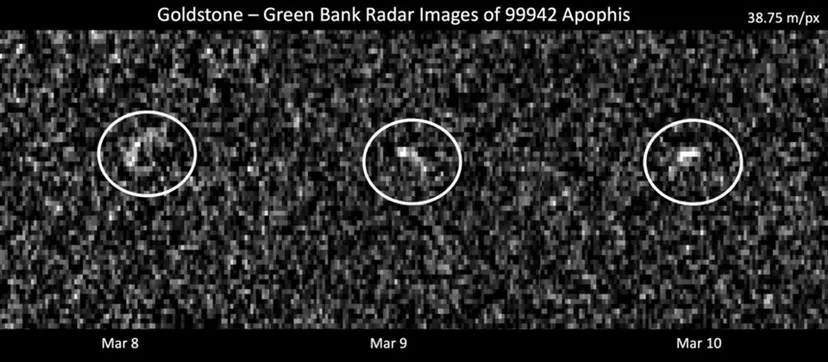
99942 Apophis is by far the most well-known representative of these objects. Discovered in 2004, Apophis is an asteroid about 300 meters in size—a rock significantly larger than the 63 Building. The danger level of potentially hazardous asteroids is measured on a scale of 1 to 10 based on two criteria: the probability of collision and the asteroid's kinetic energy. This system is known as the Torino Scale. Upon its discovery in 2004, it was estimated that there was a 2.7% chance Apophis would collide with Earth in 2029. It was the first asteroid to reach level 4 on the Torino Scale. Consequently, Apophis became known as a terrifying entity capable of bringing about a realistic disaster. It seems as if the god of darkness from Egyptian mythology was newly embodied in the form of a celestial body. If Apophis were to actually collide with Earth, it would certainly lead to a horrific outcome, if not a mass extinction event on the scale of the one that wiped out the dinosaurs. According to NASA's predictions, an impact would cause the entire Earth to shake with a destructive power over 100,000 times that of the Hiroshima atomic bomb.
Fortunately, however, subsequent observations have continuously updated the estimates of Apophis's future orbit. The collision risk for 2029, first announced following continuous radar observations in December 2004, was ruled out. But later predictions that it might collide with Earth in 2036 and 2068 kept people on edge. Thankfully, we can breathe a sigh of relief for now. According to the most recent analysis updated with vast amounts of data from continuous radar observations in March 2021, the probability of a direct collision between Earth and Apophis within the next 100 years—beyond 2068—is virtually zero, on the order of one in several hundred million.
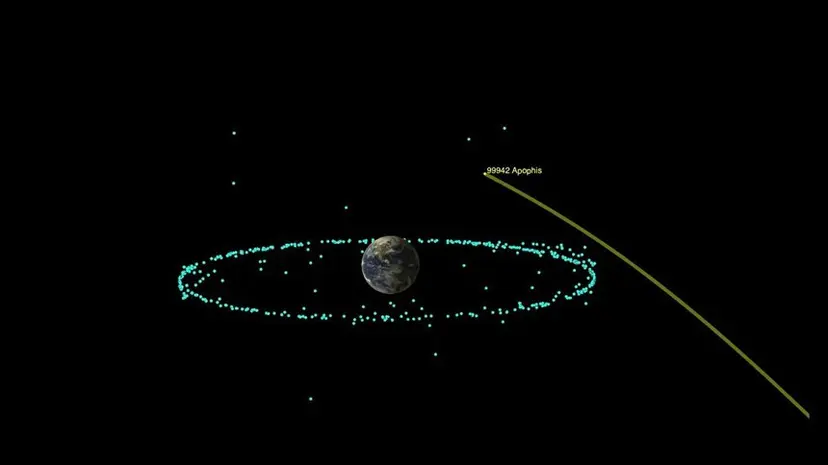
When the date predicted for the collision at the time of its discovery arrives—April 13, 2029—Apophis will approach Earth extremely closely. It will come within a staggering 32,000 km of Earth! That is even closer to Earth than the geostationary satellites orbiting our planet! An asteroid passing closer than the artificial satellites launched by humans! It will pass so close to Earth that it could easily be seen with binoculars. If weather permits, it will brighten to an apparent magnitude of 3, making it visible to the naked eye in parts of Asia. Fortunately, it will not collide with Earth, though there is a slim chance that some satellites' orbits could be slightly shifted due to the gravitational influence of Apophis. In any case, according to the latest monitoring results, Earth seems to be lucky for the next 100 years. Of course, there is no telling when this hopeful prediction might be overturned in the future.
Why do the predictions keep changing?
Then why do the predictions keep changing? Can we safely trust the predictions of the astronomers who guard our planet?
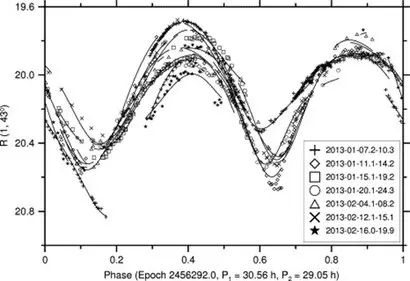
Many small asteroids, including Apophis, are not round spheres but have long, distorted, irregular shapes. You can think of them as giant potatoes or sweet potatoes floating in space. These asteroids rotate around irregular axes. As a result, the surface area reflecting sunlight changes periodically. When observing a rotating asteroid, one sees a pattern where its brightness repeatedly waxes and wanes, and from this period, the rotation period can be estimated.
Looking at the brightness changes of Apophis observed recently, its own rotation period is quite long, at about 260 hours. However, the precession period, where the rotation axis itself twists and the entire asteroid wobbles, is very short, at about 27 hours. Apophis is tumbling, spinning and wobbling at quite a high speed.
If an asteroid is spinning and wobbling like this, it becomes even harder to predict its future trajectory. While an asteroid orbits trapped by the Sun's gravity, it is also affected by sunlight. An asteroid that absorbs sunlight releases that absorbed energy in the form of radiation. As the asteroid releases this thermal energy, it gains a kind of thrust in the opposite direction. This effect is called the Yarkovsky effect. The day side of the asteroid facing the Sun and the night side facing away have different surface temperatures, and eventually, the amount of thermal energy radiated into space differs. This asymmetry can consistently influence the asteroid's trajectory.
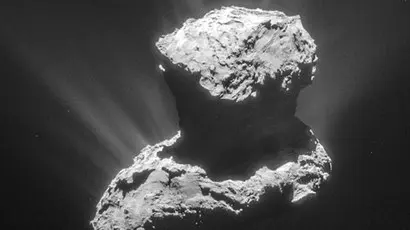
The Rosetta probe, which visited comet 67P in 2014, captured dynamic changes on the comet's surface as it underwent the Yarkovsky effect while exposed to sunlight. As the ice on the comet's surface melted due to sunlight, it frequently emitted strong jets. Changes in the surface terrain, such as the collapse of some cliffs and the shifting of rocks due to heat and radiative energy, were also captured! Who moved the rocks on an uninhabited comet? The culprit is likely thermal radiation from sunlight. By comparing the same areas on the surface of comet 67P photographed just 1–2 years apart, distinct topographical changes can be confirmed. Even for comets, maps need to be constantly updated.
The problem is that Apophis is not a neatly rounded celestial body but a highly distorted, complex-shaped rock. Furthermore, because Apophis is wobbling rapidly, the area of its surface receiving sunlight changes at every moment. Ultimately, it becomes extremely difficult to estimate the direction and magnitude of the Yarkovsky effect that Apophis experiences at any given moment.
Furthermore, even if it does not collide directly with Earth, passing closely by the planet can significantly affect the change in Apophis's orbit. Just like a "gravity assist" flyby where probes use Jupiter's gravity to change their trajectories, Apophis could gain or lose speed due to Earth's gravity. While passing close to Earth is a relief in the sense that it doesn't collide for the time being, it is also an extremely anxious moment because the asteroid's orbit changes significantly, making future tracking more difficult.
Interestingly, observing the shape of Apophis with the Arecibo radio telescope in 2013, it is thought to be not just a long, potato-shaped object, but a "double-lobe" structure with two chunks stuck together, like comet 67P. If it is indeed an asteroid made of two small chunks stuck together, predicting the future of Apophis becomes even more difficult. As it passes near Earth, the planet's strong gravity could cause large and small collapses and landslides on the surface of Apophis. At that time, as some terrain collapses, the shape of the asteroid could change drastically. This would then significantly change the surface area exposed to sunlight, making it even harder to predict the subsequent impact of the Yarkovsky effect.
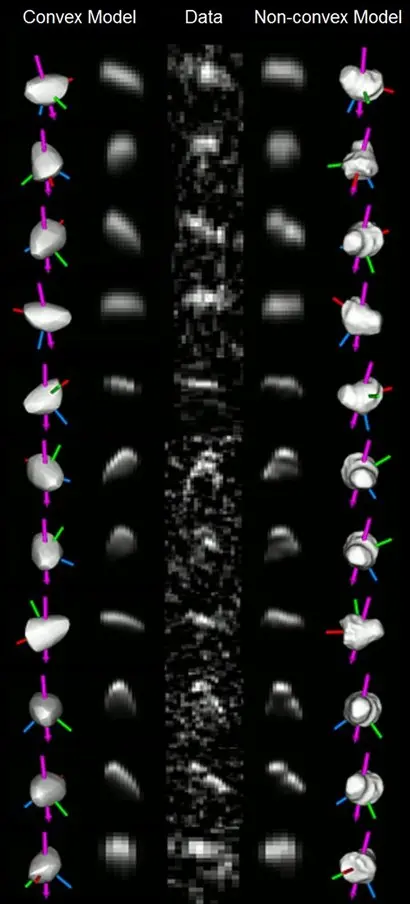
Moreover, if it is a double-lobe structure, it could be a major problem in the near future if Apophis is confirmed as a realistic threat and we need to defend Earth. If we attempt to change its orbit by dropping bombs directly on the asteroid or applying a strong impact, as in the movies 'Armageddon' or 'Deep Impact', the double-lobe asteroid could split into two pieces. Tracking the whereabouts of each split lobe would be even more difficult, and it could lead to unexpected and horrific results. The project intended to save Earth might actually lead our planet down a path of catastrophe.
It is precisely due to these complex factors that the predicted orbits of potentially hazardous near-Earth asteroids, including Apophis, are bound to change significantly whenever new, up-to-date observation results are incorporated. Therefore, to monitor the predicted trajectory of Apophis most reliably, it is necessary to perform continuous radar observations as it brushes past Earth in 2029, and if possible, to send a probe directly to accurately understand the composition and map the topography of Apophis. And South Korea is preparing an ambitious attempt at that bold exploration.
If we lack the technology to fly far, we will go to the object coming to Earth on its own!
We can use the fact that Apophis will pass very close to Earth in 2029 as a wonderful stage for space exploration. Recently, the Korea Aerospace Research Institute (KARI) and the Korea Astronomy and Space Science Institute (KASI) have begun to seriously consider a plan to send a probe to Apophis. As a latecomer to space development, it is regretful to admit, but South Korea does not yet have enough experience to send probes as precisely as the U.S. or Europe to comets beyond Jupiter or to the edge of the solar system beyond Pluto. While we have achieved remarkable progress in launching many launch vehicles and satellites into low-Earth orbit, it is an unrealistic goal to suddenly leap into deep-space exploration without intermediate steps.
In that sense, Apophis is a very grateful and interesting celestial body for a latecomer like South Korea. Because we don't have to fly far into deep space outside Earth's orbit; the celestial body comes flying to Earth's doorstep on its own! It even approaches closer to Earth than the Moon, reaching the level of a geostationary satellite! At this distance, it is a target that can be sufficiently aimed for with South Korea's current space technology.
Of course, safely sending a probe to an asteroid passing by Earth at very high speed is much trickier than simply placing a satellite in a target orbit. However, compared to unreasonable goals like suddenly sending a Korean probe to Mars or saying we will go to Pluto, it is a much more reasonable, feasible, and interesting plan.
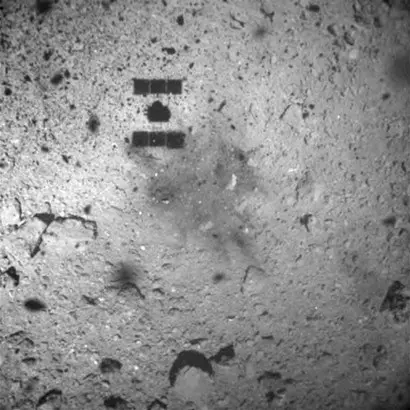
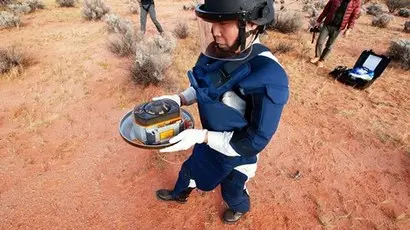
Asteroid exploration has already emerged as an important field in terms of solar system exploration and resource development. Japan's JAXA Hayabusa2 probe successfully collected asteroid samples by approaching the near-Earth asteroid Ryugu in 2018. Two years later, in September 2020, the capsule containing the samples safely returned to Earth and landed in the Australian desert. Recently, Japanese researchers announced research findings that they might be able to find clues to the true origin of Earth's water—which they failed to find in previous comet exploration—in those very Ryugu asteroid samples. In October 2020, NASA's OSIRIS-REx probe touched down on the surface of the asteroid Bennu. During the process, it collected samples ejected due to the impact with the probe, and the capsule containing those samples is scheduled to return to Earth in 2023.
Like this, a new chapter in asteroid exploration has recently begun. Asteroids, which hold substances from the early solar system intact, not only provide scientific clues about the formation and origin of the solar system but are also expected to be a treasure trove of various resources, as they contain rare minerals and metals that are scarce on Earth. Therefore, many companies are currently planning research at the level of moving asteroids into orbits near Earth to secure resources through continuous mining. That is how much asteroid exploration is in the spotlight as the new protagonist of 21st-century space exploration.
Moreover, it is not just any asteroid, but Apophis, which has been considered a terrifying entity that might destroy Earth in the near future for years! What an attractive target for exploration! To establish detailed plans for how Earth can survive most safely when Apophis is truly confirmed as a realistic threat in the near future—whether we should shoot missiles at the asteroid or send probes to use gravity to nudge its orbit—we must understand the exact characteristics of Apophis and draw its map. Ultimately, if South Korea's Apophis exploration succeeds as currently planned in 2029, it could become the most attractive project for the continued existence of all humanity in the face of the most realistic threats in the near future: a rehearsal for planetary defense.
What is really important…
Here, I would like to ask one important question. If the plan goes well and South Korea's Apophis probe takes off into space in 2029, it is highly likely that many domestic media outlets will only emphasize messages like, "Finally, we too are going into space." Of course, the fact that "we are finally going, too" into the realm of space development, which has been monopolized by other advanced countries, is sufficiently attractive. In particular, I agree that it is a good strategy to stimulate the sentiment called "gukppong" (national pride) among ordinary citizens to build a consensus on the justification for our country's space development and the input of huge budgets. But is that really enough?
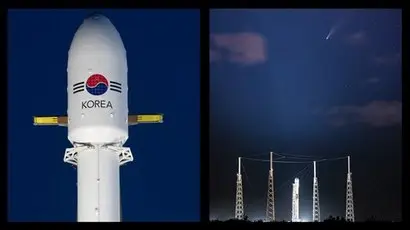
American social scientist Dorothy Nelkin pointed out in 'Selling Science' that it is not right to view science merely as a speed competition between nations, like Olympic sports. I also sympathize with that concern. Isn't treating and being enthusiastic about the process of scientific inquiry simply as regime competition or national pride an outdated, pre-modern mindset that we already experienced in the Apollo moon exploration competition era half a century ago?
The United States landed its astronauts on the lunar surface a total of six times, starting with Apollo 11 in 1969. In fact, at first glance, it is easy to think that lunar exploration was a purely scientific space mission studying space engineering and lunar geology, but that is not the case. Looking at the way the U.S. government and citizens treated the Apollo exploration at the time...