

[비즈한국] As reconstruction regulations tighten, attention is shifting toward the remodeling market. According to the Korea Remodeling Association, an estimated 62 complexes (45,527 households) in the Seoul metropolitan area are currently pursuing remodeling projects as of March. The Korea Remodeling Association stated, "This figure only counts complexes that have completed the establishment of a union, and the actual number is expected to be higher when considering those in the preparatory committee stage or early project stages."
Unlike reconstruction, remodeling allows for expanding the area or increasing the number of floors while maintaining the existing apartment framework. It can be pursued if 15 years have passed since completion and the building has received a safety rating of B or higher. Because the barrier to entry is lower than that of reconstruction, apartment complexes built in the 1990s are racing to pursue remodeling projects.
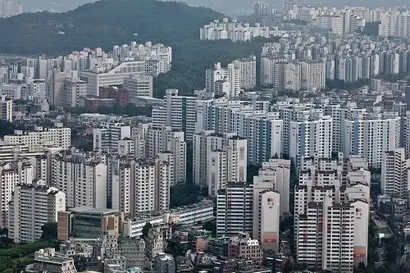
Remodeled Complexes See Prices More Than Double
Remodeling is attracting interest from residents not only because it creates a more pleasant living environment but also because it impacts rising property values. Many complexes built in the 1990s have excellent locations but were limited in price appreciation due to being older buildings; there is a growing expectation that remodeling can bridge this gap and boost their market value.
The Bangbae-dong Ssangyong Yega Classic in Seocho-gu, Seoul, the first remodeling project in Korea, was completed in 2007 by remodeling the Gungjeon Apartments built in 1978. The project involved interior renovations for 216 households across three buildings, flat expansion, and the installation of an underground parking lot.
The area per household increased by 23–36㎡ (approx. 7–11 pyeong), and at the time, the remodeling cost for union members was set at 100 million KRW for a 117㎡ (approx. 35 pyeong) unit. Before remodeling, listings for Bangbae-dong Ssangyong Yega Classic traded between 370 million and 590 million KRW, but after 18 months of construction, prices more than doubled to between 800 million and 1.4 billion KRW.
The Dogok-dong Ssangyong Yega Classic, completed in 2011 by remodeling the Dogok-dong Dongshin Apartments, is the largest remodeling complex in Korea. 384 households across five buildings underwent remodeling, and construction took 31 months. The supply area increased from 57㎡ (approx. 17 pyeong) to 83㎡ (approx. 25 pyeong), and from 93㎡ (approx. 28 pyeong) to 133㎡ (approx. 40 pyeong). Prices also jumped from the 300 million to 600 million KRW range before remodeling to the 600 million to 1 billion KRW range.
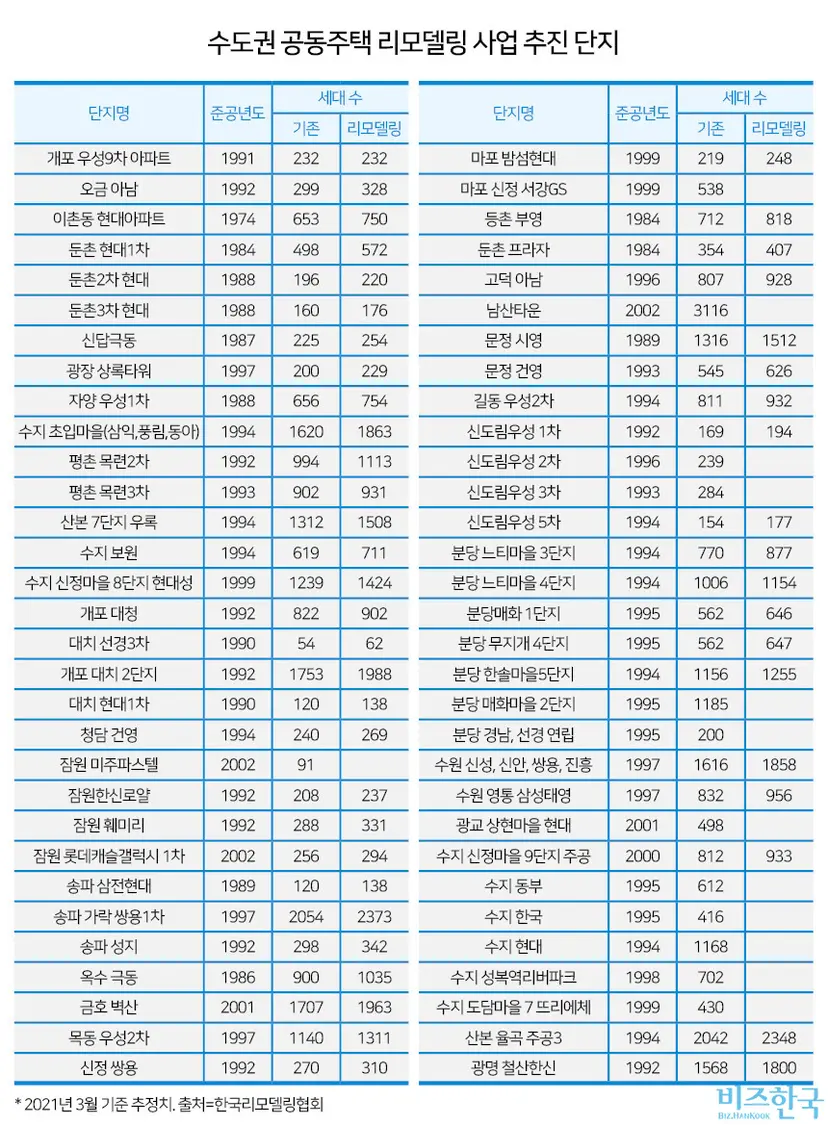
With some complexes seeing prices skyrocket after the completion of remodeling, there is an atmosphere where just the mention of "remodeling" drives up house prices. Bundang Jeongja-dong Hansol Village Complex 5, which is drawing attention as the first remodeling project in a first-generation new town, saw prices rise from the 800 million KRW range for a 74㎡ (approx. 22 pyeong) unit last year to the 1.2 billion KRW range after remodeling was approved this past February.
However, the remodeling cost contributions are not small. While the contribution for a 60㎡ (approx. 18 pyeong) unit expanding by 9.9㎡ (approx. 3 pyeong) is 50 million KRW, it is set at 230 million KRW for a 61㎡ (approx. 19 pyeong) unit expanding by 26㎡ (approx. 8 pyeong).
A representative of a real estate agency in Bundang explained, "Prices rose after the remodeling project was approved. Usually, prices increase at each stage—union establishment, project approval, and relocation—with a significant jump during the move-in stage."
They continued, "Currently, units that will expand to 118㎡ (approx. 36 pyeong) after remodeling are trading in the mid-1.5 billion KRW range, including the cost contribution. Considering that other older buildings in the same area near the subway station of the same size trade in the 1.7 billion KRW range, I believe there is room for further price appreciation after remodeling," adding, "There are quite a lot of people inquiring for investment purposes."
Prices Rising Due to 'Remodeling Hype' Even Without Guaranteed Project Approval
Apartment prices around Suji-gu, Yongin, which are pursuing large-scale remodeling projects, are also fluctuating. Over 10 complexes in Suji-gu are showing interest in remodeling projects. Among them, 8 complexes have received approval for the establishment of a remodeling union. Pungdeokcheon-dong Choip Village Donga·Samik·Punglim Apartments is the complex with the fastest-moving remodeling project in Suji-gu. It passed the safety inspection with a C grade at the end of last year.
Since then, Choip Village Apartments have been hitting new record highs daily. An 80㎡ (approx. 24 pyeong) unit that was trading at the 400 million KRW range as late as last autumn has jumped to the mid-to-high 500 million KRW range this year. According to nearby real estate agencies, they are currently trading at the 650 million to 670 million KRW range.
A, who operates a real estate agency in Suji-gu, stated, "Because of the remodeling hype, prices keep rising. Since talks of remodeling began in 2019, apartment prices in Suji-gu have risen steadily," adding, "That is the atmosphere in Suji-gu. Since many complexes are pursuing remodeling, price ranges have risen overall."
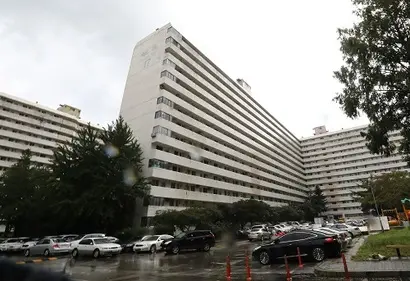
However, it is expected to take a considerable amount of time for project approval even after passing the safety inspection. In the case of Hansol Village in Jeongja-dong, Bundang, it took five years from passing the safety inspection in 2015 to receiving approval. A real estate agent in Suji-gu also said, "There is no guarantee when project approval will be granted. I understand it usually takes several years."
Although many complexes choose remodeling because the process is easier than reconstruction, some suggest that caution is required. Lee Eun-hyung, a researcher at the Korea Institute of Construction Policy, said, "Remodeling has the advantage of relatively easier government permits and a shorter construction period than reconstruction, but it also has the disadvantage of high construction costs. In some cases, it can be as high as 70-80% of the cost of reconstruction."
She added, "Even if the floor area ratio is increased through horizontal or vertical expansion, the unit layouts are not as good as those of new apartments. It also cannot be said that the building's lifespan is longer compared to reconstruction," and pointed out, "Remodeling should only be applied in limited cases, such as when reconstruction is not feasible or when it is done at a low cost."