

[비즈한국] It is projected that it will take another 135.6 years to close the global gender gap. This figure is 36 years longer than last year's projection (99.5 years). South Korea ranked 102nd in the gender gap index, moving up 6 spots from last year but still remaining in the lower rankings. It was pointed out that COVID-19 has further widened the gender gap, and that policymakers around the world must work together to address this issue.
CNN and other outlets reported on the 30th (local time) that the World Economic Forum (WEF) announced these findings after examining the gender gap in 156 countries in its "Global Gender Gap Report." Since 2006, the WEF has annually published the Gender Gap Index (GGI), which utilizes four indicators: economic participation and opportunity, educational attainment, health and survival, and political empowerment.
According to the report, it is projected to take 145.5 years to close the political gender gap. In the 156 countries surveyed, the ratio of female lawmakers was only 26.1%, and only 22.6% of ministerial positions were held by women. There was also a projection that the economic gender gap would take as long as 228 years to be eliminated. The overall income gap between women and men remains, and the proportion of female executives in companies worldwide stands at only 27%. In the sectors of education and health, the gender gap is generally narrowing worldwide.
COVID-19 has contributed to widening the economic gap between women and men. The WEF stated, "According to statistics from the International Labour Organization, female workers (5%) were more likely to lose their jobs than male workers (3.9%). Women were often employed in sectors hit hardest by COVID-19, and as re-employment was delayed, their contributions in areas such as housework and childcare remained higher than those of men."
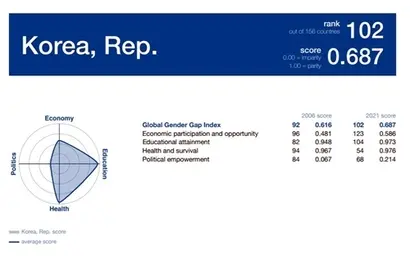
South Korea’s gender gap index was 0.687, placing it at 102nd. The closer the value is to 1, the more equal the country is. The economic participation and opportunity category was relatively worse at 123rd (0.586). This was due to the sub-items for this category, where the ratio of female senior executives and managers ranked 134th (0.185), the estimated earned income level ranked 119th (0.492), and wage equality ranked 116th (0.574). In the indicators for education, health and survival, and political empowerment, the country ranked 104th (0.973), 54th (0.976), and 68th (0.214), respectively.
Meanwhile, in this survey, the country with the smallest gender gap was Iceland. Iceland's gender gap index was 0.892, and Nordic countries such as Finland (0.861), Norway (0.849), New Zealand (0.840), and Sweden (0.823) took the top spots. China ranked 107th (0.682) and Japan ranked 120th (0.656), placing them 5 and 18 spots lower than South Korea, respectively.
In this report, the WEF stated, "The impact of the pandemic on women is likely to be underestimated," adding, "Public-private partnerships are key. Governments and companies must ensure unbiased hiring and promotion policies and ensure that retraining for the middle-skilled workforce can be provided equally."