

[비즈한국] Lunar New Year, one of the two major holidays, is approaching. During this time, my ‘guilty pleasure’ is to snoop around women-centric online communities. If you look at these forums ahead of the holiday, it’s practically a war zone. It’s mostly filled with complaints from daughters-in-law (though you can also find perspectives from mothers-in-law, sisters-in-law, and wives of brothers-in-law), and if you read them, there are stories just as dramatic as any TV show. Since the ‘ban on gatherings of 5 or more’ was extended through the Lunar New Year, I thought things might be quiet this time, but that was a miscalculation. From those in despair saying, “The ‘Si-world’ (in-law family) isn’t even in Korea... yet they insist we come,” to those firmly resolving, “They keep telling me to come down, so I’m going to go and then report them,” the intensity of the battlefield has, if anything, become fiercer.
Given the reality, it’s no surprise the content market is getting involved. On OTT platforms, you can find works that capture this mood: Kakao035720 TV’s web drama ‘The Daughter-in-Law’, which concludes its 12-episode run on February 6; KT030200’s OTT platform Seezn’s original movie ‘Big Mama’s Crazy Bongo’; and the documentary ‘B-Class Daughter-in-Law’, available on Watcha. ‘B-Class Daughter-in-Law’ is an independent documentary that drew 20,000 viewers after its release ahead of the 2018 Lunar New Year following its debut at the 2017 Jeonju International Film Festival. ‘The Daughter-in-Law’, which began as an Instagram cartoon by author Soo Shin-ji and was adapted into a web drama, enjoyed immense popularity on Kakao TV, surpassing 10 million views in just seven episodes. ‘Big Mama’s Crazy Bongo’, released in theaters on January 21 and on the Seezn app on the 28th, is based on a story that went viral on social media a few years ago, making it a familiar topic for those in the know.
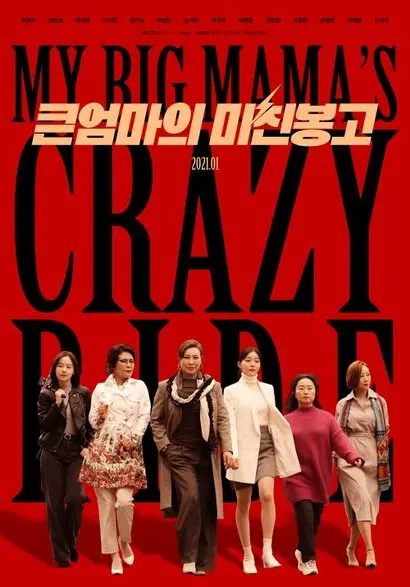
To start with the most recent, ‘Big Mama’s Crazy Bongo’, I had high expectations because I had seen the post circulating on social media years ago. It was a very short sentence: “Big Mama put us female relatives—my mom, my aunt, my cousins, and my younger siblings—into a van saying we were going to the local market, and now we’re speeding down the highway lol. We’re going to Gangneung lol.” Even though it was short, it instantly painted the entire narrative in my mind. It was a holiday, and it’s obvious that when Big Mama resolutely grabbed the car keys, there must have been an infuriating scene caused by the male relatives on the opposite side. The sense of liberation felt by the women in the van is well-captured by those “lol”s, and for a moment, it reminded me of the movie ‘Thelma & Louise’ or ‘Bandits,’ a story about female prisoners escaping.
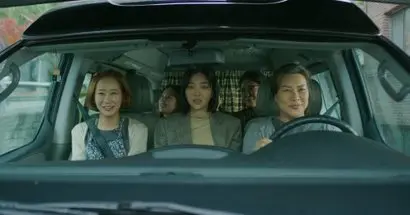
It’s no surprise that the movie was produced with inspiration from that post. The title ‘Big Mama’s Crazy Bongo’ is also intriguing. However, it is quite unfortunate that the film’s execution falls short of the creativity of the original post and the fine performances of the actors. While it is somewhat satisfying to see Big Mama (Jung Young-joo), who has sacrificed for decades, decide to divorce her stubborn, patriarchal husband and run away during the holiday, the subsequent plot lacks probability and zest. Still, Jung Young-joo’s spirited performance, typical of her musical background, is worth admiring, so if you aren’t a Seezn user, catching it when it airs on SBS during the holiday is a good option.
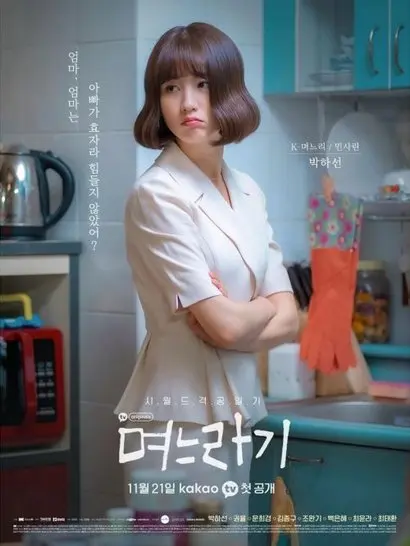
‘The Daughter-in-Law’ airs on Kakao TV using a ‘delayed-pay’ model, but Wavve subscribers can also watch it. It reached 10th place on the Wavve drama chart in the fourth week of January. Ever since author Soo Shin-ji started serializing the webtoon on Instagram, it has received overwhelming support from women in their 20s and 30s. The scenes capturing the reality of married life, particularly the ‘Si-world’, in a surreal way are impressive. It’s not a soap opera, and even in a seemingly very ordinary, and sometimes warm-looking in-law family, the daughter-in-law Min Sa-rin (Park Ha-sun) finds her existence erased moment by moment. These are moments like eating leftover rice with the mother-in-law while saying “Let’s have this,” eating the remaining fruit “just among ourselves,” and hesitating to leave for her own parents’ home to prepare food for the visiting sister-in-law and her husband. Through Min Sa-rin, who enters the Moo family, we feel the terrifying nature of quiet, ‘dust-like discrimination’ that is so subtle you can’t even point it out as discrimination. There is already talk that it should be aired on major TV networks during the Lunar New Year so that the parent generation is required to watch it.
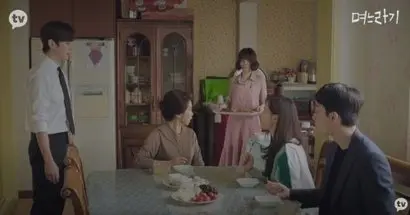
‘The Daughter-in-Law’, which fills 12 episodes with short-form content of about 20 minutes each, has gained great empathy by depicting the daily discrimination a daughter-in-law faces right after marriage with high density. Throughout the drama, Min Sa-rin appears frustrating, but we cannot scold her for not saying she dislikes it because her image is essentially our own. Instead, our blocked frustrations are released by her sister-in-law, Jung Hye-rin (Baek Eun-hye). Upon observing the in-law family during her first holiday visit, Hye-rin says:
“So, to summarize: Gu-il is tired so he goes in to sleep, Father and Uncle are drinking, Gu-young and Mi-young went out on a date, and Mother is preparing the memorial service food all by herself... Everyone is being too much. And you assume that since I’m the daughter-in-law, I should naturally be preparing the food with Mother, right?”
After that outburst, Hye-rin doesn’t visit her in-laws during the holidays. The problem is that not everyone can pull off such a refreshing act. Of course, there are always ‘extraordinary people’ and pioneers in every place. Kim Jin-young from ‘B-Class Daughter-in-Law’, available on Watcha, is one such person. Unable to endure the constant conflict with her mother-in-law, she declares she won’t participate in the holiday. What does it mean that many women feel a sense of catharsis seeing her smile and say, “I didn’t go to my in-laws during the holiday. So I had a perfect holiday”? However, Kim Jin-young’s husband and the director of this documentary, Sun Ho-bin, says in the narration, ‘I married a strange woman.’ It is a narration that cannot help but bring to mind the husband in ‘The Daughter-in-Law’, Moo Gu-young (Kwon Yool), who once said, “Sister-in-law (Jung Hye-rin) is a person who lives her own life.”
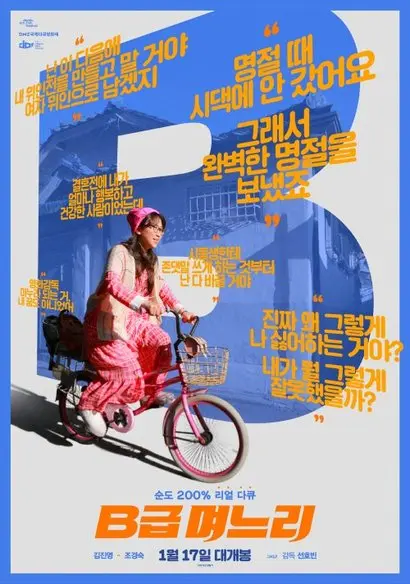
Watching this 80-minute documentary, the cause of the problem is actually clear. “It seems like it’s just between me and my mother-in-law... but in reality, there are four adults in that house who can all use their hands and feet to eat, and it’s ridiculous that only my mother-in-law and I are fighting over who did what. It’s a funny situation.” Notice how this statement by Kim Jin-young aligns with the lines of Jung Hye-rin in ‘The Daughter-in-Law’.
Seeing posts like “Are you all going down for the Lunar New Year?” appearing with cautious tones in every community makes one feel stifled, but let’s take heart as the continued emergence of such works is a sign of change. Although it’s hard to say, let’s practice saying, “I can’t come down this Lunar New Year because of the ban on gatherings of 5 or more.” It would be even better to naturally let your parents watch the works mentioned above somehow.
Jung Soo-jin, Pop Culture Columnist
I have worked across several magazines, covering and writing about movies, travel, and pop culture. I don’t want to fall behind trends, but I’ve become an “old-fashioned person” who watches the latest dramas only to predict the obvious cliches in the next scene. I am currently adrift in the vast OTT universe, trying to regain my lost touch, and my current wish is for a unified OTT subscription plan.