

[비즈한국] This year, Constitution Day has returned as a public holiday after 18 years. As we take a day off amidst the excitement of a day off, one might wonder how the Constitution relates to our everyday economic lives.
Citizens' economic activities are inseparable from the Constitution. This is because the Constitution, the highest law of the land, does not merely regulate the structure of national governance. The series of economic activities in which individuals and companies trade in the market, accumulate wealth, and receive compensation for their labor also function within the constitutional order. The rights of the economy and their limitations are also supported by the Constitution.
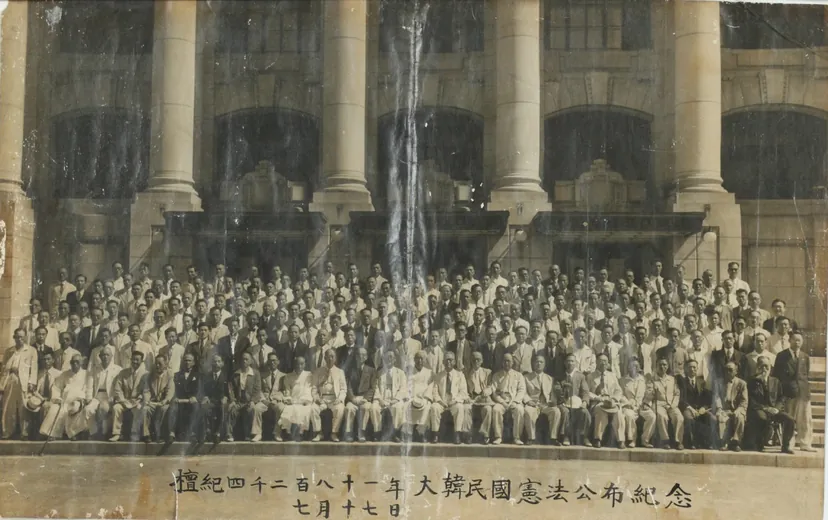
So, what kind of economic clauses were contained in the original Constitution enacted on July 17, 1948, which we commemorate every Constitution Day? Looking back at the Constitution of that time, a large number of clauses appear that are highly unconventional and progressive even by the standards of modern society. This is because the nation's founding political climate was strongly influenced by the welfare state ideology and socialist trends that were raging globally in the immediate aftermath of liberation.
Restrictions on Property Rights for Social Justice
In 1948, the members of the Constituent Assembly of the Republic of Korea were wary of the side effects that unrestricted pursuit of private property could bring. To overcome economic monopoly and poverty, state intervention and regulatory authority were deeply embedded in the constitutional blueprint they created. This ideology is clearly revealed from the very basic principles.
Article 15 The right of property shall be guaranteed. Its content and limitations shall be determined by law. The exercise of property rights shall conform to public welfare. Expropriation, use, or restriction of citizens' property rights for public necessity shall be performed by paying just compensation in accordance with the law.
Article 84 The economic order of the Republic of Korea is based on the realization of social justice and the balanced development of the national economy to enable all citizens to satisfy their basic living needs. The economic freedom of each individual is guaranteed within these limits.
Article 84, which mentions basic principles and social restrictions on property rights, is particularly noteworthy. This clause did not place individual economic freedom as the top priority. Instead, it first declared the limit of "realizing social justice that enables all citizens to satisfy their basic living needs," and then stipulated that "the economic freedom of each individual is guaranteed only within these limits."
In other words, it made it clear that individual private property or economic freedom can be constitutionally restricted if it is necessary to protect the minimum right to survival and an equal life for the entire community.
The Cornerstone of Land Reform: Article 86 and Land Distribution
At the time, the absolute majority of the Republic of Korea's population were farmers, but they were suffering from extreme poverty while unable to own their own land due to the landlord-tenant relationship. The Constituent Assembly judged that the survival of the state would be impossible without resolving this issue. Thus, Article 86, which became the constitutional basis for land reform, was born.
Article 86 Farmland shall be distributed to farmers, and the method of distribution, limits of ownership, and the content and limitations of ownership rights shall be determined by law.
This clause served as a historic milestone in completely abolishing the chronic tenancy system (landlord-tenant relationship) and establishing the principle of "land to the tiller" (those who cultivate should own the land) as the nation's highest norm.
Following this constitutional provision, the "Land Reform Act," a specific implementation law, was enacted in 1949. Farmland that had historically been concentrated in the hands of a few large landlords for a long time began to be distributed to actual cultivators through a "compensated purchase, compensated distribution" method. Instead of the large landlord class fading into the pages of history, tenant farmers were reborn as self-employed farmers who owned their own land.
The Unconventional 'Right to Equitable Profit Sharing' that Dreamed of Coexistence Between Labor and Capital
If one were to pick the most radical and surprising clause in the Constitution from today's perspective, it would undoubtedly be Article 18, Paragraph 2, which specified workers' "right to equitable profit sharing."
Article 18 ② In private enterprises aiming for profit, workers have the right to share in profits as determined by law.
This is a progressive clause that prevented shareholders or management from monopolizing the profits earned by companies and specified that workers, the protagonists of production, also have the right to share profits fairly according to the law. It is a passage that reflects the agony of the constituent assembly members at the time, who sought to avoid extreme confrontation between capital and labor and build a win-win welfare state.
However, in reality, it remained merely a declarative clause. The specific sub-laws to actually implement and enforce it were never enacted due to opposition from capitalists, social chaos in the early days of the nation's founding, and the ensuing fires of war. Eventually, this clause fell into disuse and was completely deleted during the 5th Constitutional Amendment in 1962, pushed aside by a policy favoring the autonomy and growth of private enterprises during the post-war economic reconstruction process.
Nationalization and State Control of Key Core Industries
The Constituent Assembly believed that the nation's fate-defining infrastructure could not be entrusted solely to individual capitalists. Therefore, the Constitution took a path of strictly keeping major resources and core industries under state ownership and control.
Article 85 Minerals and other important subterranean resources, marine resources, water power, and natural powers capable of economic utilization shall be state-owned. The patenting of their development or use for a certain period due to public necessity, or the cancellation of such patents, shall be performed in accordance with the law.
Article 87 Important enterprises of a public nature, such as transport, communications, finance, insurance, electricity, irrigation, water supply, gas, and others, shall be state-owned or publicly managed. The patenting of private operation due to public necessity, or the cancellation of such patents, shall be performed in accordance with the law. Foreign trade shall be under the control of the state.
Article 88 The transfer of private enterprises to state or public ownership, or the control and management of their operations, due to urgent necessity for national defense or the people's livelihood, shall be performed in accordance with the law.
These three clauses were the legal weapons of the controlled economy policy carried out by the state at the time. Not only natural resources but almost all public infrastructure and enterprises, such as transportation, communications, banks, insurance, electricity, and gas, were managed under the principle of state or public ownership, and foreign trade was also placed under the state's monopolistic control. A powerful clause (Article 88) was also provided, allowing the state to nationalize or control private enterprises at any time if deemed necessary.
This comprehensive nationalization policy contributed to the state taking the lead in building the minimum economic skeleton at a time when private capital had dried up immediately after liberation. In particular, the initial prototype of today's large Korean corporate conglomerates (chaebols) was formed during the process of disposing of vested properties, where former Japanese-owned enterprises and lands were taken over from the U.S. Military Government, nationalized, and then sold to the private sector.
With Constitution Day once again designated as a public holiday, opportunities to reflect on the value of the Constitution have increased. The context of the market economy, guarantee of private property, and the welfare state that we enjoy today is rooted in the economic agony and historical experiments of our predecessors, who fiercely sought alternatives to guarantee an "equal life for all citizens" amidst the poverty and great chaos of the early founding period.