

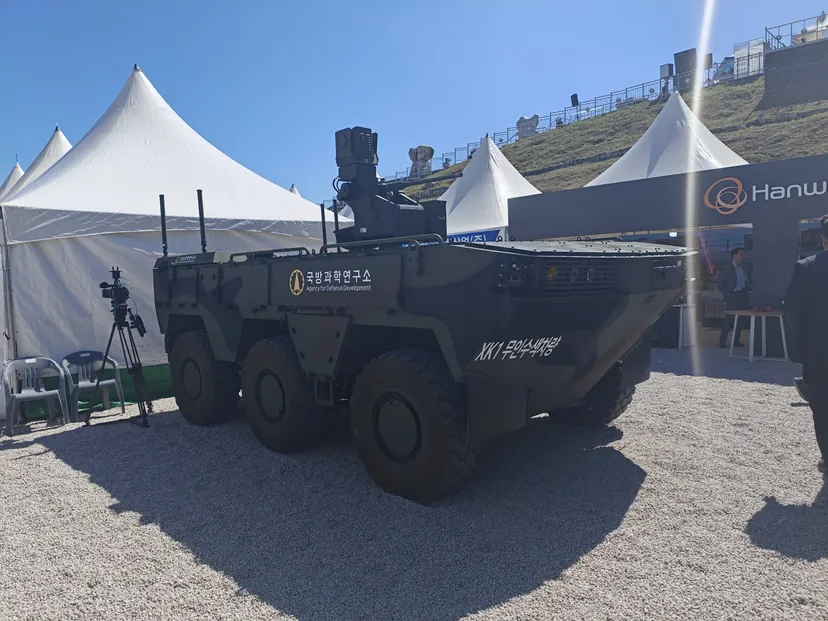
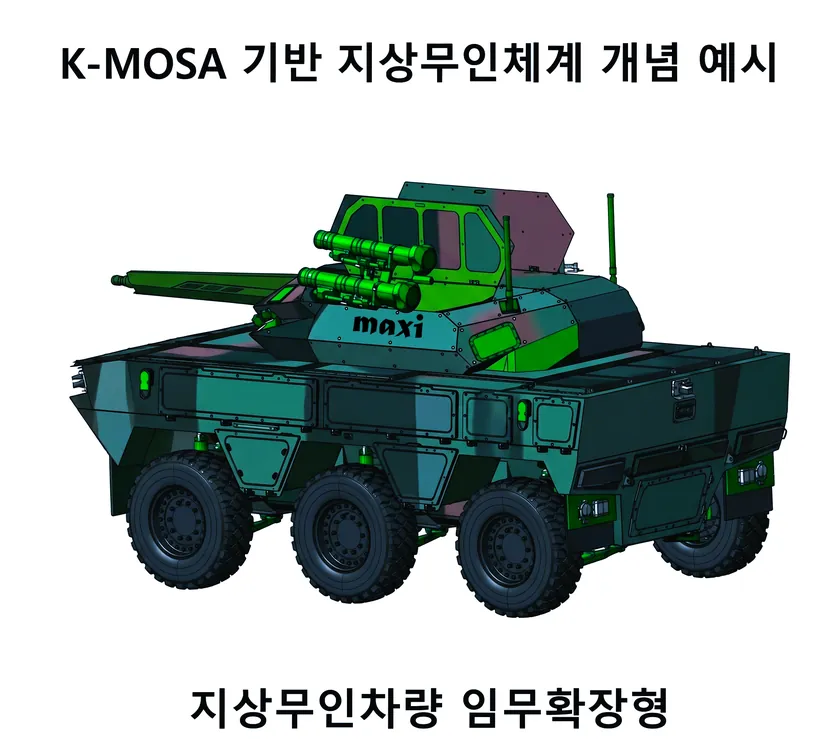
[BizHanKook] On November 5, at the ‘2026 K-MOSA Development Performance Sharing Session’ co-hosted by the Ministry of National Defense and the Agency for Defense Development (ADD) at the War Memorial of Korea, the ‘Ground Unmanned Vehicle Mission Extension Type,’ which features the first application of K-MOSA, was unveiled. This marks the first implementation of the ‘K-MOSA’ (Korea Modular Open Systems Approach) concept, which integrates a modular turret onto the XK1 unmanned reconnaissance vehicle—currently under development by ADD—allowing mission modules to be freely swapped based on operational needs. This not only accelerates the advancement of our military’s unmanned weapon systems but also opens opportunities for various companies to develop mission equipment for unmanned weapons, transforming these systems into a new export item for the K-Defense industry.
K-MOSA stands for Korea Modular Open Systems Approach. It is a technical design and business strategy that designs weapon systems using standardized modules and open interfaces, allowing new technologies and components to be swapped in without having to overhaul the entire platform. In simple terms, it is similar to swapping only the graphics card in a desktop computer. You can boost performance without redesigning the motherboard or power supply unit.
The reason the Ministry of National Defense is focusing on this policy is clear. The U.S. mandated the application of MOSA for major defense acquisition projects through a 2021 federal law amendment. Our military also formalized the promotion of K-MOSA at the Defense Science and Technology Coordination Council in December 2023. In April 2024, it amended the Defense Force Development Task Directive to mandate the review of serialization and modularization in the requirement determination and acquisition process for unmanned systems. Weapon systems have long lifespans, while technologies have short ones. The only way to avoid the recurring problem of systems becoming obsolete the moment development ends is to manage platforms and mission equipment separately.
The problem is that this structure directly conflicts with the South Korean military’s acquisition practices to date. Until now, our military has developed mission equipment from scratch for every platform. Unmanned reconnaissance vehicles, unmanned surface vessels, and small drones each used different specifications for multifunction displays, network switches, and middleware. A 2025 survey by the Defense Industry Promotion Research Institute found that 19 key mission equipment items were redundantly developed across different platforms in this manner.
The inefficiency doesn’t end with development costs. Even if you change a single line of software during the performance improvement phase, the entire system must be re-verified, making the time required for upgrades as long as new development. No matter how advanced sensors or AI algorithms civilian companies create, they face high entry barriers because they must develop new interfaces that meet military standards. This structure is fatal in the field of unmanned systems, where the technology lifecycle is rapidly shortening; by the time development is complete, the intended technology is already one generation behind.
Based on this critical awareness, Han Sang-woo, a team leader at ADD's 4th Research Center, disclosed the current research status for the full-scale application of K-MOSA in his presentation on the ‘Development of Open Common Architecture for Medium Unmanned Combat Vehicles.’ It is not merely a concept of attaching parts like blocks; rather, it involves building an ‘in-vehicle network’ that ensures both the smooth operation and security of each module, with a gateway serving to integrate the numerous pieces of equipment mounted on the unmanned weapon. This allows a single platform to be deployed for various missions simply by changing the mission equipment while maintaining the vehicle’s driving system, electronic system, and control system, thereby greatly increasing multi-purpose utility.
The first application of this capability is the Ground Unmanned Vehicle Mission Extension Type. This vehicle is an upgraded performance version of the XK1 unmanned reconnaissance vehicle developed by ADD. The XK1 is designed to stand at the vanguard of armored reconnaissance and mechanized units, entering high-risk areas before manned vehicles. It is equipped with a K6 12.7mm remote-controlled machine gun to attack enemy armored vehicles or troops, or it can be fitted with mine detection equipment at the front to clear danger zones. The newly revealed Mission Extension Type mounts a new multi-purpose, multi-mission capable turret onto this, and this is where K-MOSA is applied.
The turret, the core mission equipment of the Ground Unmanned Vehicle Mission Extension Type, is equipped with gear that can perform various tasks. First, it features a medium-caliber autocannon, providing the capability to destroy enemy infantry fighting vehicles or the electronic equipment of tanks. It also carries two Raybolt anti-tank missiles, enabling it to engage tank targets.
Furthermore, two additional pieces of equipment are included: direct-impact interception drones (hard-kill drones) and drone detection radar. When the drone detection radar mounted at the four corners of the turret detects an enemy loitering munition, the cover on the right side of the turret opens, and an interception drone is launched. Along with these, various other equipment is expected to be applied to the Ground Unmanned Vehicle Mission Extension Type, allowing it to be deployed for diverse missions by changing equipment like a transforming robot in a cartoon.
However, it is also true that there is still a long way to go for our defense science and technology to complete the K-MOSA concept. Currently, structural design and infrastructure development for power infrastructure, data infrastructure, data models, and AI/autonomous reference are underway for the development of the Ground Unmanned Vehicle Mission Extension Type. Additionally, common data links and cyber security reference architectures capable of operating all equipment are being developed—a field where we have yet to see success. In particular, the fact that various components are mounted and operated creates potential loopholes in terms of cyber security, making this an area that requires careful research and development.