

[BizHanKook] As rising real estate prices spread across the board, the government is accelerating its efforts to expand housing supply. President Lee Jae-myung pointed to the hardships of the public as the cause of protests occurring in places like France, and ordered an increase in the speed of housing construction starts. However, contrary to the government's declaration of a "supply-at-all-costs" policy, the sluggishness of the construction sector is showing little sign of improvement. This is because the prices of construction materials have skyrocketed due to the wars in Ukraine and the Middle East.
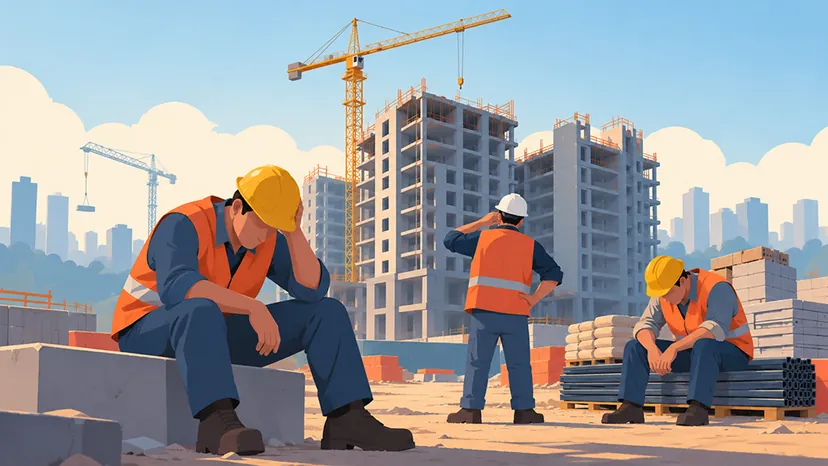
Although the Korean economy saw surprise growth in the third quarter of this year, the construction industry recorded negative growth compared to the same period last year due to factors such as sluggish housing starts. Since the construction industry influences the entire economy—not just in terms of production but also employment—the slump in the construction market is also having a negative impact on the labor market. It is pointed out that the government should strengthen financial support for the construction industry not only for housing supply but also for job security.
Presiding over a cabinet meeting on the 27th, President Lee said, "While the circumstances differ slightly from country to country, many experts point to the public's suffering caused by high fuel costs and inflation, a stagnant economy, and accumulated inequality as the background for the difficulties Europe is experiencing." Ordering an expansion of high-tech industry investment and domestic demand cultivation policies to recover public livelihoods, President Lee emphasized, "We must speed up public projects with sluggish execution, and housing start performance must also be maximized." He added, "Housing supply has meaning in itself, and it also plays a role in revitalizing the sluggish construction market." Reflecting this, two days later on the 29th, the Ministry of Land, Infrastructure and Transport announced a plan to supply 76,700 households across six locations in Gyeonggi Province, including Gimpo, Guri, and Hanam. The government plans to develop residential land in these areas and begin construction by 2030.
The reason President Lee emphasized housing start performance is that residential construction helps not only with supply itself but also with the revitalization of the real economy felt by ordinary citizens. Even if there are signs of recovery in construction orders, the situation where it does not lead to actual construction starts persists, negatively affecting the economy as a whole. The slowdown in starts is due to the rapid rise in construction costs following Russia's invasion of Ukraine in 2022. Construction costs jumped further as the Middle East conflict intensified. The construction cost index reached 138.7 (2020=100) in August 2026, with building construction and maintenance reaching 136.7, and civil engineering reaching 144.0.
This significant rise in construction costs is acting as a downward pressure on the construction industry. In addition, the burden of financing due to high interest rates has also held the industry back. In fact, despite the government's "supply-at-all-costs" atmosphere, construction investment in the first half of 2026 fell by 1.5% compared to the same period last year. Construction investment had previously fallen by 9.7% last year, marking the largest decline since 1998 (-13.2%) during the foreign exchange crisis, and this downward trend has not yet subsided.
The construction slowdown is having a negative impact on the economy. According to the "Advance Estimate of Real Gross Domestic Product (GDP) for the 3rd Quarter of 2026" released by the Bank of Korea on the 27th, our economy grew by 3.4% in the third quarter of this year compared to the same period last year, but the construction industry recorded a negative growth of 1.4%. However, compared to the previous quarter, construction production increased by 2.0% and construction investment by 0.7%, showing some signs of a rebound. Construction investment also contributed 0.1 percentage points to quarter-on-quarter GDP growth. While there has been an improvement compared to the previous quarter, the overall slump in the construction market has not been fully resolved. The problem is that the sluggishness in the construction sector, which has continued since the third quarter of 2024, is still persisting two years later.
The slowdown in the construction industry is hurting jobs, particularly for vulnerable groups such as temporary and daily workers. According to the National Data Agency, the number of temporary and daily workers in the third quarter of this year was 5.727 million, a decrease of 95,000 from the same period last year. This is the lowest figure for a third quarter since 1995 (5.451 million). The number of temporary and daily workers has been falling consistently since it dipped below the 6 million mark, going from 6.111 million in 2021 to 5.932 million in 2022.
In particular, the number of daily workers in the third quarter of this year was 833,000, a decrease of 38,000 from the same period last year, marking an all-time low for a third quarter. This decrease in daily workers was largely influenced by the 28,000 reduction in daily workers within the construction industry.