

[비즈한국] Dark matter. For astronomers, it is a truly fascinating concept, yet simultaneously a source of great frustration. While dark matter is necessary to explain the observed state of the universe, no clear evidence of its actual existence has ever been captured.
When discussing the lingering mysteries of dark matter, we sometimes jokingly say that it’s no longer the astronomers’ fault, but the physicists’. Astronomers have spent decades observing the movements of stars and galaxies to infer the existence of dark matter and have even narrowed down its characteristics to some extent. However, by their nature, astronomers are merely people who look at the sky.
Now, the responsibility to actually capture this phantom—the role of the Ghostbusters—must be left to the physicists. Recently, however, physicists announced that they have finally detected something suspicious. They claim that after a long wait, they might have finally captured a dark matter particle. Has this long hunt finally borne fruit?

We first need to organize the candidates for dark matter. Since we don't know what it is at all, there are quite a few imaginary candidates.
First, there is the WIMP (Weakly Interacting Massive Particle). WIMP does not refer to one specific particle. It is a hypothetical candidate that interacts very rarely, based on the weak force. WIMPs are relatively heavy and can occasionally interact with ordinary matter. Notable examples include hypothetical particles mentioned in supersymmetry theory, such as neutralinos and higgsinos. A neutralino is a particle created by the entanglement of symmetric particles of neutral bosons in the Standard Model. The higgsino is the supersymmetric partner of the Higgs boson and is characterized as a fermion with a spin of 1/2 rather than 0. The ghost candidate being pursued by the LZ (LUX-ZEPLIN) experiment, which has recently become a topic of discussion, is precisely these heavy WIMPs.
There is also a much lighter candidate called the axion. The axion was proposed as a concept to ensure that symmetry is not broken in strong interactions. Sterile neutrinos, often called the fourth neutrino, are also mentioned as dark matter candidates. Unlike existing neutrinos, these are hypothetical neutrinos that do not even participate in weak interactions and are influenced only by gravity.
Heavy dark matter particles like WIMPs can leave direct strikes on atomic nuclei. On the other hand, for light dark matter particles like axions, leaving traces on electrons might be more advantageous. If dark matter is a neutrino, its presence can be indirectly verified by checking if the energy distribution of electrons during beta decay within the experimental apparatus differs slightly from expectations. As such, the detection method changes depending on what kind of particle dark matter is.
Unfortunately, we don't even know what kind of particle dark matter is. So, we are forced to keep all possibilities open, simultaneously testing every method we know while waiting. We can only identify the type of particle dark matter is once a definitive signal is captured somewhere. It’s not like an undercover investigation waiting for a known criminal to appear; it’s more like hoping a criminal whose identity is completely unknown happens to get caught in our dragnet. Even if we catch something suspicious, the process of verifying whether it’s the culprit we’ve been waiting for is inherently tricky and must be approached with extreme caution.
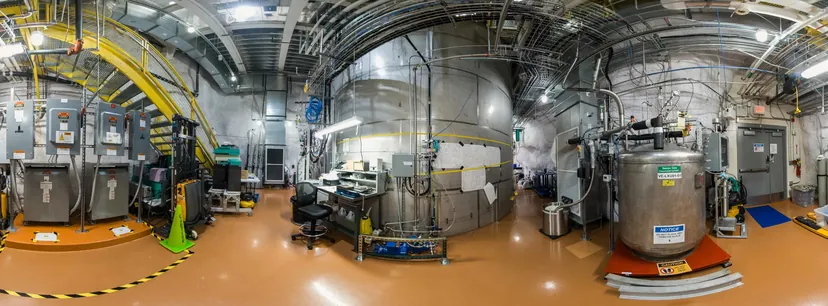
The LZ experiment searches for the heavy WIMP-class dark matter candidates that can directly strike atomic nuclei. The Sanford Underground Research Facility is located 1.5 km beneath the ground in South Dakota, USA. The reason the dark matter hunting ground is located deep underground is because of the cosmic rays pouring down from all directions. The Earth's surface is constantly showered with particles like muons created by cosmic rays. These particles create neutrons as they react with surrounding matter. Neutrons are electrically neutral and can strike atomic nuclei. They are nasty little things that aren't dark matter but act like it. Thick rock layers significantly reduce these particles. On the other hand, since we know that the WIMPs we are looking for hardly react with ordinary matter, they can pass through most of the rock.

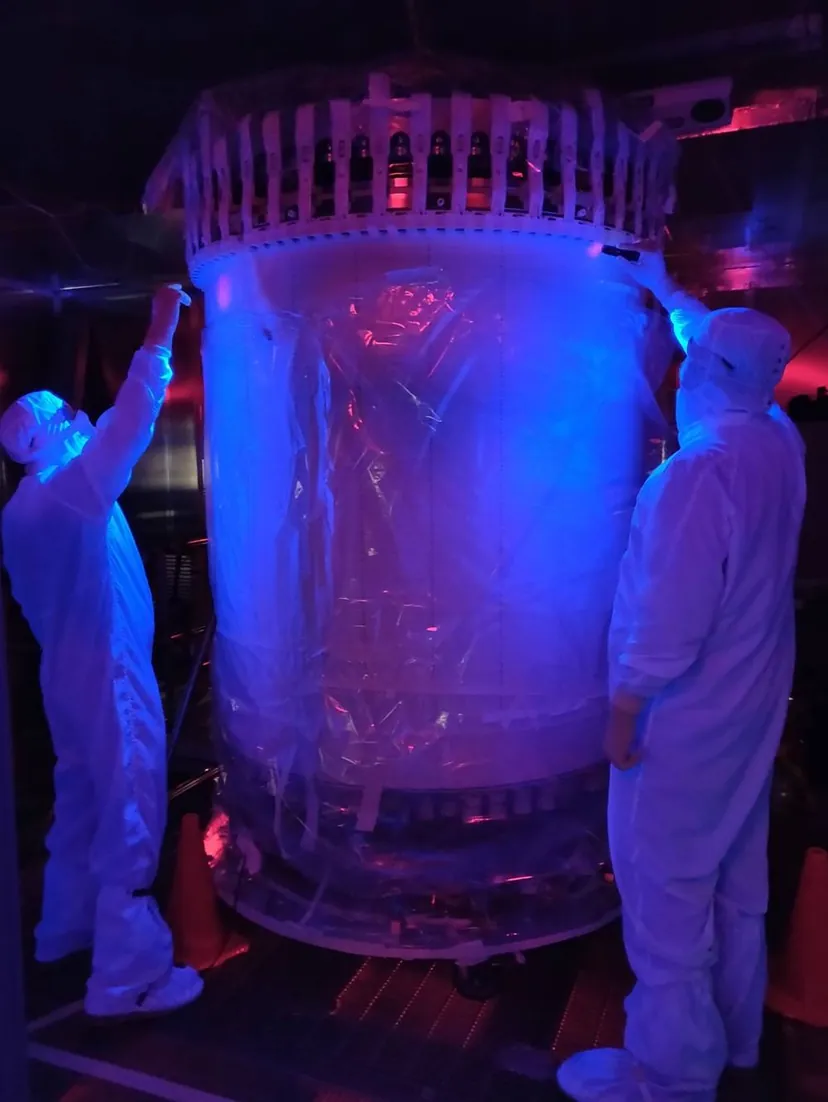
At the center of the LZ experiment device are 7 tons of liquid xenon. This is the very substance that Rocky, the alien species in "Project Hail Mary," handles freely. Of course, unlike the Rocky species, we cannot handle xenon in its solid state. Of the liquid xenon inside, only about 4.7 tons in the inner chamber are actually used for dark matter searching, as material on the outskirts is highly likely to be contaminated.
The reason xenon was chosen is, first of all, that its atomic nucleus is heavy. As xenon has an atomic number of 54, it is heavy. Liquid xenon is about three times denser than water. Therefore, there is a slightly higher chance that nasty dark matter particles will collide with xenon nuclei and leave a trace. Not only that, but the xenon on the outer walls acts as a shield against external radiation, protecting the inner part. Xenon is chemically stable, which makes it advantageous for the precise removal of impurities.
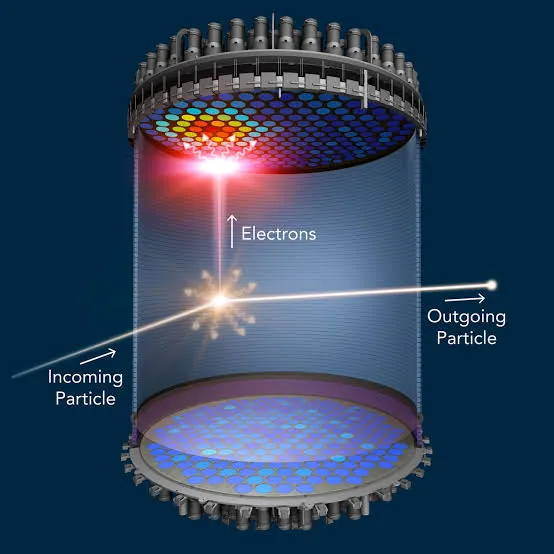
The most important advantage is that when a WIMP collides with xenon, it leaves two types of light simultaneously. First, the moment a WIMP collides with a xenon nucleus in its liquid state, the first flash is emitted within tens of nanoseconds. At this time, ultraviolet light with a wavelength of 178nm is emitted in all directions, which is called S1.
During this process, electrons are emitted from the xenon nucleus. The freed electrons move upward following the electric field. They escape into the gas layer above the liquid xenon and collide continuously and violently with other xenon atoms in the gas state. Due to this collision, the excited xenon atoms emit a second light. This is called S2.
S1 leaks out, and shortly after, S2 follows. The time difference between the two signals allows us to know how deep the first signal started. And through the spread pattern of the light detected by the upper optical sensors, we can also know the horizontal position where the initial signal began. Through these fleeting, consecutive signals, we can three-dimensionally reconstruct exactly where and when the signal started inside the detector.
The nuclear recoil caused by a WIMP directly hitting a nucleus and the electron recoil caused by leaked free electrons show different signal patterns. By comparing the ratio of light and charge detected in each signal, one can infer what the colliding particle is. In this way, physicists have installed a net to wait for dark matter as WIMPs very thoroughly. Now, everything must be left to the coincidences of the universe. We hope for two main coincidences. First, that the identity of dark matter is indeed a WIMP and nothing else. Second, that such a WIMP passes exactly through this detector.
The persistent hunt lasted for a total of 220 days, from March 2023 to April 2024. A suspicious signal was captured on June 16, 2023, quite early in the hunt. Signals appearing to be S1 and S2 were detected in succession. However, they didn't make a fuss right away. A more intense and breathtaking period of internal verification followed. They conducted a kind of blind test with the anxious feeling that it might just be the mischief of another neutrino or cosmic ray that had squeezed through the rock.
Even when a signal is initially captured, researchers are not aware of which area the signal was recorded in, as it is encrypted. This is to prevent biased misinterpretations from seeing suspicious data in the middle. Only after all final data collection is finished are the data opened. Only then can they objectively judge how statistically significant the signal is compared to the entire data collected over the observation period.
Therefore, the researchers also confirmed later that a signal had been captured in June 2023. The existence of the suspicious signal that flashed through the detector at the time became known to the world only after more than three years had passed. It went through a very thorough and intense review.
The number of signals used for the final analysis was 1,710. Most matched well with the expected background noise. However, the two signals captured on June 16 deviated from the trend of background noise. The location where the signals were captured was sufficiently far from the detector wall, and the possibility of it being contamination from external cosmic rays was not high.
The research team estimated that the scale of the nuclear recoil energy that caused this signal must be at least 250keV. This is an enormous amount of energy. It is difficult for ordinary particles to disturb an atomic nucleus with this level of energy. With this threshold alone, it can be seen that numerous other factors that could disturb the nucleus are automatically excluded. The research team inferred the identity of the signal to be a higgsino, the supersymmetric partner of the Higgs boson. They were reportedly so happy that they started writing the paper after confirming the signal and finished the draft in one day.
If it really was a dark matter particle, it could be seen as a very powerful particle that coincidentally swept through the detector. Although the value varies depending on the model, the significance of this signal is, unfortunately, about 2.6 sigma, which does not exceed 3 sigma. If the exploration continues in the same way, it means there is a 0.5% chance that a strange signal of this level will pop up again. It does not mean there is a 99.5% probability that it is dark matter.
It is not a completely satisfying result, but considering how elusive dark matter is, this alone can be considered a quite interesting event. In the future, if we continue to wait for similar signals for a longer time and enough statistical data of dark matter-suspicious signals accumulates, only then will we be able to reach a more definitive conclusion.
Of course, it is still far too early to make a fuss. There have been many cases in the past where people thought they had discovered a signal suspected to be dark matter, only for it to end as a disappointing happening because independent verification failed. A representative example is the DAMA experiment at Gran Sasso in Italy, which announced that it had captured a pattern of dark matter signals changing according to the seasons, but no similar signal was confirmed in independent detection experiments in South Korea. Even now, detectors in Italy, South Korea, and all over the world are waiting for dark matter without any promises.
Watching the persistent hide-and-seek with the unidentifiable dark matter, many say that dark matter will eventually follow the history of ether. While there is a possibility, there are also aspects that make it difficult to simply place it on the same line as the situation of ether. The phantom of ether, which had filled the universe of humanity for thousands of years, completely disappeared through undeniable experiments showing that the speed of light is always measured as constant regardless of direction and time.
The situation with dark matter is more subtle. It could even be considered nastier. There are many experiments trying to prove dark matter, and no definitive evidence has appeared yet. Yet, there is no experimental idea that can clearly show that dark matter does not exist. Even clearly proving that dark matter does not exist is a very difficult situation.
Someone might complain that because the very definition of dark matter is cleverly set as a particle that does not interact, even if detection signals don't appear, they make excuses that dark matter is just "naturally that way." It cannot be denied that there is such an aspect. However, we cannot ignore all the consistent phenomena observed in the universe for a long time, the problems that the universe appears heavier and has stronger gravity than it looks. One of the truly sacred yet nasty principles of science is that "the absence of evidence is not evidence of absence."
Ultimately, the end of the debate surrounding dark matter is one of two things: either clearly capturing the signal of dark matter and identifying it, or waiting without promise for traces of dark matter while looking at silent detectors. I hope that the two short signals captured in 2023 were the first flare signaling the end of this long battle.
Who is the author Ji Ung-bae? He loves cats and the universe. After watching "Galaxy Express 999" as a child, he dreamed of spreading the beauty of the universe. Currently, he is an assistant professor at the College of Liberal Arts at Sejong University, participating in various science communication activities such as lectures and writing. He has authored books such as "About the Uselessness of Astronomers," "We Are All Born Astronomers," and "Strange Questions That Come to Mind When Looking at the Universe," and translated books including "How I Killed Pluto," "Quantum Life," and "UFO."