

[비즈한국] Since the modern era when the format of comics was established, cartoons have grown while serving as the face of newspapers and magazines for a long time. Among them, editorial cartoons, in particular, were a window for the general public to view the world. Lee Do-young’s ‘Illustrations,’ considered the first Korean cartoons, appeared in the center of the front page starting from the inaugural issue of the ‘Daehan Minbo’ and represented the landscape of this country just before losing sovereignty and the hearts of the common people. After liberation, cartoons took their place on the pages that opened up again as if it were the most natural thing in the world. ‘Gobau Yeonggam,’ ‘Walsun-ajimae,’ ‘Tteokkeobi,’ ‘Yaro-ssi,’ ‘Hankyoreh Picture Board’...
Among these newspaper cartoons, the one that gained a reputation for its uniquely groundbreaking ideas and descriptions is ‘Jangdori’ by cartoonist Park Soon-chan. The cartoonist began the series in the Kyunghyang Shinmun on February 6, 1995, at the young age of 25, and ceased publication in print after 26 years on May 24, 2021. However, since moving online, he has been showcasing biting, incisive critiques through even freer and broader expressions.
Cartoonist Park Soon-chan has been fearlessly swinging his ‘Jangdori’ (sledgehammer) at those who “occupy high places” from the most popular perspective. The ‘soul food’ he chose is naengmyeon (cold noodles). On a sweltering summer afternoon, we gathered at a naengmyeon restaurant located near the suburban Wonreung Station.
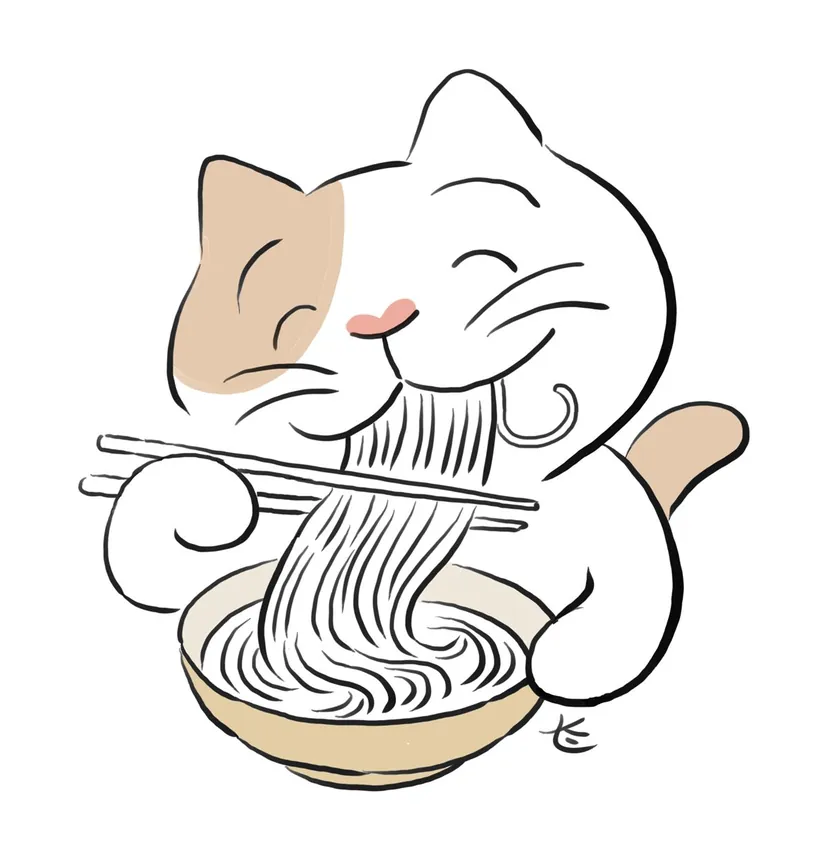
A ‘Naengmyeon Tour’ from Hamhung through Pyongyang to the Present
The naengmyeon restaurant recommended by Park Soon-chan was a famous spot known for its long waiting lines. He said he used to visit frequently, but since the lines get quite long in the summer, it's best to visit during off-peak times, avoiding lunch and dinner hours. True to his word, even though we met at a rather awkward time, most of the tables were full. And this was in a remote area near an old railroad track, not in the middle of the city. “Real hidden gems aren’t about location. People will find them even if they are in a very far and remote corner.” A subtle sense of pride typical of a regular customer could be felt in Park’s words.
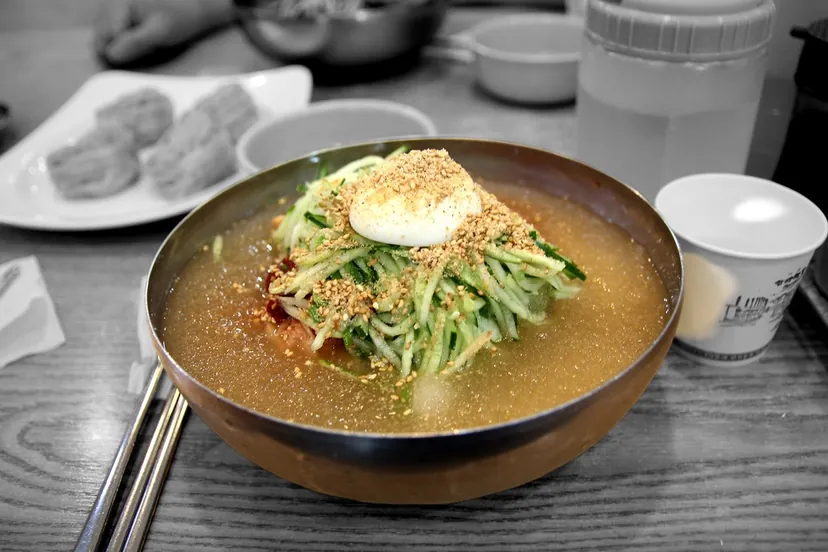
This restaurant serves kudzu (chik) naengmyeon, and while the noodles were great, the mountain of shredded cucumber on top was particularly impressive. One might easily associate kudzu naengmyeon with a sharp, spicy seasoning, but perhaps because of the cucumber or the broth, it offered a refreshing, savory taste without any harsh acidity. Park drew a firm line, noting that many naengmyeon dishes served as side menus at gukbap (soup and rice) restaurants are overly seasoned, emphasizing that the balance—not too sweet, not too spicy—is what truly matters.
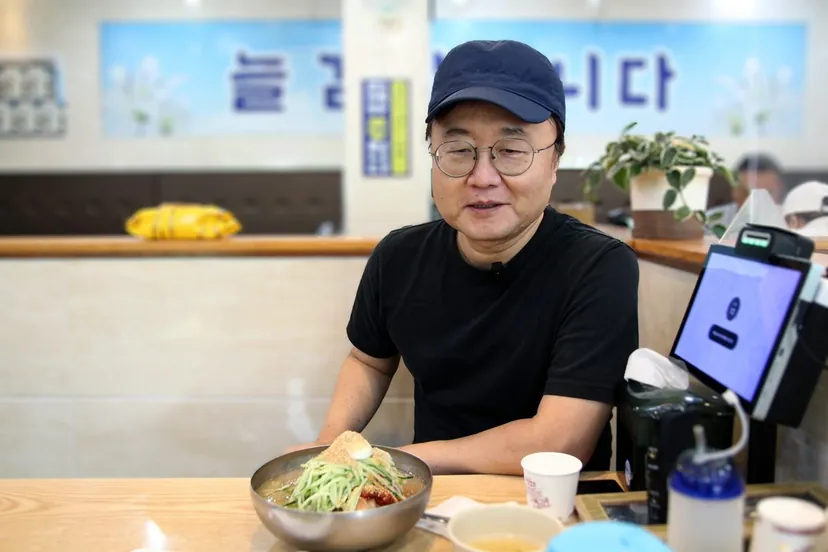
The artist has always loved noodles and ate them often while working, especially naengmyeon. He first encountered noodles with the bibim-naengmyeon (spicy cold noodles) of the Hamhung style. There was a famous Hamhung naengmyeon alley near the watch alley in Euljiro and Sewoon Plaza, and he started going there frequently because he loved the taste. However, his first impression of the subtle, plain Pyongyang-style naengmyeon was that it was “impossible to eat.”
In the early 1990s, long before Pyongyang naengmyeon became a trend, 21-year-old Park first encountered it at a restaurant in Yeonhui-dong. He tried adding vinegar and sugar, but it didn't get any better, leading him to think, “Why do people eat this like this?” Back then, the crowded restaurant was filled with elderly patrons. He assumed they were displaced North Koreans who knew the authentic taste of Pyongyang naengmyeon.
Much later, as he grew older, he came to understand the taste and spent 3–4 years visiting various Pyongyang naengmyeon spots. He got quite obsessed, even visiting old restaurants in Uijeongbu, the birthplace of the ‘Uijeongbu-style Pyongyang naengmyeon.’ Eventually, he discovered a shop in Mok-dong, Seoul, and thought, “Ah, this is different; this place is truly delicious.” This is a local institution that has been around for about 40 years, and in the artist's view, it might be the closest to the current taste of Pyongyang naengmyeon in North Korea.
After a while, he began to enjoy naengmyeon simply as a natural way to cool off in the summer. The kudzu naengmyeon we had today was, in that sense, a convenient way to enjoy a refreshing summer delicacy. However, apart from naengmyeon, he has reduced his overall noodle intake lately. Since noodles eaten at home tend to become instant food, he eats less for the sake of his health.
Regretting the Passing of Traditions and the Rise of ‘Instagrammable’ Trends
As we discussed food, Park expressed sadness over the flavors of dishes that disappear as traditions are lost. For instance, a Chinese restaurant that had operated for 40 years in front of the Kyunghyang Shinmun office, where he serialized ‘Jangdori,’ served handmade jajangmyeon with large, old-fashioned potato chunks, but it closed when the owner’s health failed. A haejangguk (hangover soup) restaurant near Dongdaemun Design Plaza that served Joseon-style soup with a soy sauce base also closed as the grandmother who ran it became ill. It was a place that required waiting in line from the moment it opened, but it was no longer possible to eat there.
He laments that these old foods, which require a lot of care, are disappearing, while many dishes now focus on mixing existing cultures rather than new ingredients or recipes, and there is an increase in “Instagrammable” food created just for photos.
“You have to eat them while they are still here. I think it’s fortunate that I went to eat at the haejangguk place I mentioned earlier. It’s gone now.” Listening to the artist, who regrets the things we’ve lost, including the traditional home-brewed liquor culture, makes me think of the foods I can no longer eat. It’s not just the closure of a single shop; it’s a loss of cultural context.
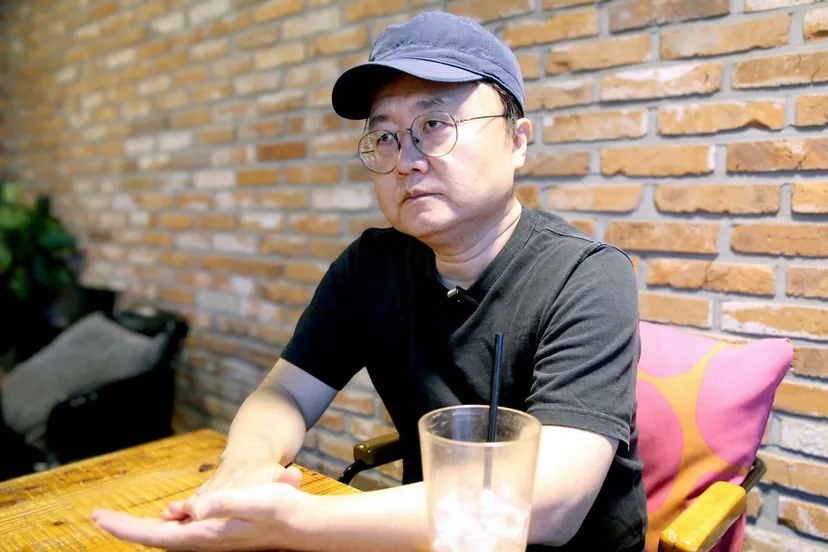
The cartoonist connects this sense of loss to his work as well. “Cartoons are the same. It’s hard to talk about what ‘Korean comics’ really are. When you talk about a certain genre of Japanese manga, there’s a connection. There’s a stylistic lineage that goes back a year, decades, or even further to Ukiyo-e. But in Korea, having gone through the war, there’s such a lack of continuity, which is a pity.”
In a sense, it is true that in this country, which hasn’t been free from the effects of the war for long, the stages where something takes root and continues are broken in many parts of society, from food to comics. One could analyze that the unique characteristic of K-culture is to make things look plausible and tasty, like a mixed stew, on that foundation, but that is a highly current and results-oriented perspective. Park’s frustration hits exactly on the points we need to consider beyond our moderately pretty achievements.
“If You Put on Airs, It’s Over”
The charm of ‘Jangdori,’ which has spanned 26 years and continues online to this day, lies in its ability to bring the reader’s eye to the essence of current affairs without resorting to personal or demeaning mockery of specific figures. Although the cat character ‘Nyangdori’ is seen more often than the protagonist ‘Jangdori’ these days, the inherent fun of ‘Jangdori’ persists even after moving online. The line between satire and ridicule seems thin but is actually clear, as is the line between humor and mockery. Park’s comics remain sharp yet clean because they never cross that line. How does he maintain these seemingly contradictory virtues?
Although he has drawn political cartoons for a long time, the artist isn't actually that interested in politics, nor does he like any specific political group. He simply thinks politicians represent a lot of people. Politicians are a condensation of many people’s desires and the current tendencies of Koreans, and he has seen those desires in individuals around him, not just in specific politicians. That’s why he draws them like a mirror. For example, he says he draws a former president who forced people to drink alcohol with the feeling of, “Ah, there are many people like this; you should reflect on yourself by looking at this person. Feel something.” It’s a different tone from anger at a specific individual. When I asked him, “What is satire?” he replied:
“The reason for doing satire varies by era. The era when Honoré Daumier (1808–1879, a satirical painter who laid the foundation for early humorous realistic satirical cartoons) drew was different from now. Back then, exposing entities that couldn’t be seen through images had meaning, but now there are too many images. I don’t think we are in an era to do things the old way; there is a separate approach for today. For me, when I satirize a politician, I approach it by using them as a mirror to see ourselves. That’s how people doing this work can find meaning and fun. Simply attacking someone might be fun for a moment, but it’s hard to keep up for a long time. Of course, if you only plan to do it for a short time, you can do that.”
Since the internet era, Park has gained attention by introducing the ‘Jangdori Serial Drama Series,’ which applies satire in a new way. With titles like ‘Yundori,’ ‘Gandori,’ ‘Attack of the Search Party,’ ‘Yongsan Grandeur,’ and ‘Game of Kings,’ he shows a different rhythm from the 4-panel newspaper format, and his unconventional portrayal of figures gives huge laughs. Even during his newspaper serialization, ‘Jangdori’ presented scenes that weren't suppressed by the weight of the name ‘newspaper editorial cartoon,’ including pop culture parodies. The ‘Jangdori’ from May 13, 2023, which featured a ‘Mr. Yoon’—who committed sexual harassment while performing diplomatic duties—as the ‘Giant of Truth,’ is a highlight still talked about today. The ‘Giant of Truth’ was a parody of the popular Japanese animation ‘Attack on Titan,’ which was a truly groundbreaking scene for a newspaper cartoon.
Park believes that the satire or commentary in comics does not necessarily have to be bound by the authority and framework of the medium. That’s easy to say, but hard to put into practice. “Comics are something that should be entered into comfortably and meet the reader appropriately; if you put on airs, it’s over.” The artist’s words summarize the attitude with which his comics have viewed the world. Going a step further, he says it isn’t appropriate to assign separate terminology like ‘editorial cartoon’ and distinguish it. He argues that calling them just ‘comics’ is enough, and adding titles grants unnecessary authority, and the moment authority enters a comic, it’s over as a comic.
So what kind of comics does he draw? He says, “Calling them just comics is the end of it.” It’s the same as any other comic. Comics that receive a response from readers survive, and those that don’t die. To Park, who meets readers directly through blogs, Instagram, and YouTube, the medium—including newspapers—doesn't hold much significance. What’s important is making people come to find the artist because they want to see the artist’s commentary. “The idea that ‘it must be serialized because it has the authority of a newspaper comic even if readers aren't watching’ no longer exists.”
Towards Original Creations
‘Hwanjaeng-i’ is Park’s first long-form comic. He worked on ‘Cartoon Park Chung-hee’ with the late cartoonist Baek Moo-hyun, who fell to illness while challenging politics, but at that time, his role was to turn the story written by Baek into a comic. ‘Hwanjaeng-i,’ created as part of the ‘100 Independence Activists Webtoon Project,’ is the first full-length work that Park worked on entirely by himself. Featuring Lee Do-young, recorded as the first Korean cartoonist, as the protagonist, it reveals the ‘fight through pictures.’ In the comics he serialized in ‘Daehan Minbo,’ Lee Do-young not only shed light on the reality of the time but also delivered sharp and powerful criticism against traitors like Lee Wan-yong. If mere description wasn't enough, he would even bring the Jade Emperor onto the page to scold them.
The artist adds imagination to each scene and connects it to the present. He especially thought of the impact people must have felt seeing targets directly hit in the center of the first page of a newspaper, comparing it to the rise of new media like YouTube today. The characters in the work look down on it as vulgar, which is a metaphor for how legacy media currently looks down on YouTube. His intention was to make it fun to watch rather than following the style of educational comics. It is truly interesting that Lee Do-young, who has almost no records of his personal life, is no longer remembered just by the badge of ‘the first Korean cartoonist.’ The artist reveals the perspective that “historical works are about what people feel empathy for now.” He shows that the virtue of historical works lies not in the simple reenactment of the past, but in a representation that connects with the present.
When asked about his future plans, Park said he wants to make a comic with his own original story and characters. Since ‘Cartoon Park Chung-hee’ and ‘Hwanjaeng-i’ used real historical figures, he wants to create a completely new, original work. The genre could be SF or historical. However, he says nothing is concrete yet. We look forward to the day we encounter Park Soon-chan’s original creations.
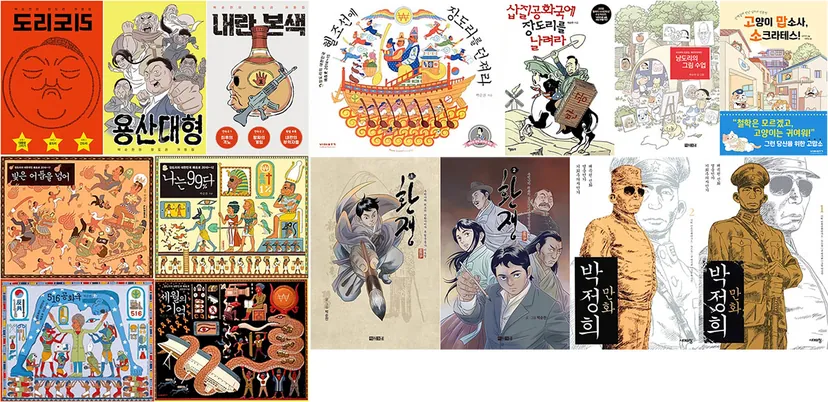
After a brief period as an apprentice before his debut, he passed the open recruitment for the Kyunghyang Shinmun and began drawing ‘Jangdori’ in 1995 at the age of 25. He compiled his 26 years of serialization into books under the title ‘Jangdori’s Modern History of the Republic of Korea,’ including ‘Throw a Sledgehammer at the Republic of Shoveling,’ ‘I Am the 99 Percent,’ ‘Memories of Time,’ ‘Throw a Sledgehammer at Hell Joseon,’ ‘Goodbye Pseudo-Golden Age,’ and ‘Light Beyond the Darkness.’ After leaving the company, he continued his work online, compiling works into ‘Dori Dori,’ ‘Yongsan Grandeur,’ and ‘The True Colors of Insurrection.’
In addition to ‘Jangdori,’ he drew ‘Cartoon Park Chung-hee’ with the late Baek Moo-hyun and participated in the 100 Independence Activists Webtoon Project with ‘Hwanjaeng-i,’ based on the first Korean cartoonist, Gwanjae Lee Do-young. Beyond comics, he also published the humanities book ‘Good Heavens, Socrates!’ written with essay tutor Park Hong-soon, and the drawing primer ‘Nyangdori’s Drawing Class.’ He won the 1st Annual Editorial Cartoon Award in 2008 and the Bucheon Comics Award for Excellence in 2013 for ‘I Am the 99 Percent.’