

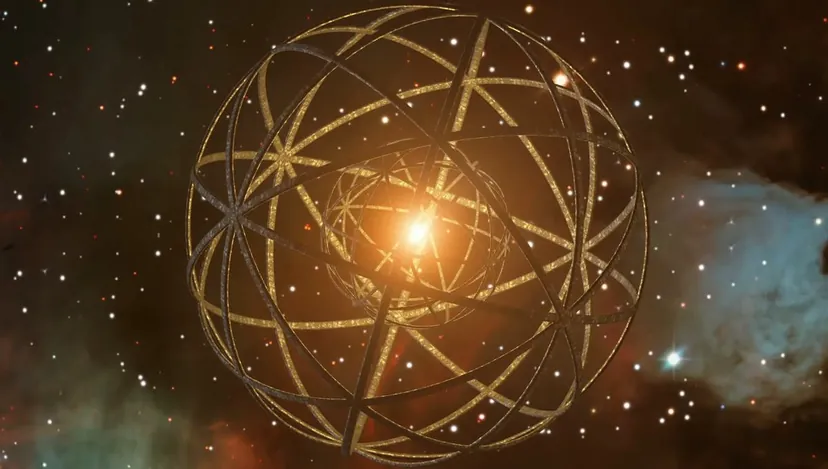
[비즈한국] To find clues to extraterrestrial civilizations, astronomers are conducting a research effort called "Project Hephaistos"—a name that brings the movie "Project Hail Mary" to mind. So, when searching for extraterrestrial civilizations through astronomical observation, what can serve as a clue? Among various possibilities, one concept that has sparked much debate among science fiction fans is the Dyson sphere: a massive artificial structure enclosing a star.
Recently, results were announced from observations of the two most likely candidates for a Dyson sphere using the James Webb Space Telescope. Did an extraterrestrial civilization that built a truly massive artificial structure really exist there?

Even Civilizations That Harvest Starlight Leave Behind Waste Heat
The idea of a Dyson sphere first appeared in Olaf Stapledon's novel "Star Maker." The sun is undoubtedly the most powerful energy source in the solar system. As humanity advances, it demands more energy. With the advent of the artificial intelligence era, energy consumption is also exploding. A highly advanced technological civilization might attempt to obtain energy directly from their central star. This would involve surrounding the star with structures equipped with massive solar panels to efficiently collect starlight energy at close range. Later, physicist Freeman Dyson organized this sci-fi imagination into a scientific concept, making it widely known as a Dyson sphere.
However, the problem is thermodynamics. No matter how highly developed a technological civilization is, it would be difficult to defy the scientific laws of the universe. Even if they capture starlight and use it as energy to sustain their civilization, that energy does not simply vanish. According to the law of conservation of energy, the energy that enters must eventually be released in another form. Considering the second law of thermodynamics, any real device is bound to emit entropy into the external universe. A significant portion of the remaining waste heat can be emitted as radiation at a lower temperature.
A major point of contention in SpaceX's recent space data center plans is the method of handling waste heat. Making waste heat disappear entirely is impossible. While one might attempt to release it slowly at a very low temperature, eliminating or hiding the waste heat itself is nearly impossible.
If the temperature of the waste heat is in the range of several hundred Kelvin, its traces can mainly be seen in the mid-infrared region. This is the wavelength range sensitive to MIRI, the James Webb Space Telescope's mid-infrared instrument. If the temperature is lower, the trace shifts to longer-wavelength infrared. Thanks to this, James Webb becomes a tool for finding traces of extraterrestrial civilizations that might be living wrapped in Dyson spheres. If a star, which appears dark at other wavelengths due to being obscured by a massive structure, emits a uniquely bright signal in the mid-infrared, we can suspect it is a Dyson sphere unable to hide its waste heat.
Seven Candidates Remaining Among 5 Million Stars
The research team of Project Hephaistos utilized Gaia data, which extensively observed stars in our galaxy. They combined this with WISE and 2MASS data, which surveyed the sky in the infrared range, to examine approximately 5 million stars. They used Gaia data to determine the distances to the stars and selected those that appeared exceptionally dark for their distance. They then compared the infrared intensity of each star using 2MASS and WISE data.
Through this selection process, seven candidates remained. All were dark but shone exceptionally bright in the infrared region. They appeared to be M-type red dwarfs with very low surface temperatures, and it was found that about 7–17% of their total emitted energy was coming from the infrared region.
Of course, this alone is not enough to conclude they are Dyson spheres. Infrared light can also appear exceptionally bright if a primordial planetary dust disk remains around the star for a long time. Usually, such dust disks gradually coalesce into planets or are pushed away by stellar winds about 10 million years after the star is formed. However, occasionally, dust disks remain for over 40 million years. Because they resemble Peter Pan, who never grows up, they are called "Peter Pan disks."
In the spectra of such stars, emission lines of hydrogen atoms usually appear clearly. However, no specific hydrogen emission lines were seen in the seven Hephaistos candidates. Consequently, the possibility that they were young stars surrounded by dust disks was ruled out.
Another Celestial Object Revealed Beside the Star
On July 28 and September 9, 2025, James Webb targeted two of the seven candidates. And an unexpected fact was revealed.
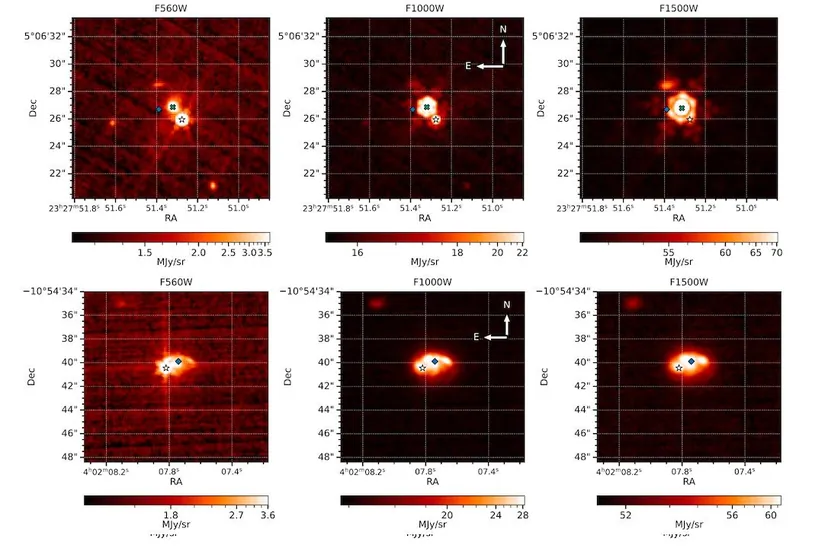
James Webb observed the stars as small, sharp points with higher resolution than existing telescopes. Then, another entity appeared right next to the stars. It was a celestial object that looked like a long, spread-out smudge. In the 5.6-micrometer range, which is a relatively short wavelength in MIRI's observation range, the stars appeared brighter. However, as the wavelength increased, the stars faded, and the blurry object next to them became more prominent.
The identity was a background galaxy that happened to overlap in the same direction. The bright mid-infrared signal captured in previous observations was not from the star but from the galaxy behind it. While previous observations could not clearly distinguish between the star and the background galaxy, James Webb's images clearly separated the two objects. The angular distance between the stars and the background galaxies averaged about 1 arcsecond.
In previous observations, the two candidates appeared to emit infrared signals corresponding to a temperature of about 180 Kelvin. Considering that the temperature of the central star is about 3500 Kelvin, for a structure enclosing the star to maintain a temperature of around 180 Kelvin, it would need to be at a close distance of within approximately 1 Astronomical Unit (AU) from the star. The distance to the stars is over 600 light-years. Therefore, if such a structure actually existed, it should have appeared tightly clustered within 0.01 arcseconds of the star. However, the actual infrared sources revealed in the James Webb images—the background galaxies—were much further away.
Galaxies that emit a lot of infrared light can be covered in thick dust clouds. One type is a "dust-obscured galaxy," or Hot DOG. There is a powerful active galactic nucleus with a black hole at its center, and as thick dust surrounds it, an unusually large amount of energy can appear in the infrared. The background galaxy that overlapped with candidate D, observed this time, has the potential to be one of these Hot DOGs.
On the other hand, the background galaxy overlapping with candidate E is slightly different. This galaxy is also surrounded by dust, but the primary cause of the infrared is estimated to be explosive star formation occurring within it, rather than an active galactic nucleus. The combined mass of new stars born in this galaxy each year reaches about 20 times the mass of the Sun.
Between Extraterrestrial Signals and Natural Phenomena
In the end, definitive evidence of an extraterrestrial civilization—a smoking gun for a Dyson sphere—did not emerge this time either. If one was looking forward to the discovery of an extraterrestrial civilization, it is a disappointing result. However, this observation left an important lesson. The universe is crowded with numerous celestial objects. It happens more often than one might think that a nearby star and a distant background galaxy overlap in a similar direction.
When that happens, the characteristics of a much more distant background galaxy can be mistaken for those of a nearby star. An ordinary star might look as if it is hiding a Dyson sphere. One must carefully examine whether the observed signal actually came from that star or is the result of light mixing from an accidentally overlapping background galaxy. Sometimes, it is not an extraterrestrial civilization, but the natural phenomena of the universe itself that deceive us.
If there are countless extraterrestrial civilizations in such a vast universe, why have we not discovered a single one of their signals yet? Facing the question posed by the Fermi paradox, the silence of the universe continues.
Perhaps there are extraterrestrial civilizations that have figured out how to handle waste heat and live alone in the dark without leaving behind any heat at all. Even if such beings existed, they would not be caught in our search nets. It is effectively the same as having no way to observe them. If a civilization wants to hide that thoroughly, perhaps it is the etiquette of the universe not to force a discovery.
It may not be the case that a technological civilization necessarily requires more energy as it advances. It is possible they solved the energy shortage problem in a completely different way, rather than a dramatic method like a Dyson sphere. For example, if it were a civilization that succeeded in cold fusion, there would be no reason to laboriously build a massive structure around a star.
Ultimately, the process of searching for extraterrestrial civilizations is bound to rely on various reasonable assumptions and expectations. Whether those were truly reasonable inferences will only be known once the day comes when we discover their existence.
Who is Ji Woong-bae? He loves cats and the universe. After watching "Galaxy Express 999" as a child, he dreamed of sharing the beauty of the universe. He is currently an assistant professor in the Division of Interdisciplinary Studies at Sejong University, engaged in various science communication activities such as lectures and writing. He has authored books including "On the Uselessness of Astronomers," "We Are All Born Astronomers," and "Strange Questions That Come to Mind When Looking at the Universe," and translated books such as "How I Killed Pluto," "Quantum Life," and "UFO."