

[비즈한국] Around the turn of the millennium, there were artists who left paper behind and turned toward the ‘Web.’ Breaking free from the shackles of publishing and distribution, they attempted experimental creative work on new media and even created unprecedented genres such as ‘empathy-toons’ (relatable comics) and ‘emotional-toons.’ Their works, which depicted their daily lives and thoughts through avatars (self-characters) drawn in relatively light art styles, won over readers' hearts and established themselves as a trend. It’s similar to today's daily-life YouTubers, perhaps.
Just as my diary remains homework while ‘Nanjung Ilgi’ (Admiral Yi Sun-sin's war diary) remains a masterpiece, not every daily life becomes a work of art. Daily life only becomes a work that captures readers' attention when meaning is added, transforming it into an extraordinary, non-daily experience. Therefore, a ‘daily-life toon’ is not easy. Just as it is hardest to cook the rice we eat three times a day well, it is difficult to create.
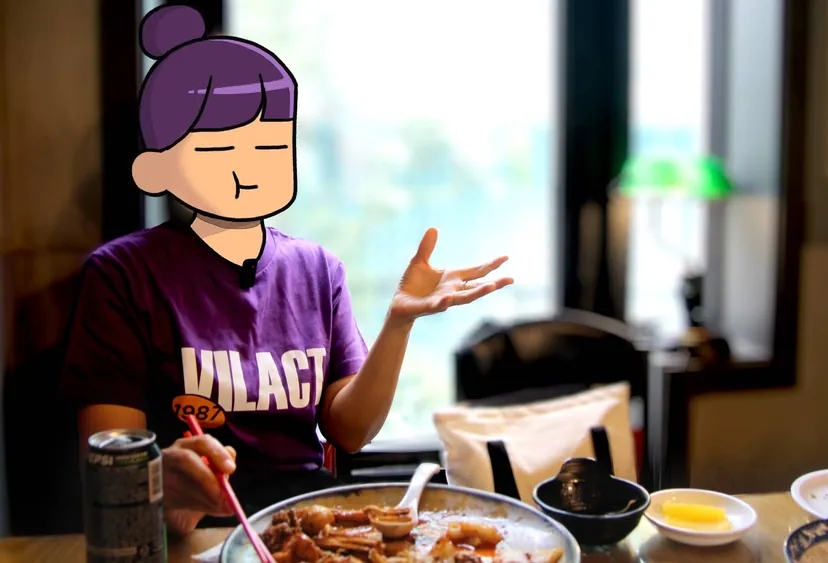
Cartoonist Kim Fanta, who debuted in 2006, has been consistently drawing ‘daily-life toons’ for 20 years. I met Kim, who recently published ‘Meme Idioms You Understand at a Glance,’ at a Mala specialty restaurant in Sinchon in August, right in the middle of the intense midsummer heat.
Meeting ‘My Food’ While Chasing Trends
If Mao Zedong’s small spark burned the fields of China, the spicy and numbing taste of Mala set fire to the mouths of Koreans. Looking at media reports, it seems the trend began in Korea around 2019. Unlike the short-lived flashes of trends like Taiwanese castella, Tanghulu, and Duocoon, Mala remains highly popular. The spicy taste of Mala, which has a different texture than the "spicy taste of Koreans," created a huge sensation, primarily among the younger generation, and now it seems to have settled into our daily lives, moving beyond the level of exotic food.
Kim says she also challenged herself to try Mala by following this trend. "Since I'm a content provider, I have to be sensitive to trends. So when Tanghulu was popular, I had to go try it. I tried Mala for the same reason, and it turned out that Mala Xiang Guo (spicy stir-fried pot) really suited my taste. I was fascinated that it was different from Korean spiciness, so now whenever I’m a little stressed, I say, ‘Let's go eat Mala Xiang Guo!’" When she casually referred to herself as a "content provider," I could sense her desire for her creative work to be seen as a professional activity of daily life rather than being placed on a pedestal of mystery and authority.
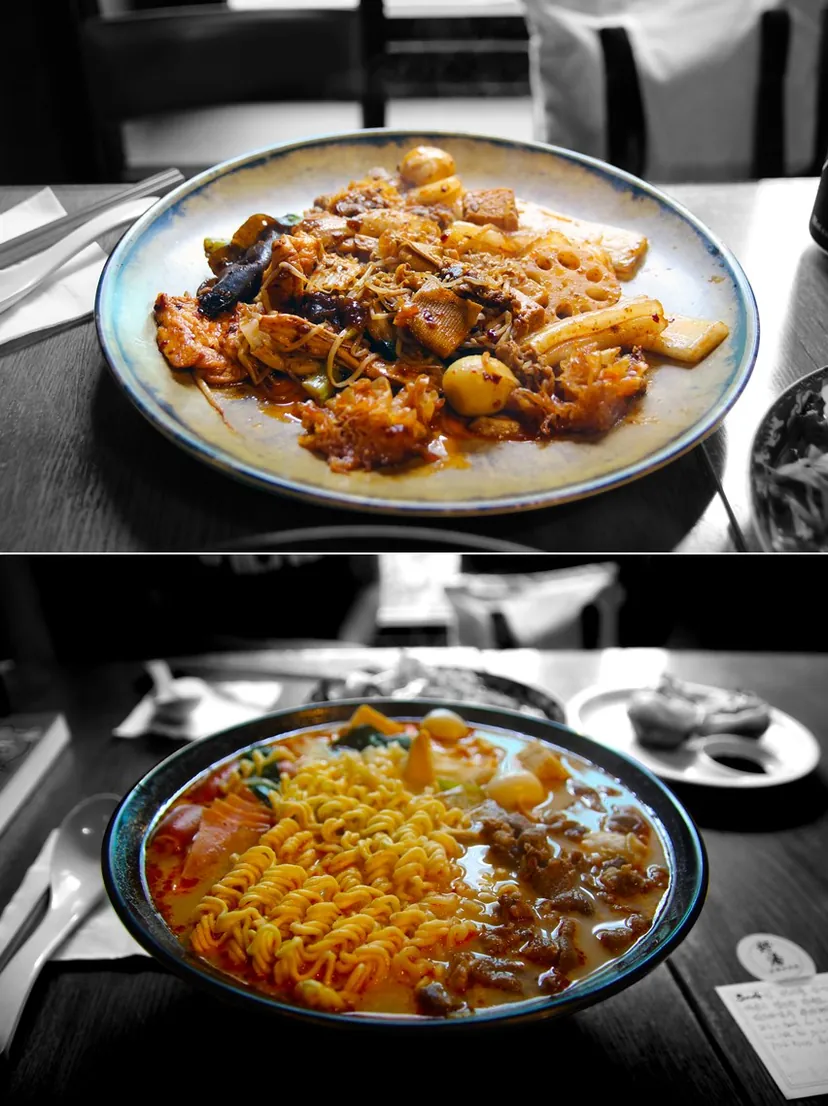
If Mala Tang is a soup dish made by boiling ingredients in broth, Mala Xiang Guo is a stir-fried dish made by tossing ingredients in Mala sauce and oil. In typical Mala restaurants, customers put desired ingredients like meat, vegetables, and noodles into a bowl, and the kitchen cooks them as requested. This somewhat unfamiliar method sometimes creates fun happenings. The artist also said that at first, she was flustered because she put so many different ingredients in the bowl that the portion of the finished dish was enormous.
The artist, who devoured the Go Woo-young series and mastered Chinese history as a child, has now drawn ‘Meme Idioms’ dealing with Chinese proverbs. As we shared stories about Chinese history and culture, the conversation naturally turned to Chinese food. The artist mentioned that she still remembers Liangpi (Chinese-style chewy noodles) and Roujiamo (a dish similar to a hamburger) that she tasted while traveling in Xi'an.
While ordering a carbonated drink to soothe our numbed tongues, I took the opportunity to ask about her pen name, ‘Fanta,’ which I had been curious about. As guessed, the name comes from the soda Fanta. When I asked her which flavor she prefers, she replied that the essence of Fanta is orange.
“If it were today, I would have become a YouTuber”
The artist has been drawing comics since high school. In college, she participated in events like Comic World to publish fanzines, which caught the eyes of publishing industry insiders, leading her to take on illustration outsourcing and short comics. The early to mid-2000s was a time when publishers of comic magazines still existed.
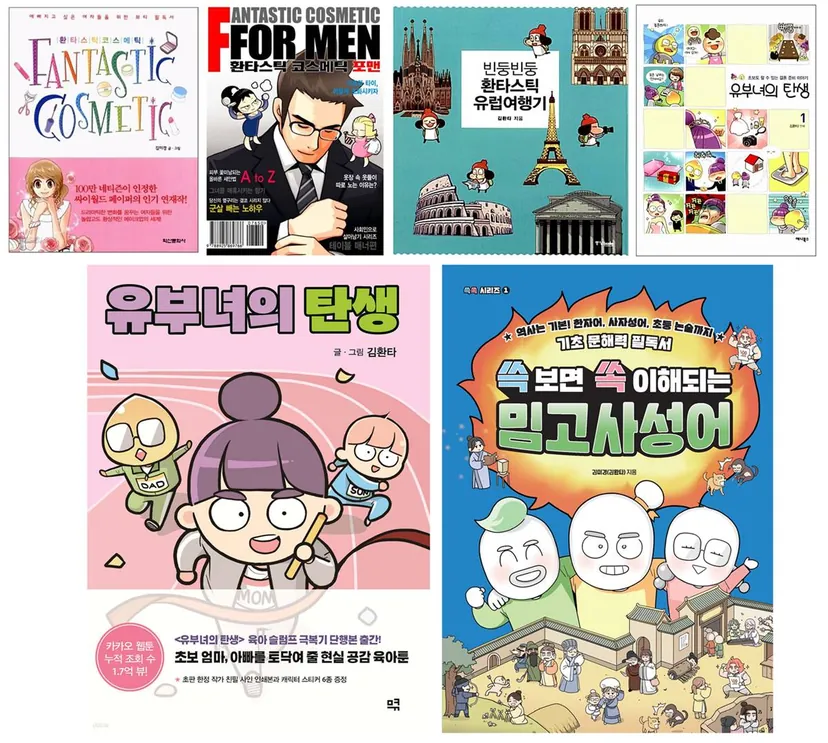
Unable to endure the murderous schedule of published comics, she worked as an English tutor after graduation, but even then, she kept posting comics on her blog. The work compiled from those is ‘Fanta-stic Cosmetic.’ It was a time when content posted in online spaces was frequently being compiled into books. The artist added that if it were today, she would have become a YouTuber, and suggested that the younger generation's immersion in video content is not entirely their own will but also a result of social factors, such as the experience of specific media. It was an insight typical of an artist who responds sensitively to changing tides while never losing sight of what she loves.
Kim Fanta-style Content Condensed from Daily Life
Just as the information the artist painstakingly gathered became the material for ‘Fanta-stic Cosmetic’ during a time when product information or related content was scarce, works like ‘Idle Fanta-stic European Travelogue’ and ‘The Birth of a Married Woman’ are also based on the artist’s experiences and observations. The heart of “Hongik Ingan” (devotion to the welfare of mankind)—that since I suffered to learn this, I don’t want others to—became the motive for her creation. It is Kim Fanta’s response to the world’s reproach that you shouldn’t learn something just to give it away to others.
The same goes for ‘Meme Idioms.’ After watching her child learn new words and abbreviations through YouTube, she realized that the compressed assembly method of modern language, including memes, resembles Chinese idioms, and she began drawing educational comics for her children. By being selected for a support project by the Korea Manhwa Contents Agency, she gained confidence and momentum in her creative work. One can sense the heart of the artist, who is both a mother and a teacher.
An essential element in the process of Cartoonist Kim Fanta recreating her daily experiences into comics is the time spent seasoning the material. For example, there is a two-year time gap between reality and the work in ‘The Birth of a Married Woman.’ Her creative attitude of allowing a ripening period between experience and expression differs from the generalized method of "daily-life toons" that are close to live broadcasting. It is a unique characteristic of Kim Fanta, who calms down heated emotions to present something that is comfortable yet deep.
In the AI Era, Let’s Have Comics Like Mala Tang, Full of Human Experience
At the end of the talk about trends, the topic of AI (artificial intelligence), which is a hot topic in the comic world, came up. The artist believes that while the AI trend cannot be resisted, the significance of what humans experience directly will become even more important.
“I went to Seoraksan Mountain with my husband recently, and I grumbled because I didn't want to go at first. But on the way down from the mountain, I found myself looking for good hiking boots. I liked it after trying it. I told ChatGPT about this, and it said that’s a characteristic of a Control Freak, and that such people need to experience things directly to control their emotions. I think that experience is essential in today’s world. Since indirect experience is something anyone can easily access, wouldn’t humanistic insights gained from direct experience become more important?”
Listening to her, I wondered: even if AI describes human emotions, what happens if the human has never felt those emotions themselves? While not every problem’s answer can be found in experience, perhaps a large part of what constitutes ‘being human’ is still experience. Thus, perhaps drawing out humanistic insights will remain the domain of humans for a long time to come. I learn from an artist who drew comics because she grew up watching them, and who draws them because she wants to share what she has experienced and learned.
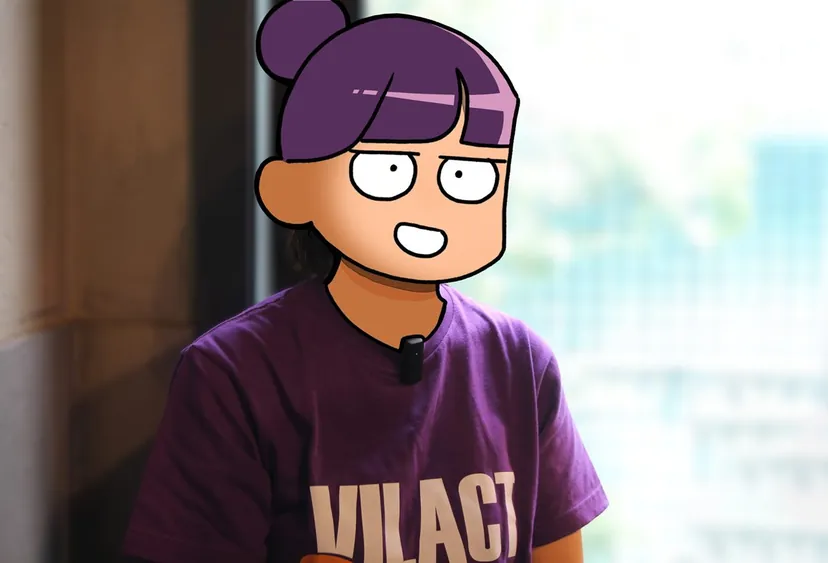
Kim Fanta hints that her next project is an educational comic using English vocabulary as the subject. Her background as an English tutor comes to mind, and the artist laughs, saying she thinks a "universe" of some sort is leading her in this direction. She also mentioned that she is working on a project using Chinese character radicals, stemming from her memories of struggling with difficult characters while studying Chinese. I hope the artist’s wish—that her experiences lead to enjoyment and new discoveries for her children and readers—reaches them truly.
As we wrap up the interview, the artist adds one last thing. “But don’t you think my cartoons are like Mala Tang? Boiling together various experiences.” I couldn't help but nod in agreement. A comic that produces a special, spicy, and numbing taste from the ingredients of daily life—that is the work of Cartoonist Kim Fanta.
She debuted in 2006 with a comic containing makeup know-how, and since then, she has consistently drawn works such as ‘Fanta-stic Cosmetic’ (Haksan Publishing, 2008), ‘Fanta-stic Cosmetic for Men’ (Haksan Publishing, 2011), ‘Idle Fanta-stic European Travelogue’ (Joongang Books, 2013), and ‘The Birth of a Married Woman’ (Kakao Webtoon, 2014~2026), which covers the journey from marriage to childbirth, childcare, and family life. Recently, she published ‘Meme Idioms You Understand at a Glance’ (2026), which can be called an educational comic for idioms, as a book after serializing it as an Instagram toon. Her Instagram account is @kimfanta, where you can see her daily life, news about new works, and personal projects.