

[BizHanKook] Surprisingly, South Korea is home to a massive meteorite crater. It is even considered one of the largest young impact craters officially confirmed in Asia to date. This is the Jeokjung-Chogye Basin discovered in Hapcheon, Gyeongsangnam-do, also known as the Hapcheon Impact Crater.
Today, this place does not look like the site of a massive cosmic disaster. Rather than a place where a meteorite fell from the sky, carving the ground, crushing rocks, burning forests, and shaking the surroundings with shockwaves, it looks like a peaceful basin surrounded by mountains. Inside, there are rice paddies, a village, and the daily lives of people. For a long time, the locals didn't even know they were living inside a giant meteorite crater. They simply thought it was a uniquely shaped basin surrounded by mountains.
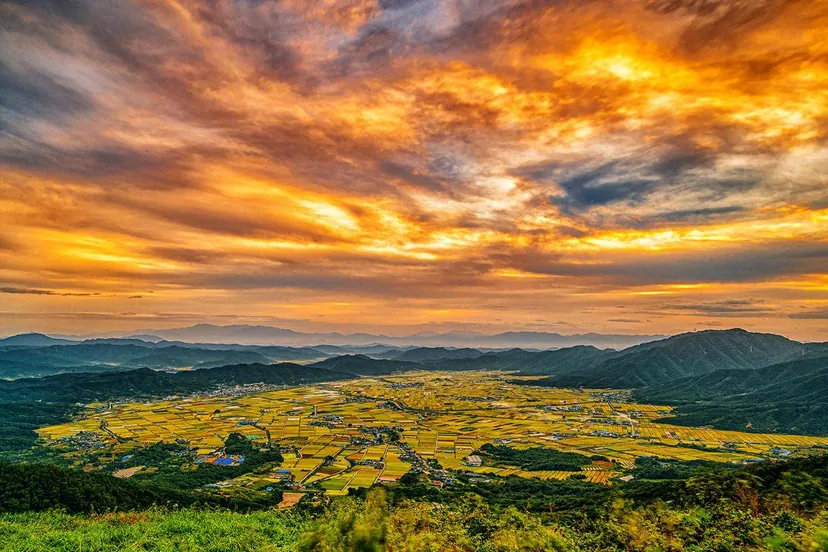
However, as geologists investigated the area, a surprising fact was revealed. Beneath the seemingly ordinary rice paddies and village lay traces of a massive space rock that struck the Korean Peninsula approximately 42,000 years ago. According to research, the Hapcheon impact event is estimated to have occurred about 42,300 years ago, with a margin of error of about 1,000 years, based on radiocarbon dating of charcoal fragments found within the impact breccia. The crater is located in the Jeokjung-Chogye Basin of Hapcheon and is surrounded by mountains approximately 200 to 700 meters high. In other words, it is a basin shaped like a giant bowl.
The fact that this is a meteorite crater rather than a simple basin was confirmed through shock metamorphic structures. A representative example is the "shatter cone." Shatter cones are not easily created by ordinary geological processes; they are formed when immense pressure and shockwaves penetrate rock. In other words, they are the rock's testimony that a truly powerful impact occurred here.

Recently, however, something even more surprising was discovered inside the crater. Evidence has emerged that could be a crucial clue to understanding the origin of life. In the heart of the crater created by a giant meteorite on the Korean Peninsula, traces have been found showing an environment where life could have sprouted on the early Earth. This does not mean that the Earth's first life began in Hapcheon. The Hapcheon crater is a young geological structure from about 42,000 years ago, while the origin of life on Earth dates back billions of years. However, this place is a vital natural laboratory that demonstrates how environments capable of fostering life actually functioned on the early Earth.
The key piece of evidence is stromatolites. Simply put, a stromatolite is a stone made by microorganisms. More accurately, it is an organic-sedimentary structure built layer by layer as microbial mats trap sediments and induce mineral precipitation. Microorganisms create a sticky film, and tiny mineral grains adhere to it. More microorganisms grow on top, and more minerals accumulate. If this process is repeated over a long period, thin layers pile up like the pages of a book, creating a unique rock structure. This is a stromatolite.
We pay special attention to stromatolites because they are among the oldest physical traces of life on Earth. The oldest stromatolites on Earth date back about 3.5 billion years. Stromatolites are important fossil records showing how microorganisms lived and interacted with their environment on early Earth. They are traces of microorganisms not merely floating in water, but actively participating in sediment transport, water flow, and mineral precipitation processes to create geological structures.
The research team discovered stromatolites on the inner northwestern edge of the Hapcheon crater, where the edge of an ancient lake used to be. At the first discovery site, more than 20 stromatolites and fragments were found in an area smaller than 1 square meter. They were roughly 5 to 20 centimeters in size, and their shapes varied—platy, dome-shaped, columnar, etc. When cut into thin sections and examined under a microscope, wavy and wrinkled thin layers are visible, with thicknesses roughly between 10 and 100 micrometers. A stromatolite about 10 centimeters in size was also found at another site, Misagol.
If we imagine the scene: about 42,000 years ago, a massive meteorite falls from the sky over the southern Korean Peninsula. At the moment of impact with the surface, tremendous energy is released. Rocks are shattered, some melt, and the ground is deeply gouged. Surrounding forests and vegetation burn, and the traces remain as charcoal fragments. The massive scar formed this way is the Hapcheon crater.
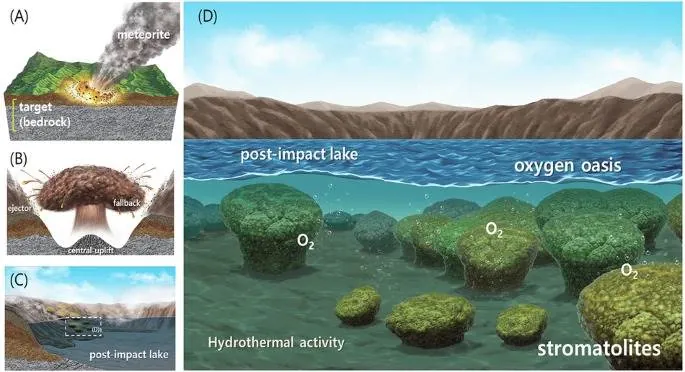
But the story did not end with destruction. Over time, water began to collect within the crater. As rain fell and groundwater seeped in, a lake formed within the basin. However, this was no ordinary lake. It held a hydrothermal environment created by heated rocks, fractured crust, and circulating water. In a sense, the Hapcheon crater was a hot lake laboratory created by a meteorite impact.
Heat rose from below, and the water reacted with the rocks, dissolving minerals. Water rich in calcium and carbonates was created, and microbial mats began to grow on the lake's edges. The microorganisms trapped sediments and induced mineral precipitation. As time passed, the stone record known as a stromatolite was left behind.
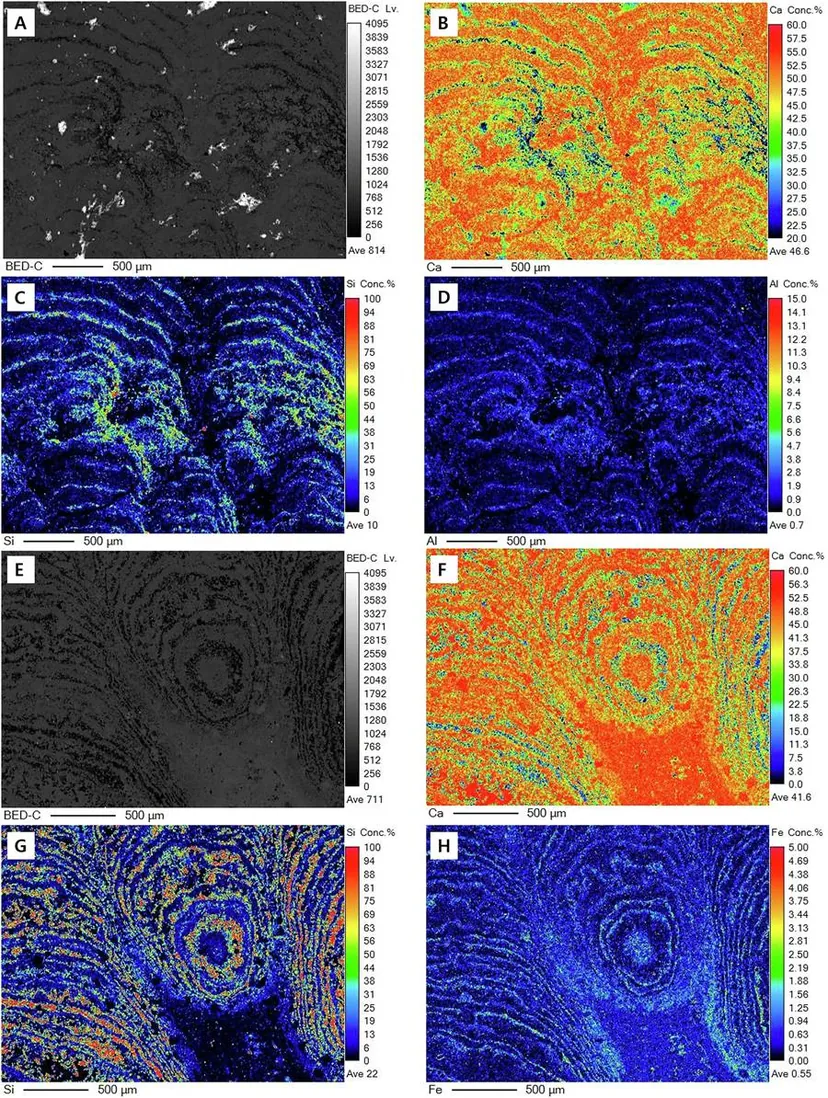
The paper reports that lake sediments approximately 65 meters thick were confirmed at a drilling site in the Hapcheon crater. This suggests that the depositional center of the paleo-lake formed after the impact was located to the northeast of the crater's center. Furthermore, elements like calcium, strontium, and sulfur were clearly concentrated in the early lake sediment layers. Specifically, the calcium signal was high at about 200,000 cps in the 72-meter to 50-meter depth section, then dropped sharply to below 10,000 cps in later stages. The research team interprets these changes as being related to an environment within the lake where calcite, or calcium carbonate, was directly precipitating.
This is crucial for stromatolite formation. Stromatolites are not just structures formed by the accidental clumping of mud. They require microbial mats and specific chemical conditions for minerals to precipitate. In particular, for carbonates to precipitate, the water must contain sufficient calcium and carbonate ions. The research team suggests the possibility that the bottom water and sediment pore water of the early Hapcheon crater lake were supersaturated with calcium and carbonate ions. In fact, calcite content in the basal lake sediment layers was as high as 8% to 10%, and up to 12% was confirmed at peripheral drilling sites. In other words, the lake in the Hapcheon crater was an excellent chemical stage for microorganisms to build stone.
However, there is an important question here: how do we distinguish whether these structures are truly the result of biological activity or merely inorganic structures that happen to look like life? The same problem always arises when studying traces of early life on Earth. Finding a structure that looks like life in ancient rock does not allow us to conclude immediately that it is life, as geological processes can sometimes create patterns that mimic life. Therefore, researchers do not look only at the external shape; they check the microstructure, mineral composition, organic matter distribution, and elemental distribution.
The Hapcheon research team used Raman microspectroscopy and Electron Probe Micro-Analysis (EPMA). As a result, layers rich in organic matter, quartz, and calcite were identified within the stromatolite. The Raman spectra confirmed signals for calcite, quartz, and carbonaceous material. Notably, detrital minerals like quartz were concentrated in the organic-rich layers, and these particles were even positioned beyond the typical angle of repose. The research team interpreted this as supporting the process of "trapping and binding," where microbial mats trap and bind sediment particles.
This is the crux of the matter. A microbial mat is like a sticky biological trap laid on the ground. When flowing water brings in small particles, the microbial mat catches them. As particles accumulate, the microorganisms grow over them again. If this process repeats, organic and mineral layers are stacked alternately. Thus, a stromatolite is not merely a stone, but a complex record created by biological activity, physical deposition, and chemical precipitation.
The next question is time. When did these stromatolites grow? The research team measured the radiocarbon age of the organic components in the stromatolites. The results were not simple; they did not emerge neatly with the inside being older and the outside being younger. In some cases, age inversion occurred, where the layers became older and then younger again toward the outside.
For example, the innermost part of the 20STR03 specimen was measured at 23,390 years ago, showed a pattern of increasing age up to 28,320 years ago as it moved outward, and then became younger again at the edge, at 14,660 years ago. The research team cautions against interpreting these values simply as absolute growth ages, because old carbon can continuously enter the lake in a crater environment.
When a meteorite impact occurs, existing surface materials, charcoal, plant fragments, soil organic matter, impact breccia, and slope deposits all get mixed up. Subsequently, as it rains, water flows, and slopes collapse, old organic matter flows into the lake. Thus, older carbon can be mixed into newly growing microbial mats. Nevertheless, it is interpreted that this specimen grew at some point between approximately 23,390 and 14,660 years ago. In the paper's figure caption, this is summarized as between approximately 24,300 and 14,600 years ago.
Now the overall picture is clear. At first, there was an impact. The impact shattered the ground, heated the rocks, and created cracks underground. Then, a lake formed inside the crater. A hydrothermal system operated as hot rocks and water reacted. The lake became rich in calcium and carbonates, forming an environment with high pH and salinity. Microbial mats grew on the lake's edges. The microorganisms trapped sediments, induced carbonate precipitation, and created stromatolites. Inside those stones, osmium fingerprints of the meteorite and europium fingerprints of hydrothermal activity were left together.
This is the most important message of this discovery. A meteorite crater is not just a trace of death. It can become a unique habitat where life thrives for a certain period after the impact. The paper suggests the possibility that the hydrothermal activity in the Hapcheon crater lasted for at least 27,000 years or more after the impact. The criteria are the impact time of about 42,300 years ago and the minimum stromatolite age of 14,660 years ago. In other words, the hot environment created by the impact may not have been a fleeting spark but a geological heating system that lasted for tens of thousands of years.
This is where the story of the origin of life begins. For a long time, we have linked the origin of life to deep-sea hydrothermal vents. The hypothesis is that hot water rises from the deep ocean, complex chemical reactions occur in a mineral-rich environment, and the first life or its precursors were born there. This hypothesis remains strong, but there are difficulties in the deep sea. While life needs water, too much water can be detrimental to the formation of complex organic molecules. For molecules to connect and form long chains, concentration is sometimes necessary. The cycle of wetting and drying can be advantageous for bringing molecules close together and promoting bonding.
Terrestrial crater lakes can provide exactly this environment. When it rains, water fills the crater; when it dries, the edges dry out. Hot hydrothermal fluids supply minerals. Light enters the edge of the lake, and microbial mats grow easily in shallow water. Sediment, metal components, and old organic matter continue to flow in from the crater walls. In other words, the crater is a dish made by destruction, an incubator warmed by geology, and a small planetary laboratory where chemical reactions are repeated.
The paper concludes that the findings from the Hapcheon crater show that hydrothermal activity generated by meteorite impacts on the early Earth could have promoted the growth of stromatolites within the crater. Furthermore, it suggests that because asteroid impacts were much more frequent on the early Earth, the possibility that the proliferation of stromatolites in such craters acted as local oxygen oases should be examined.
The "oxygen oases" mentioned here are important. We live in an oxygen-rich world today, but early Earth was not. The Great Oxidation Event, where atmospheric oxygen increased significantly, occurred about 2.4 billion years ago. Even before that, it is possible that photosynthetic microorganisms locally produced oxygen. However, that oxygen did not immediately change the entire Earth. There may have been small oases first. Oxygen may have been produced bit by bit in local environments such as shallow lakes, microbial mats, and where stromatolites grew. These small pockets of oxygen may have accumulated, repeated, and expanded over a long time, eventually preparing the way for changes in the entire global environment.
However, one point must be made clear. The stromatolites in the Hapcheon crater are not life from 3.5 billion years ago on the early Earth. This does not mean that the first life on Earth was born directly in Hapcheon. The paper also handles this point cautiously. Hapcheon stromatolites are not direct evidence of the evolution of oxygenic photosynthesis or the Great Oxidation Event. In particular, palynological data from the Hapcheon paleo-lake suggest that green algae were dominant, and the evolution of green algae is much later than the Great Oxidation Event. Therefore, it would be an exaggeration to say that the Earth's first life was discovered in Hapcheon.
To be precise, the Hapcheon crater is a natural laboratory showing that a lake-hydrothermal system created after an impact in a young Earth environment could actually support the growth of microbial structures like stromatolites. We are not seeing the beginning of life in Hapcheon right now. However, we are seeing how the environment in which life could have begun worked. This difference is important.
This discovery is also very interesting from an astronomical perspective. Meteorite craters are not unique to Earth. They exist on the Moon, Mars, Mercury, and many celestial bodies in the solar system, including icy moons like Europa and Enceladus. Mars, in particular, is a planet that had water in the past, and the possibility of ice and brine underground is still being discussed. If a Martian crater once held water, created a hydrothermal system due to the impact, and structures similar to microbial mats formed within it, those traces could still remain in sedimentary rock today.
This could change the strategy for extraterrestrial life exploration. When we look for life, we often look for water first. This is a correct approach. But now we need to ask more specifically: How long did that water stay? What kind of rock did that water react with? Was there a heat source there? Were minerals supplied? Was there a shallow edge, cycles of wetting and drying, and a surface where microbial mats could grow? A crater can provide these conditions all at once.
Meteorites can destroy life. But at the same time, they can break the crust, supply heat, create waterways, dissolve minerals, create lakes, and provide the space for a new ecosystem to begin. The history of life may not have started only in peaceful places. Rather, new chemistry may have begun in broken, heated, mixed, and wounded places. Life on Earth may not have been born in a perfectly stable greenhouse, but on the edge of collisions, volcanoes, lightning and UV radiation, drying and flooding, and toxicity and energy.
In that sense, the Hapcheon crater shows a beautiful paradox. The stone that fell from the sky once destroyed the ground. The impact shattered mountains and rocks, burned plants, and left a deep basin. But as time passed, water collected in that wound. Hot rocks heated the water, the water carried minerals, and microorganisms created a thin film on top. The film trapped sediments, layers stacked one by one, and finally, the traces of life became stone.
There were many times I regretted that scientifically interesting sites could only be seen abroad. Like the Chicxulub crater in Mexico, the site of the dinosaur extinction, Meteor Crater in Arizona, USA, or the stromatolite fossil sites in Australia, giant and important scientific sites always felt like they were far away. But in fact, such a site exists right in the middle of the Korean Peninsula. There is a giant crater left behind by a meteorite, and inside it remain traces of a lake and hydrothermal environment created after the impact. Furthermore, stromatolite fossils were discovered that show how life could have sprouted on the early Earth. One of the most wonderful sites, interesting astronomically, geologically, and biologically, is right here in Hapcheon, Korea.
So, this small layered rock found under the rice paddies of Hapcheon asks us a very big question. Did life begin in a peaceful world? Or did it begin in the wounds left by the violent collisions of the universe, where water, heat, and minerals met? We do not know the answer yet. But we now know at least one thing: A meteorite crater is not just a trace of death. Sometimes, it is a vessel where life grows again.
For this summer vacation, it might be a good idea to go on a science tour to Hapcheon. It would be a journey to imagine for yourself the giant cosmic wound hidden between rice paddies and villages, and the traces of life that grew within that wound. You might be able to encounter, in the closest place possible, how a stone that fell from the sky came to tell the story of life on Earth.
Reference