

[비즈한국] A quiet war is underway in the offline payment terminal market between Toss Place’s "Toss Front" and Naver Pay’s "N Pay Connect." Both terminals support card, QR, NFC, and simple payments, as well as face recognition payment (Face Pay/Face Sign), and are equipped with mini-kiosk, coupon, and loyalty point features. In terms of specifications, it is difficult to find significant differences. We examined what actually sets them apart from the perspective of store operations.
Competition for Merchants: Fierce Marketing with Free and No-Contract Offers
The costs and contract structures of the two companies are not significantly different. Both companies supply terminals to VAN (Value Added Network) agencies, which handle sales, installation, and management. Monthly fees, contracts, penalties, and installation costs are determined by the policies of the agencies, not the headquarters. There is no separate device usage fee, only the cost of the device, but neither company has disclosed the supply price of the terminals. According to industry insiders, it is known to be at a similar level to existing card terminals.
The key factor is the subsidy. If a payment terminal subsidy—applicable to small merchants with annual sales of 300 million KRW or less—is applied, the target stores can effectively benefit from "0 KRW promotions" and install the terminals without burden. On the other hand, stores with annual sales exceeding 300 million KRW typically use them by purchasing at retail price or through benefits offered by specific promotions. Since some agencies handle both brands, conditions vary by timing and provider.
Competition between agencies has heated up recently as Naver has been putting more effort into expanding Connect. Some firms are offering free terminal installation with an 18-month free A/S period attached to a contract, while others that handle both services are promoting "Connect 0 KRW" deals at the forefront.
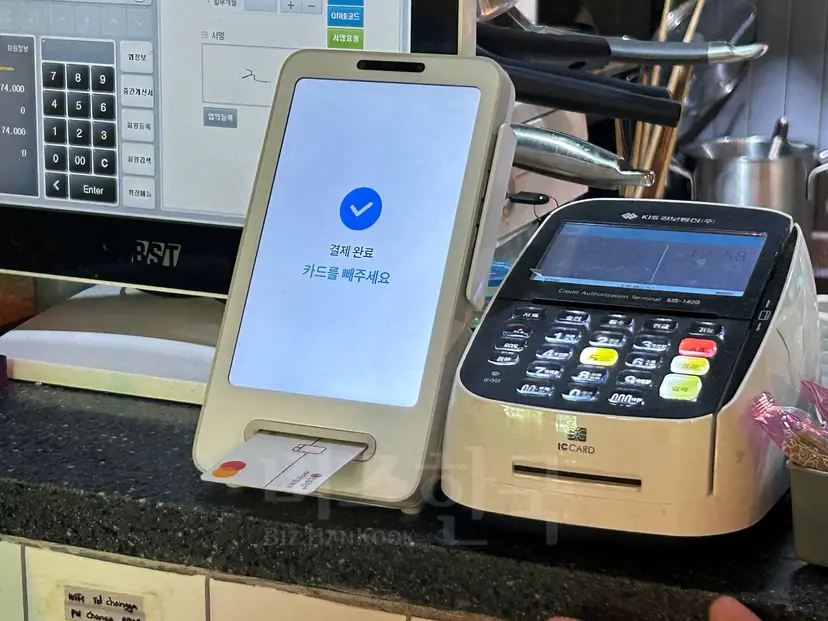
A Mr. Jung, who runs a cafe in Jungnang-gu, Seoul, said, "I didn't want to be tied to a contract, so I used the Toss Front and software for free, and only paid 69,000 KRW in a lump sum for the receipt printer (Toss 'Terminal')." A Mr. Kim, who operates a chicken franchise store in Geumcheon-gu, Seoul, said, "The agency that supplied my old POS contacted me first and offered to replace it for free, so I switched to Connect last month. I haven't noticed any changes in conditions like card fee hikes or installation costs."
Total POS Integration vs. Keeping Existing POS with Efficient Terminals
The real difference lies in the POS operating method. Toss operates its terminals (Toss Front/Terminal) along with its proprietary "Toss POS" software. Toss POS, which is provided for free, can be installed in environments including Mac, Windows, Android tablets, and iPads. Business owners can choose whether to just attach the terminal to their existing POS or use the full Toss POS. Sales, ledgers, inventory, reservation management, and VAT filing data downloads can all be done in one place. It is also linked to an app, allowing owners to check sales by card company or delivery app in real-time even outside the store. If necessary, additional devices can be added for the kitchen, though this incurs extra costs.
Naver does not have its own POS. The structure allows owners to keep their existing POS systems, such as Easy POS or OK POS, and only change the payment terminal. A Naver Pay representative stated, "POS is a system that significantly impacts store operations, so the advantage is that you can maintain a familiar environment while adding various payment methods and review functions," emphasizing that it is a collaboration model with VAN and POS companies.
Toss Leads with 400,000 Merchants, Naver’s Rapid Rise to 100,000
Toss opened the market first with its official launch in March 2023. It currently leads the market with 400,000 merchants. The terminal supports cards, Samsung/Apple Pay, QR, NFC, and Face Pay, as well as policy-based payments like Zero Pay, local currency, and public livelihood recovery coupons—all in one device.
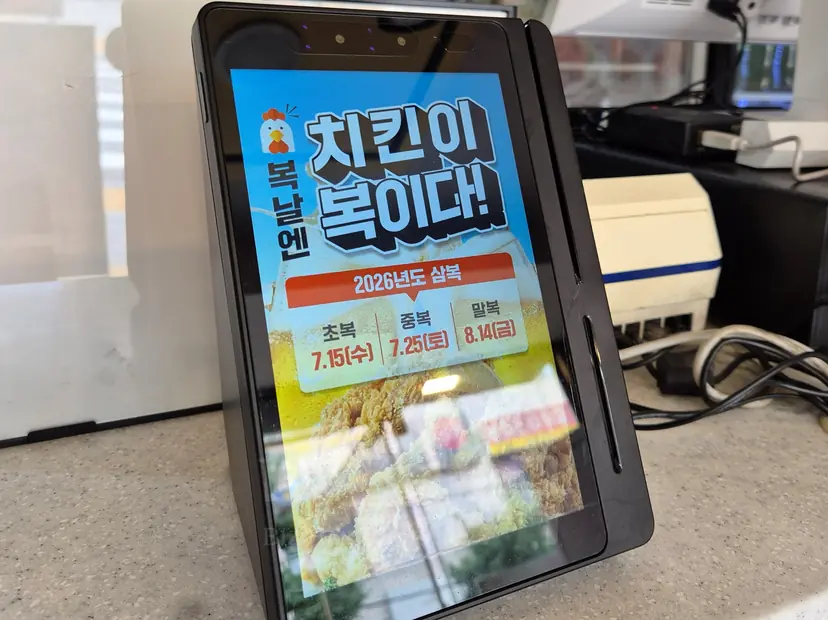
Features designed to reduce the workload on store owners are also notable. If a paper menu is photographed and uploaded, it automatically recognizes and registers menu names and prices. For stores with many items, products can be uploaded in bulk via Excel. The "Front Decoration" feature, which uses the standby screen for promotions, includes a reservation function, allowing franchise headquarters to distribute seasonal images to stores collectively.
It also supports table/pickup orders where customers order via QR without a separate tablet, identity verification for alcohol/cigarette sales using mobile IDs, and stamp rewards accumulated simply by paying without entering a phone number. A Toss Place representative explained, "Since merchants are our primary customers, we have been reflecting feedback immediately. The mini-kiosk was a feature created at the request of store owners back when small card terminals didn't have kiosk functions."

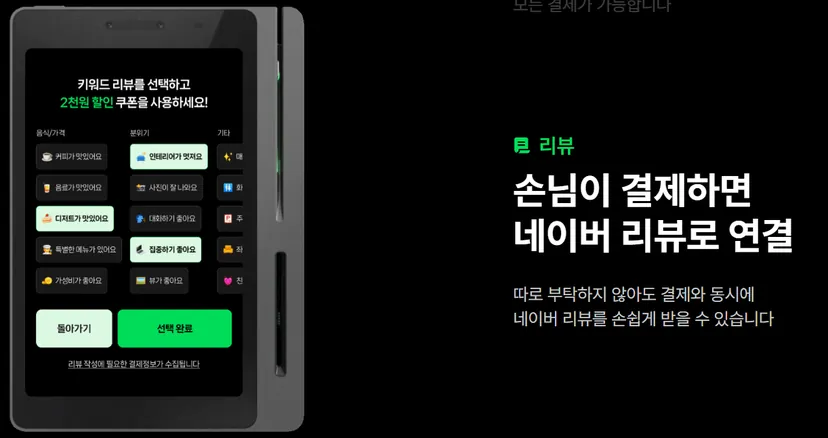
Connect, launched last November, has secured about 100,000 merchants; while it is a latecomer, its growth is steep. The core focus is reviews. If a customer logs in via the QR code on the screen immediately after payment, they can leave keyword reviews tailored to the industry without having to verify receipts, and coupons that previously had to be obtained through search or maps can be applied immediately on-site. The mini-kiosk ordering and local currency payment functions previously introduced by Toss are also available.
As it is a structure that integrates payments into the Naver ecosystem—connecting search, maps, and Place—it is evaluated as being advantageous for cafes, restaurants, hospitals, and hair salons where reviews and exposure directly lead to sales. The group's weight has also been placed behind it, with Chairman Lee Hae-jin personally demonstrating Face Sign payment during the so-called "Samso Meeting" with Nvidia CEO Jensen Huang and other heads of major domestic companies last month. There are also plans to introduce reservation integration and CRM functions in the future.
The Variable: Network Stability
Card fees and settlements are handled by VAN companies for both parties. An agency official remarked, "Fees are similar for both companies at around 1%, and settlement periods are typically similar, within one to two days." They added, "Toss is a structure that ultimately leads into its own POS ecosystem, so there are separate integration costs every time you attach a printer or kitchen device. In the case of Naver Connect, since it integrates with separate POS systems, compatibility issues may arise."
Network stability is considered a variable. If the payment machine stops, only cash or money transfers remain, making operational disruptions inevitable. Toss Front experienced payment errors in May, and Naver Pay also faced outages related to points and money in February. Both companies are strengthening their response systems.
A Naver Pay representative stated, "Offline merchants can further expand their connections with customers through existing Naver search and maps via Connect. We will gradually enhance functions to increase the effectiveness of securing regular customers for merchants."
A Toss Place representative said, "We have been supplying terminals directly because we believed this direction was correct from the time the market's viability was not yet confirmed. We will continue to add functions that various merchants want, tailored to their specific industries."