

[비즈한국] There are broadly two ways in which pop culture content deals with history. One focuses on the grand structures, movements of eras, and significant figures, while the other illuminates the ordinary men and women—the common folks—who silently endured and lived through those times. If the former can be called a macroscopic approach, a way of looking at the forest, the latter can be considered a microscopic approach, a way of looking at the trees.
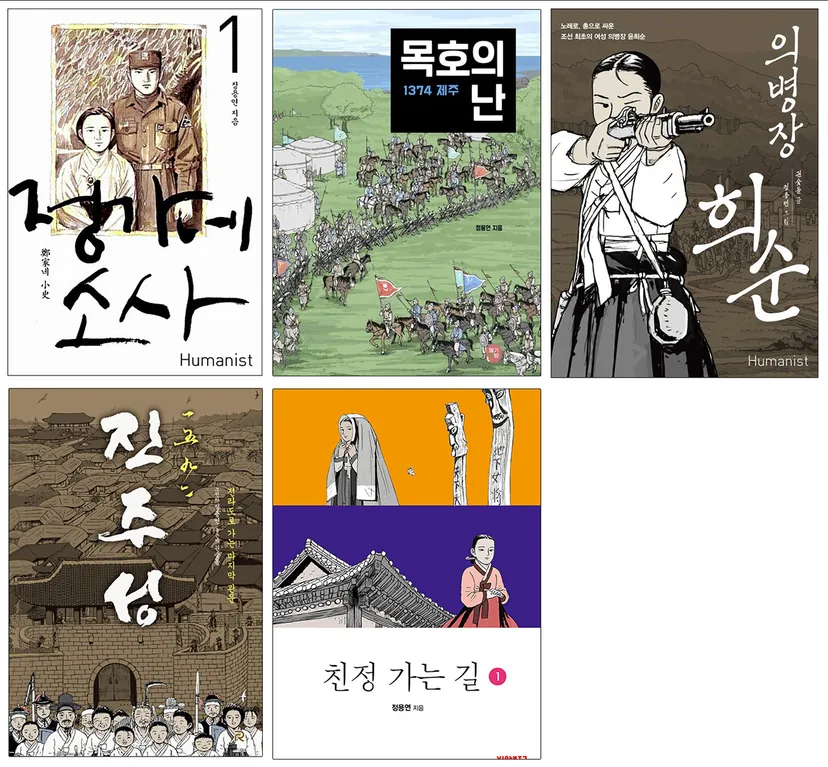
Even while holding a thin, lightweight smartphone in our hands, it is an old habit to follow the grand and heavy narratives featuring heroes and great figures with our eyes. However, there are those who cast their gaze away from the main streets of Jongno or the deep, walled palaces to embrace and depict the “Pimatgol” alleyways and the humble dwellings of the common people. I met cartoonist Jung Yong-yeon, who has spent over 10 years looking deeply into the lives of ordinary people through works like "Jeong-ga-ne Sosa," "Mokho Rebellion: 1374 Jeju," "Righteous Army Leader Hee-soon," and "1592 Jinjuseong," at a ppyeo-haejang-guk (pork bone hangover soup) restaurant in Bucheon, Gyeonggi-do.
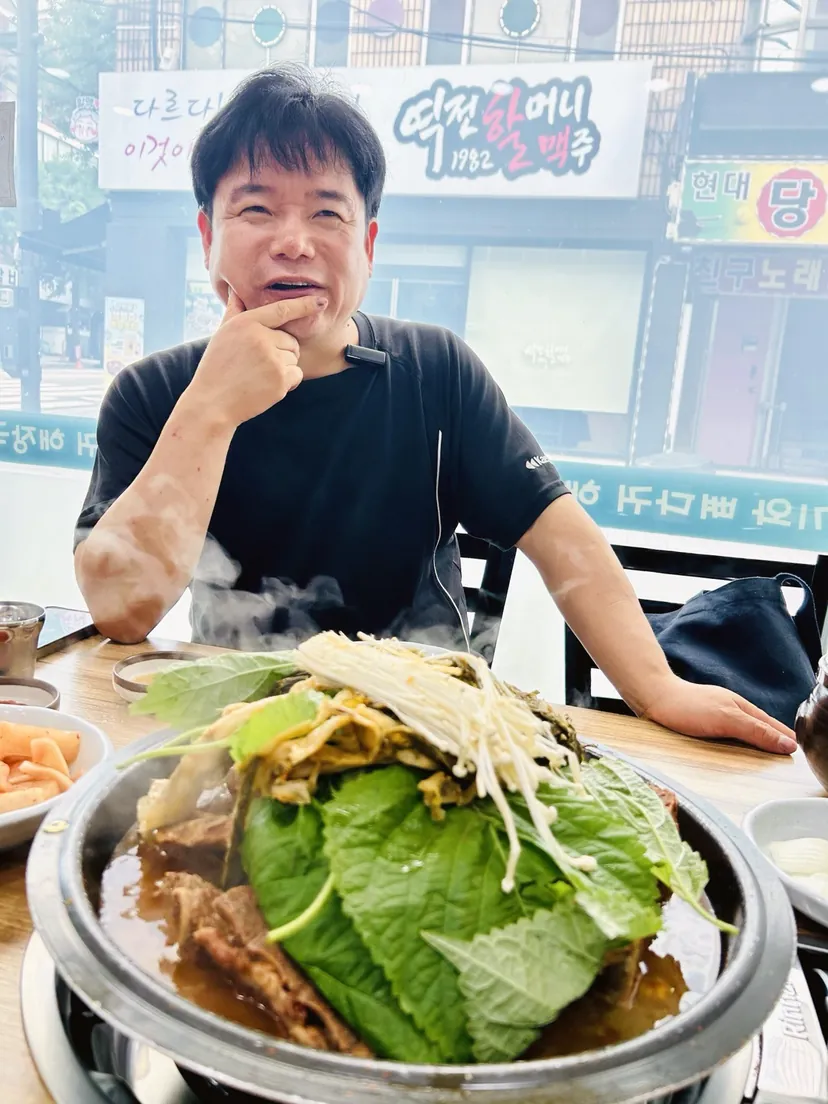
Ppyeo-haejang-guk Over Hokkaido Delicacies
In the alley in front of the Wonmi-gu Office in Bucheon, the original branches of two famous ppyeo-haejang-guk restaurants face each other. There used to be a third, leading to a "Romance of the Three Kingdoms" scenario, but with two left, it has become a "Chu-Han Contention." Since Jung Yong-yeon, who resides in a studio at the Korea Manhwa Museum, picked ppyeo-haejang-guk as his soul food, I headed to that very alley where the "pork bone war" continues.
Ever since he witnessed a gruesome cattle slaughtering scene in his childhood, the artist has avoided beef, making ppyeo-haejang-guk his go-to choice for dining out. He eats it when meeting colleagues and when hiking nearby Mt. Sapae. He recently mentioned having the best ppyeo-haejang-guk of his life at a restaurant in Sadang Station after walking the Seoul Trail for a long time with fellow cartoonist Kim Kyung-ho ("Ghost General Mudongi," "Beondegeez"), and said that during his trip to Hokkaido, Japan, last year, he craved ppyeo-haejang-guk desperately even with exotic delicacies in front of him. We spent a long time talking about the ppyeo-haejang-guk we were eating, while eating ppyeo-haejang-guk, and sharing stories about how much he missed it.
One might think he had been eating it since birth, but Jung first encountered ppyeo-haejang-guk as an adult while hanging out with friends. He says there was nothing better than sitting across from friends with ppyeo-haejang-guk and alcohol. Affection grows for food that holds memories of friendship.
A Narrative Set on a Small Table
For Jung Yong-yeon, food is a medium filled with sentiment. It is the mulberry and croaker in "Jeong-ga-ne Sosa," the bing-tteok in "Mokho Rebellion: 1374 Jeju," and the azalea pancakes in the short story "Spring." These items are infused with midsummer friendships, romantic feelings, memories of neighbors and fathers, and the lingering attachment and yearning for lovers who have departed. Although the artist's work is not specifically about food, he treats food as a primary element containing the primordial life and emotions of humans. In his work, food and the act of eating are key devices that reveal the characters' narratives and relationships.
As a result, he is meticulous in drawing the tables holding the food and the spaces where the tables are placed. In his work "Yak-hyeon," which was selected for the 2023 Korea Manhwa Museum's diversity comics production support project, he initially drew a scene where people were sharing a table in the Joseon Dynasty setting. Realizing it was a historical inaccuracy, he corrected it by having the table removed and redrawing the scene with individual dining tables. During the interview, the artist brought an old Haeju-ban (a small tray table from Haeju) he owns, saying it was the one he used as a reference. This table, supposedly made in Haeju, Hwanghae-do, also appears in the dining scenes of "1592 Jinjuseong" and the short story "Sister-in-law."
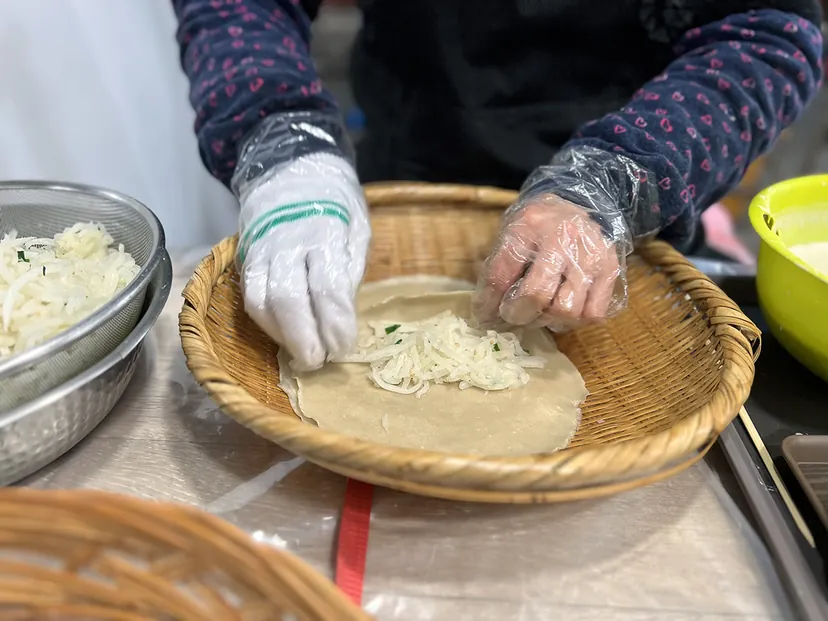
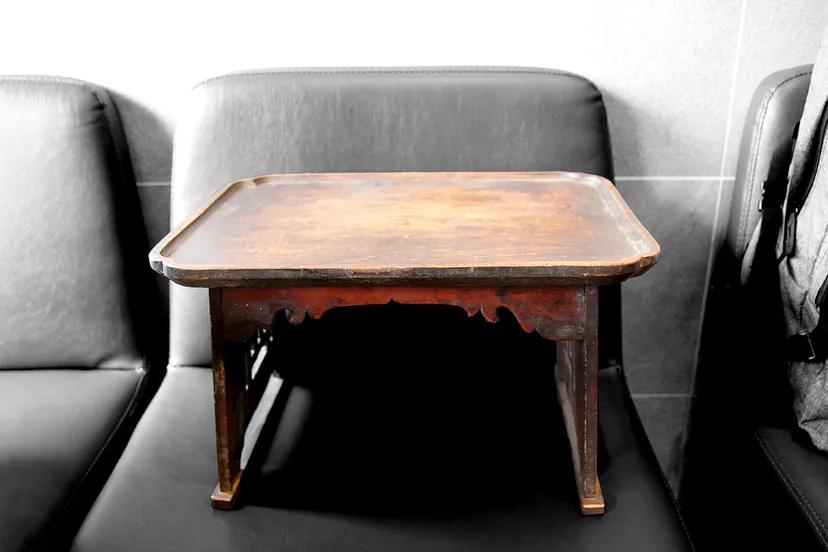
The artist's collection of small tables, which he began gathering one by one as a hobby, has now grown to seven. He says that looking at these tables, each with different characteristics by region—such as Haeju-ban, Naju-ban, Ho-jok-ban (tiger-leg table), Gae-dari-soban (dog-leg table), Tongyeong-ban, and Gangwon-do-ban—allows one to feel their unique structural beauty. Drawing historical works that always require a "war" against historical verification has led to mistakes, but the process of overcoming those mistakes has built in him a meticulousness that pays closer attention to detail.
The artist said that although he doesn't know when, he would like to organize and exhibit the tables and utensils he has collected, along with the stories behind each acquisition, if given the chance. Knowing how affectionate the narratives set upon the tables he arranges are, I told him he must let me handle the planning of that exhibition.
Painting the Micro-History of Nameless People
Although he debuted as a cartoonist in 1991 by publishing "Night of Hades" in a weekly comic magazine, it was the publication of "Jeong-ga-ne Sosa" in 2012 that truly brought Jung Yong-yeon's name to the forefront of the comics industry. Since then, he has consistently released history-themed comics through books like "Mokho" (later published as "Mokho Rebellion: 1374 Jeju"), "Righteous Army Leader Hee-soon," and "1592 Jinjuseong," as well as short and medium-length works like "Yong Seo-in," "Goe-ryeok-nan-sin," and "Cheongpa Station," all published in the Korea Comics Association's anthology "BOGO."
The artist explains that being born into a family that wasn't well-off, not being able to go to college right away, and living through various jobs including factory work, construction, and sales after his debut, led him to focus on the lives of ordinary people.
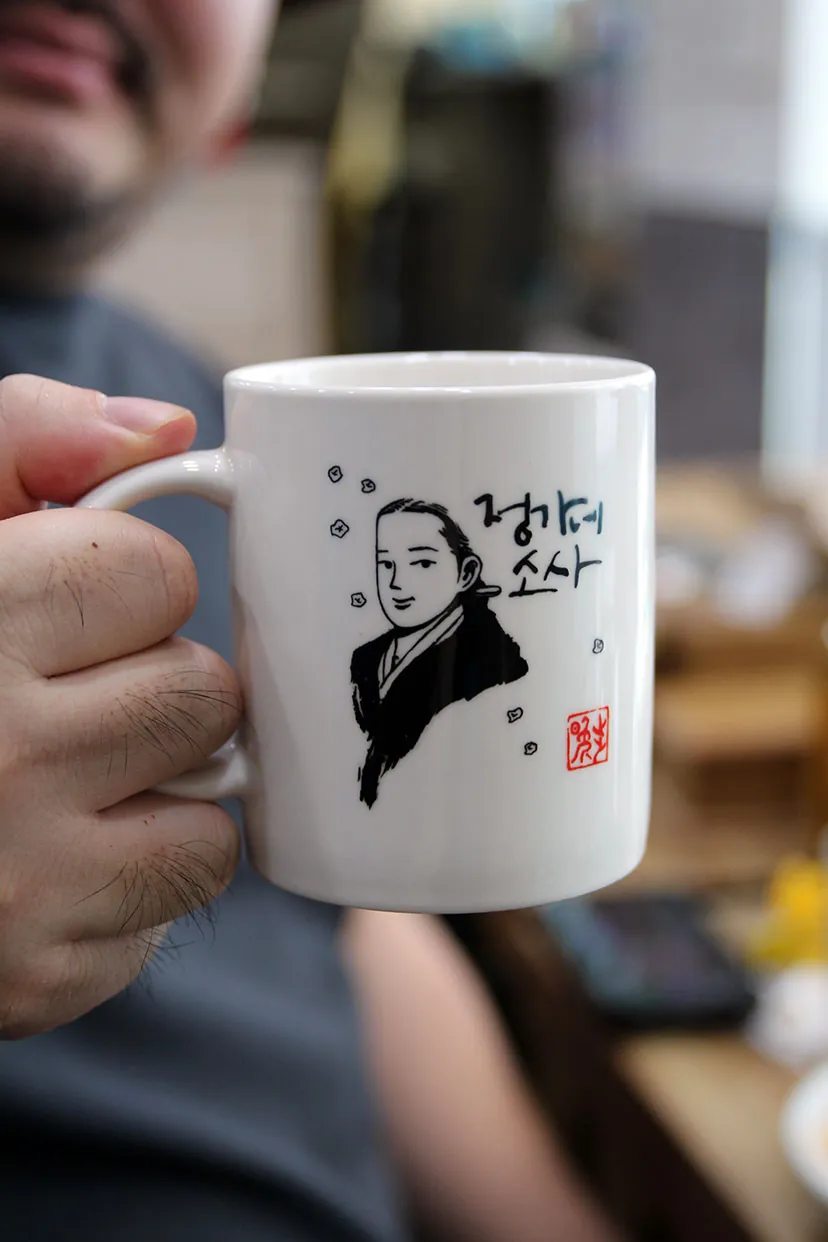
If the autobiographical family history and "small history" contained in "Jeong-ga-ne Sosa" are in touch with the grand gears of modern and contemporary history, then in "Mokho Rebellion: 1374 Jeju," the stories of Jeju people massacred during the Yuan Dynasty's interference period follow the churning ocean currents to lead to the April 3 Incident and Gangjeong Village. In the afterword of "1592 Jinjuseong," which depicts the story of Admiral Kim Si-min and the people of Jinju who protected the path to the Honam granary during the Imjin War, the artist wrote, "Everyone is a protagonist." He depicted not the high-born, but those who shared the burden of history's backbone—the nameless, the obscure soldiers, the true owners of history. The very stories that grand narratives and discourses pettily erase.
In the artist's work, where even large battle scenes are drawn one by one with a spoon pen without the help of SketchUp or AI, it is difficult to find the feats of heroes like the great Xiang Yu. The scenes of the Saebyeol Oreum battle or the Beomseom Island siege in "Mokho Rebellion: 1374 Jeju," and the battle scenes in "1592 Jinjuseong," are overwhelming, but the power driving those scenes does not come from Choe Yeong or Kim Si-min. In a war where everyone stakes their only life, ten people's firm steps decide the outcome rather than one person's ten steps.
Jung Yong-yeon is currently balancing work on support projects, submission to contests, and finishing incomplete manuscripts. He says there are about five books' worth of works waiting for a chance to be released to the world, and finishing these is his current goal. The artist said he is "enduring" as an artist, but there are many readers waiting for his work—an artist who draws our story here and now, rather than the exotic flowers on a distant mountain. I hope his spoon pen stays busy for a long time.
While reviewing the interview with the artist, which lasted from lunch until dinner, I looked up the work "Lunch" by Danwon Kim Hong-do, whom the artist respects. Looking at this painting from the "Danwon Pungsokdo-cheop" (Album of Genre Paintings by Danwon), one can see nameless commoners eating lunch in their own way, from the men eating barley rice and makgeolli after hard labor to the mother breastfeeding her child beside them. A gaze contains intent. The lunch spent meeting Jung Yong-yeon taught me why Danwon stared intently at the mundane landscape of nameless people tilling the land, raising children, and sharing meals and drinks together.
He prefers literary and restrained drawings and stories over works with high commercial entertainment value. He cites Jiro Taniguchi, who drew "The Solitary Gourmet," and Yoshiharu Tsuge of "Nejishiki" as his favorite cartoonists. He is also very interested in old Japanese gekiga and art comics. He names Jiro Taniguchi as the artist he respects most, valuing not only his excellent cartooning techniques but also his attitude of silently continuing his own world throughout his life. He says he also likes Sanpei Shirato of "Kamui Den" and Katsuhiro Otomo of "Akira" very much. "Compared to the activities of such people, I haven't reached even the tip of their toes, but I am still drawing comics." The humbleness in Jung Yong-yeon's words carried a longing for consistency.