

[비즈한국] German software company SAP completed the acquisition of German artificial intelligence startup Prior Labs on July 17. The company, established in late 2024, was brought into the fold of Europe's largest software firm after only about 18 months of existence.
The deal amount was not disclosed. However, SAP announced it would invest over 1 billion euros (1.67 trillion won) in Prior Labs over the next four years to grow it into a world-class AI research institute focused on structured corporate data. Even after becoming part of SAP, Prior Labs will retain its existing brand, research organization, customer relationships, Freiburg headquarters, and offices in Berlin and New York. It also plans to continue its open-source strategy of making research results and AI models publicly available.

An acquisition just 18 months after founding might make it look like a company that succeeded overnight with a single idea. However, it is difficult to truly understand Prior Labs if you calculate its timeline solely from the date of incorporation.
The Start of the Technology Was Faster Than the Start of the Company
The core technology of Prior Labs is an AI model for tabular data called "TabPFN." It is a technology that analyzes information composed of rows and columns, such as Excel files we use frequently, or corporate data related to customers, accounting, production, and inventory.
Currently, the AI market's attention is focused on Large Language Models that generate text, images, and video. However, the foundation of actual corporate operations still relies on tables and numbers. To predict which customers will churn, which client's payment might be delayed, how much product demand will occur, or whether there is a risk of supply chain issues, companies must analyze the structured data they have accumulated.
Previously, every time new data arrived, data specialists needed to select and train a separate machine learning model. TabPFN adopted a method of using a single model pre-trained on massive amounts of synthetic data to perform predictions on new data immediately.
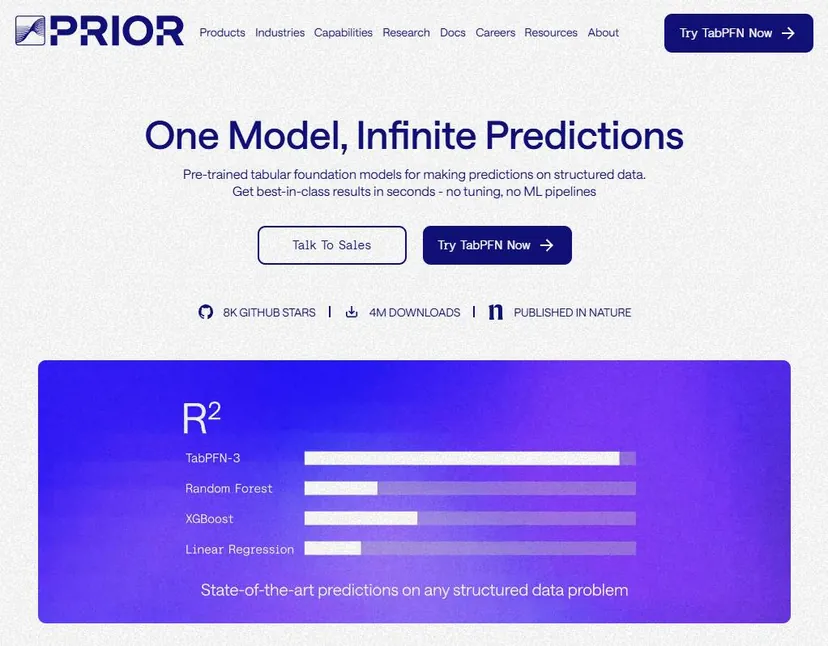
The starting point of this technology was a paper published by a research team at the University of Freiburg in Germany in 2022. Subsequently, improved research results on TabPFN were published in the scientific journal Nature in 2025. The researchers stated that on small-scale tabular data sets consisting of up to 10,000 samples, TabPFN showed faster and higher predictive performance than existing machine learning and automated machine learning models.
The research team founded Prior Labs in late 2024 to commercialize the technology. Corporate registration took place in December 2024. In February of the following year, the company raised 9 million euros (15 billion won) in a pre-seed round led by European venture capital firm Balderton Capital. The Hector Foundation, established by SAP co-founder Hans-Werner Hector, also participated in the investment.
In May 2026, just over a year after its founding, the acquisition agreement was signed with SAP, and the deal was finalized in July following regulatory approval. According to Prior Labs, the TabPFN open-source model had exceeded 3 million downloads at the time of the acquisition announcement and had been utilized in hundreds of independent academic studies. Rather than prioritizing rapid revenue growth in a short period, the company chose a strategy of defining a new AI technology territory and becoming a standard used by researchers and developers.
Although Prior Labs was acquired after only 18 months, what SAP acquired was not technology created over 18 months. It was the result of at least four years of research that began in a university lab and evolved through papers, open-source projects, and validation by external researchers.
A Combination of Two Researchers and an M&A Expert
Prior Labs’ founder composition also reflects the characteristics of European deep-tech startups. Co-founder Frank Hutter is a professor of machine learning at the University of Freiburg and a leading researcher in automated machine learning, which allows AI to find the appropriate models and settings on its own. After studying at the Technical University of Darmstadt, he earned his PhD from the University of British Columbia in Canada and has received European Research Council grants three times. He is currently on leave from the university to lead research at Prior Labs.
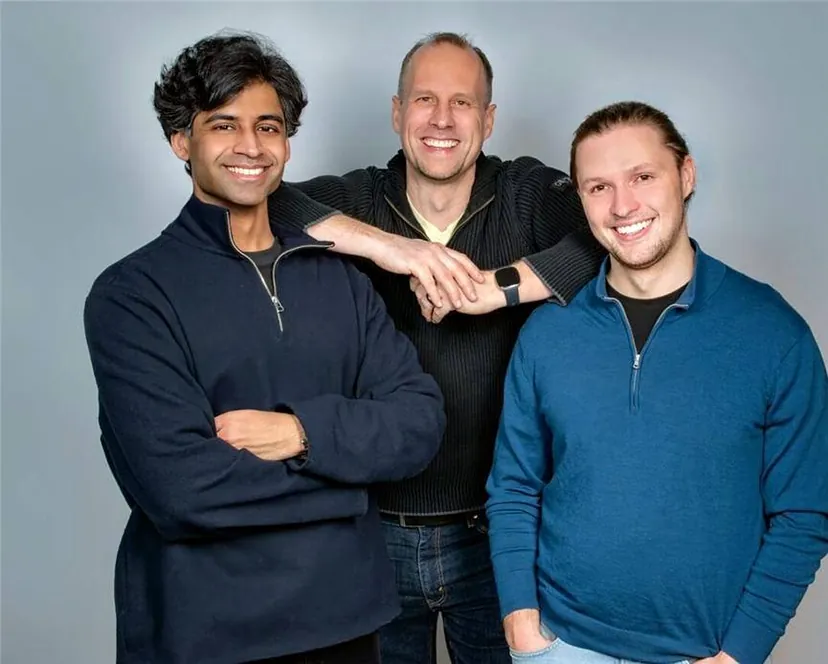
Noah Hollmann is the lead author of the TabPFN paper and a co-founder of Prior Labs. Having studied both medicine and computer science, he has focused on the problem of using AI to analyze structured data accumulated in the medical and scientific fields. In other words, the company's core product was not introduced from the outside after the founding, but originated from research the founders conducted themselves.
The third co-founder, Sauraj Gambhir, is not a technical researcher but an expert in investment and mergers & acquisitions. He participated in the growth of the RBC Ventures organization in Canada from about 20 to over 400 people, and later handled investments from Series A to D and corporate divestment deals at ING Ventures in the Netherlands. At Prior Labs, he was responsible for fundraising, business development, operations, and growth.
Having good technology does not automatically build a good company. Converting research results into a product, persuading investors, applying it to customers, and finalizing a deal with a large enterprise require different sets of skills. Prior Labs formed a team from the start that included a professor with academic authority, a researcher who developed the technology, and a businessman with experience in investment and M&A.
Since the acquisition, Prior Labs has shifted to a co-CEO system. Gambhir oversees business, and Hutter leads research. This seems to be a choice to separate research and business without making one a subordinate function of the other.
LeanIX Took 11 Years, Prior Labs Took 18 Months
This is not the first time SAP has acquired a startup. In 2021, it acquired Berlin-based business process management company Signavio. In 2023, it acquired LeanIX, which analyzes the entire structure of a company’s software and IT systems, and in 2024, it acquired WalkMe for about $1.5 billion, which guides employees to easily use new enterprise software.
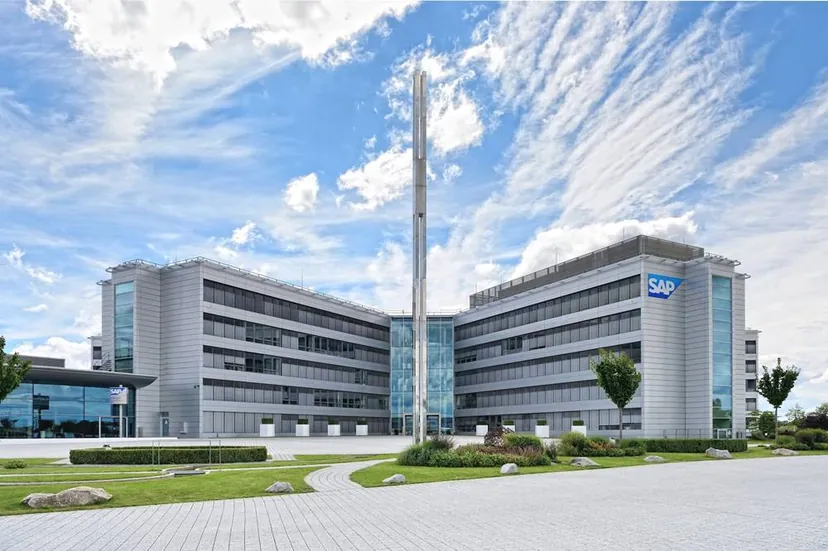
Recently, it also acquired Dremio, a data platform company that connects internal and external SAP data. While they are software companies in different fields, connecting them reveals the picture SAP is trying to paint.
Signavio analyzes how business processes actually operate. LeanIX shows what applications and IT systems a company is using. WalkMe helps employees introduce new systems into their actual work. Dremio connects data scattered across various locations. To this, Prior Labs adds the ability to predict the future from corporate data.
The difference between LeanIX and Prior Labs is particularly interesting. LeanIX was founded in Bonn, Germany, in 2012 and acquired by SAP in 2023. It took about 11 years from founding to acquisition. At the time of acquisition, it had over 1,000 customers worldwide. Most importantly, LeanIX had been a strategic partner of SAP and Signavio for about 10 years before the acquisition. SAP observed LeanIX's product and organization over a long period and confirmed their potential for synergy through joint customers and product integration before acquiring the company.
In contrast, Prior Labs did not wait to build up sufficient revenue and a customer base. What SAP judged was not the company’s current size, but how important their technology would be in the future enterprise AI market.
If LeanIX was a "relationship-accumulation" acquisition following a long partnership, Prior Labs is closer to a "technology-preemption" type, securing the lead in a new technological field early on.
European Startup Acquisitions Take Time
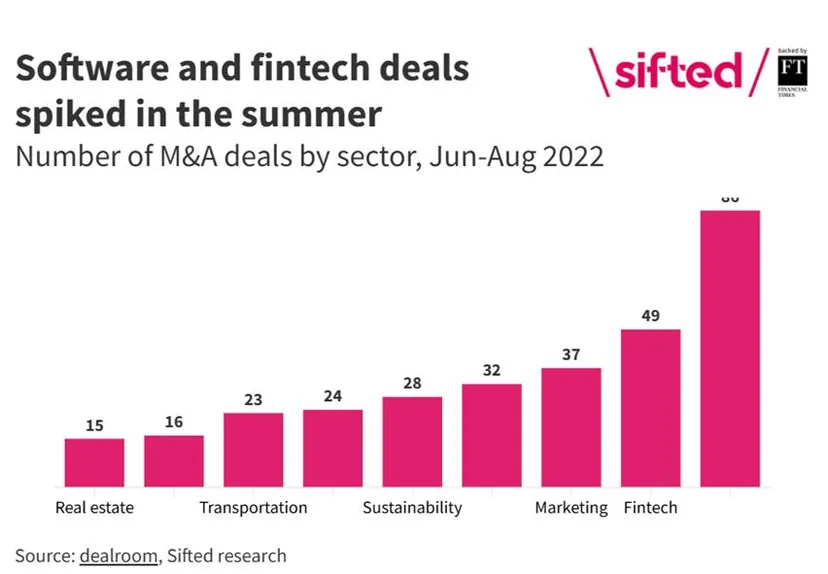
Prior Labs’ 18-month journey is exceptional even when compared to the typical European startup acquisition process. According to an analysis of 443 M&A cases of European technology companies by Sifted, a media outlet specializing in European startups, it takes an average of seven years from startup founding to acquisition. The most frequent investment stages just before acquisition were Seed and Series A, and by sector, enterprise software acquisitions were the most active.
In Europe, even when good technology emerges from universities or research institutions, it takes a significant amount of time to become independent, build products, and secure the first industrial customer. Different laws and regulations for each country, fragmented markets, and growth capital markets smaller than those in the U.S. also slow down the expansion speed of companies.
According to the European Commission, about 30% of European unicorn companies relocated their headquarters outside the EU between 2008 and 2021. More than 60% of European startup acquisitions are also by non-EU companies. While Europe is strong in research and early-stage startups, it still shows weaknesses in growing companies to a global scale and in the virtuous cycle where European companies acquire each other.
Because of this, SAP's acquisition of Prior Labs holds a significance that goes beyond the investment in one company. Technology that started at the University of Freiburg was acquired by a German company instead of a U.S. giant, and the research organization remains in Europe. SAP decided to provide capital, corporate data, and a global customer network while maintaining Prior Labs as an independent lab rather than fully absorbing it into existing business units.
In AI and deep-tech acquisitions, keeping the researchers is as important as the technology itself. If a research organization is incorporated into a general business unit and forced to prioritize short-term revenue and existing product schedules, the research speed and key personnel—the very reasons for acquiring the company—could vanish. Keeping Prior Labs as an independent organization is a choice that prioritizes the autonomy of the research team over post-acquisition integration.
Large Enterprises Buying Startups, Startups Utilizing Large Enterprises
The acquisition of startups by large enterprises is not a simple transaction of purchasing lacking technology from the outside. It is a way to compress internal R&D that takes a long time, and to simultaneously secure key talent in a new field and market credibility.
Looking at SAP's acquisition cases, there are two types of timelines with which large enterprises view startups. There is the time for validation through long-term experience with joint customers and product integration, like LeanIX, and there is the time, like Prior Labs, where technological change is so fast that waiting is judged to be a risk in itself.
From the startup's perspective, a large enterprise is not just a final purchaser. They are partners who prove that technology works in real industry through joint development, technical validation, and product integration, and in the long term, they can become investors or acquirers. What is important is not to approach with the goal of selling the company from the start, but to clearly demonstrate what gap the company fills in the large enterprise's future strategy.
The implications for Korean companies are clear. Do not view proof-of-concept projects with European large enterprises as one-off revenue; accumulate relationships through product integration, joint customers, and repetitive collaboration. At the same time, deep-tech companies should prove their long pedigree of technology through papers, patents, public benchmarks, and third-party verification rather than just a short corporate history. Ultimately, an acquisition happens not when a startup wants to sell, but at the moment a large enterprise decides that not possessing that technology is a bigger risk. What Prior Labs, which was chosen by SAP after only 18 months, has shown is exactly that moment.
The author Lee Eun-seo majored in law in Korea and studied theater in Berlin. Based in Berlin, a city of art and a European startup hub, she leads 123Factory, which connects the startup ecosystems of Korea and Germany while growing alongside the city.