

[비즈한국] During the Public Debate on Real Estate Policy presided over by President Lee Jae-myung, a proposal was made to strengthen property taxes on homes exceeding a market value of 1 billion won. If this standard were simply applied to Seoul apartments, approximately 910,000 households—or more than 62% of the total—would be affected. This suggests the scope of the discussion is expanding beyond a few high-priced homes in the 3 billion to 5 billion won range to the overall Seoul apartment market.
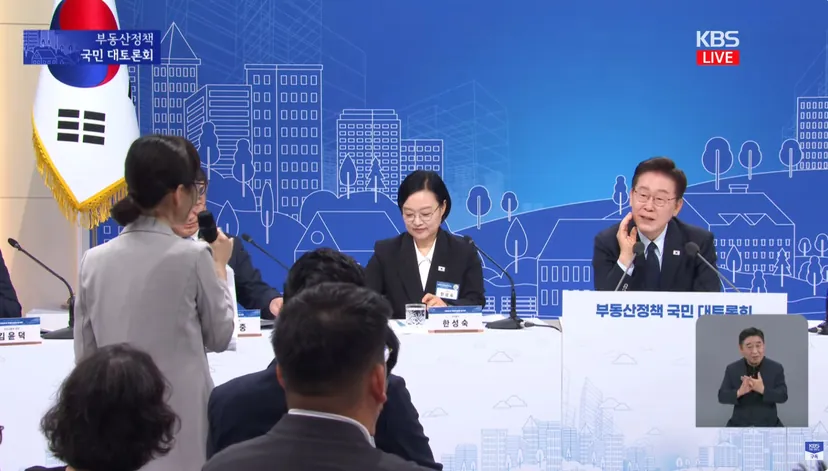
An analysis by Biz Hankook, requested from Real Estate R114 to categorize the number of households by apartment price range in Seoul, shows that as of July 17, there were 914,982 apartments with a market value exceeding 1 billion won out of a total of 1,469,011, accounting for 62% of the total. Apartments priced at or below 1 billion won numbered 554,029, or 38%. If the threshold for "ultra-high-priced housing" is set at over 1 billion won, it means 6 out of every 10 apartments in Seoul would qualify.
Apartments exceeding 1 billion won were distributed across all 25 autonomous districts in Seoul. Gangnam-gu had the highest number at 118,450 households (96% of apartments in Gangnam-gu), followed by Songpa-gu with 110,026 (95%), Seocho-gu with 72,971 (95%), Gangdong-gu with 59,883 (83%), Yeongdeungpo-gu with 54,351 (81%), Seongdong-gu with 53,888 (97%), and Mapo-gu with 52,694 (91%). In 16 of the 25 districts, more than half of the local apartments exceeded 1 billion won.
The number of targeted homes varied significantly depending on the threshold for "ultra-high-priced housing." Apartments in Seoul exceeding 3 billion won totaled 166,403 households (11% of the total), while those exceeding 5 billion won numbered 29,969 (2%). 99.9% of apartments exceeding 3 billion won were primarily located in what is known as the "Han River Belt," including the districts of Gangnam, Seocho, Songpa, Yongsan, Gwangjin, Seongdong, Mapo, Dongjak, Yangcheon, Yeongdeungpo, and Gangdong. 95% of apartments exceeding 5 billion won were concentrated in the three Gangnam districts and Yongsan-gu.
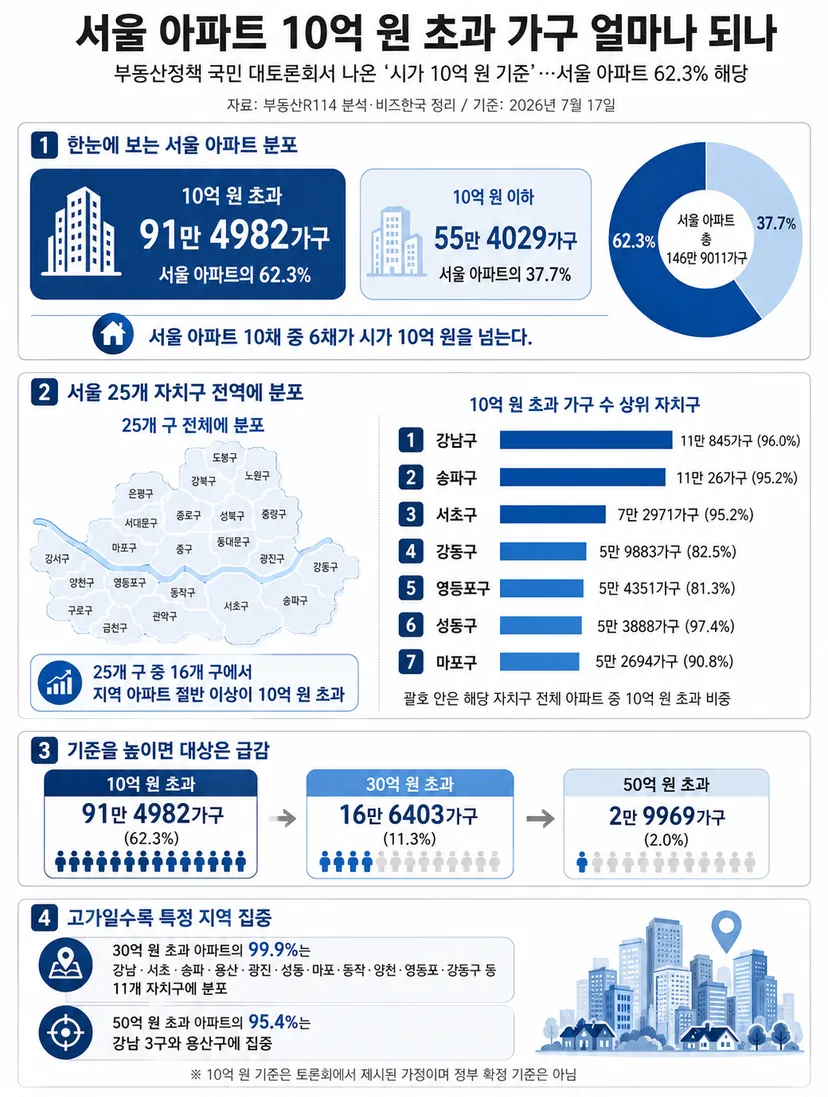
The proposal to strengthen property taxes based on a market value of 1 billion won was made during the Public Debate on Real Estate Policy on the 23rd. Jung Se-eun, a professor of economics at Chungnam National University, responded to President Lee Jae-myung’s question about the definition of ultra-high-priced housing by suggesting, "About twice the national average price." The intention was to consider the national average apartment price to be around 500 million won, to protect homes for actual residential use up to 1 billion won in market value, and to impose progressive property taxes on the excess amount. She mentioned a 1% effective tax rate for the top price brackets.
Professor Jung pointed out, "The core actual residents that the policy must protect are the bottom 50% who do not own homes and those looking to secure housing at the national average level," adding, "The current problem did not arise because of a lack of supply of 2 billion to 3 billion won apartments in Seoul." She emphasized that speculation and price hikes starting in the high-priced housing market could spread to all of Seoul and key provincial regions, requiring strong tax reforms to prevent this.
On this day, President Lee Jae-myung diagnosed the "one smart home" phenomenon in the real estate market as a side effect of the one-household, one-home protection policy. He said, "The 'one smart home' has caused serious problems in our society," adding, "Because expensive and cheap homes were treated the same, people efficiently bought one home to enjoy investment profits." He pointed out that a tax system that does not distinguish between home prices and the purpose of residence or speculation has concentrated demand on a single high-priced home.
He also expressed concern that the domestic property tax burden is too low. President Lee stated, "Even to reach standard developed country levels, we would have to increase it by three times the current rate," while acknowledging, "Wouldn't that trigger riots if we tripled it?" His point was that while he agrees with the need to strengthen property taxes, the specific targets and the scale of the increase must be determined with tax resistance in mind.
In a phone call with Biz Hankook on the same day, Professor Jung Se-eun explained, "(The property tax threshold) should be based on the national average, not adjusted to Seoul. In regional areas, even 500 million won is a high price, and 1 billion won is an ultra-high price." She added, "The 1 billion won market value threshold is a rough figure suggested considering twice the national average apartment price and the current comprehensive real estate tax standards." Regarding the 1% effective tax rate, she clarified, "I didn't mean that everything above that must uniformly be 1%. It was intended to suggest that while maintaining the current progressive tax structure, the overall effective tax rate should be around 1% in higher price brackets."