

[비즈한국] As the Lee Jae-myung administration pushes to expand "productive finance," the delinquency rate for loans at domestic banks has soared to its highest level in 9 years and 7 months. While the government aims to redirect bank funds currently tied up in real estate and mortgage loans toward corporations, high-tech industries, and venture/SMEs, the rapid rise in corporate loan delinquency rates is increasing the burden on banks to manage their financial soundness. Expanding productive finance has emerged as a new challenge for the financial sector, and the key will be how precisely these risks of insolvency can be managed.

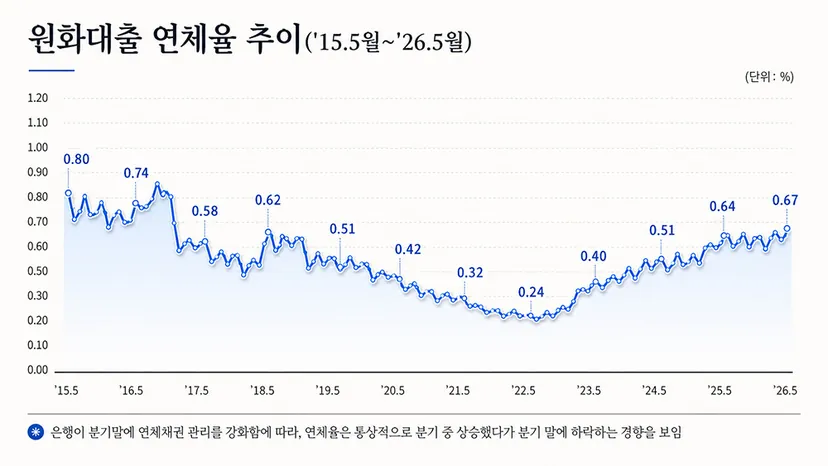
According to the Financial Supervisory Service (FSS), the delinquency rate for won-denominated loans at domestic banks stood at 0.67% at the end of May, up 0.06 percentage points from the previous month (0.61%). This is the highest level since October 2016 (0.81%). It also represents a 0.03 percentage point increase compared to the same period last year. The delinquency rate, which had been suppressed by liquidity support and low-interest rates following the COVID-19 pandemic, is rising again, compounded by the burden of high interest rates, sluggish domestic demand, and worsening corporate performance.
SME loan delinquency rate surpasses 1%
Corporate loans are driving the rise in delinquency rates. At the end of May, the corporate loan delinquency rate at domestic banks was 0.84%, up 0.10 percentage points from the previous month, a sharper increase than the rise in household loan delinquencies (0.03 percentage points). Within corporate loans, the delinquency rate for large corporate loans rose to 0.27%, an increase of 0.05 percentage points from the previous month and 0.12 percentage points higher than a year ago (0.15%).
The situation for SME loans is even worse. At the end of May, the SME loan delinquency rate reached 1.00%, rising 0.10 percentage points from the previous month (0.90%). This is the first time in 11 years, since May 2015, that the SME loan delinquency rate has hit the 1% mark. The delinquency rate for small and medium-sized corporate loans rose to 1.11%, up 0.13 percentage points from the previous month (0.98%), while the delinquency rate for sole proprietor loans also climbed to 0.84%, up 0.06 percentage points from the previous month (0.78%).
Household loans are also not entirely safe. The household loan delinquency rate at the end of May was 0.45%, up 0.03 percentage points from the previous month. While the mortgage loan delinquency rate only rose by 0.01 percentage points to 0.31%, the delinquency rate for household loans excluding mortgages, such as credit loans, rose by 0.07 percentage points to 0.90%. Although not as severe as corporate loans, high interest rates and asset market volatility are clearly impacting the repayment capacity of individual borrowers.
New defaults rise while cleanup speed slows
The problem is that while new defaults are increasing, the banking sector's pace of clearing overdue debt is failing to keep up. In May, the volume of new delinquencies amounted to 3.3 trillion won, an increase of 400 billion won from the previous month (2.9 trillion won). Conversely, the volume of overdue debt cleared was 1.5 trillion won, a decrease of 100 billion won from the previous month (1.6 trillion won). The new delinquency rate also rose to 0.13%, up 0.01 percentage points from the previous month.
This means that new loan defaults are increasing faster than banks can write off or sell off non-performing loans. Delinquency rates typically tend to drop temporarily at the end of each quarter as banks focus on clearing out bad debt. Even considering that the May figures do not include end-of-quarter effects, the significant rise in the corporate loan delinquency rate is a burden.
On top of this, corporate loans themselves are growing rapidly. According to the Bank of Korea, the outstanding balance of corporate loans at depository banks stood at 1,408.3 trillion won at the end of May, an increase of 10.6 trillion won from the previous month. With corporate loan balances growing, a rise in delinquency rates inevitably forces an increase in the burden of credit loss provisions and pressures banks' capital management.
Expanding productive finance: The key is selection capability
The government has emphasized that bank funds should flow into industries and corporations rather than remaining stagnant in real estate and household loans. Productive finance is a plan to support real economy growth by supplying capital to high-tech strategic industries, export companies, and SMEs/ventures. In its financial policy direction for this year, the Financial Services Commission has also proposed a major financial shift centered on productive finance, inclusive finance, and trusted finance.
The direction itself is generally supported by the financial sector, as it has been consistently pointed out that bank profits have been overly dependent on mortgage loans and interest income. The problem is that corporate loans are more sensitive to economic fluctuations and industry-specific risks than household mortgage loans. In particular, SMEs and sole proprietors are simultaneously exposed to sluggish domestic demand, rising labor costs, increased production costs, and higher interest rates, which can rapidly deteriorate their repayment capacity.
If productive finance is promoted simply by increasing the total amount of loans, it could burden the financial soundness of the banking sector. Distinguishing promising companies to supply capital is a completely different issue from expanding the total volume of corporate loans to meet policy targets. For banks, this requires improving industrial insight and credit evaluation capabilities, while financial authorities must strike a balance between supply targets and soundness regulations.
The FSS is also conscious of these risks. The FSS stated that it would prepare for a potential expansion in delinquency rates by considering changes in conditions, such as the increase in corporate loans and rising interest rates following the full-scale implementation of productive finance. It plans to encourage the banking sector to enhance its loss-absorption capacity through active write-offs and sales of non-performing loans, as well as the accumulation of sufficient capital and credit loss provisions.