

[비즈한국] Hanjin’s 15.6 billion won claim for liquidated damages against Samsung C&T due to construction delays at the Daejeon Smart Mega-Hub Logistics Center has been dismissed by the court. The court ruled that both parties had extended the completion deadline through a contract modification and that Samsung C&T had completed the construction within that timeframe. Conversely, the court ordered Hanjin to pay 9.8 billion won in additional construction costs incurred due to the project extension.
The 23rd Civil Division of the Seoul Central District Court (Presiding Judge Lee Jung-jae) dismissed Hanjin’s claim for liquidated damages against Samsung C&T on the 1st. In contrast, the court upheld Samsung C&T’s counterclaim for 9.75091 billion won in additional construction costs resulting from the schedule extension, ordering Hanjin to pay this amount plus late interest. However, the court did not accept the 19.5 billion won requested by Samsung C&T for price inflation, which the company had attributed to COVID-19 and the Russia-Ukraine war.
“Hanjin Must Bear Costs of Construction Extension”
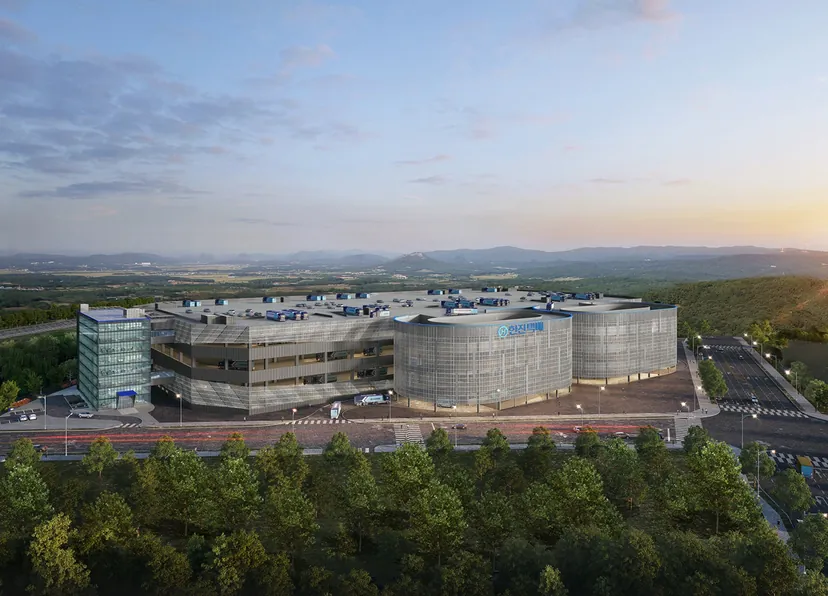
The dispute between the two parties began during the construction of the new Daejeon Smart Mega-Hub Logistics Center. The project involved building a facility the size of 20 soccer fields (a total floor area of approximately 150,000 square meters) in the Daejeon Yuseong-gu Integrated Logistics Complex. Currently, it operates as the largest logistics center in South Korea, capable of processing 1.2 million boxes per day. Hanjin entrusted Samsung C&T with the construction of this center in 2021. The initial contract stipulated a construction period from May 2021 to December 2022, with construction costs of approximately 155.4 billion won.
During the construction process, the completion schedule faced significant delays. Samsung C&T completed the logistics center and received approval for use on October 31, 2023. Previously, both sides had signed a modification agreement in December 2022 to extend the completion deadline to October 31, 2023. Hanjin argued that while signing this agreement, they had reached an understanding that Samsung C&T would continue to be liable for liquidated damages starting from the original December 2022 deadline. Consequently, Hanjin filed a claim for 15.6 billion won, which is 10% of the final contract amount. When Samsung C&T refused, Hanjin filed a lawsuit in January 2024.
However, the court determined that Samsung C&T had no obligation to pay liquidated damages. Although the modification agreement included the updated deadline and a liquidated damages rate, there was no mention of imposing damages starting from the original deadline. While there was a phrase mentioning "future consultation" regarding liquidated damages, the court ruled it could not serve as a basis for Hanjin’s claim since no separate agreement was reached thereafter. The court held that since Samsung C&T finished the construction and obtained use approval by the modified deadline, no performance default occurred.
On the other hand, the court ruled that Hanjin should bear the costs associated with the extended construction period. Logistics equipment installation and related fire safety work, which were separately commissioned by Hanjin, were interconnected with the building construction, and design changes for contaminated soil, waste disposal, soft ground treatment, and new ramp installations also contributed to the delays. It was confirmed that Hanjin had approved the revised schedules and design changes. The court concluded that the evidence submitted by Hanjin was insufficient to prove that the delays were caused by Samsung C&T’s faults.
The construction contract stated that if the duration was extended due to reasons not attributable to the contractor, additional expenses such as site management costs should be adjusted. The court-appointed appraiser calculated a total of 9.8 billion won, including approximately 6.9 billion won in indirect construction costs incurred during the extension and approximately 2.8 billion won in other additional costs. Hanjin did not dispute the appraised amount itself.

Exclusion Clause for Price Fluctuations Valid: “Samsung C&T Bid Knowing the Conditions”
However, the 19.5 billion won in additional construction costs requested by Samsung C&T due to price increases was not accepted. In the original contract, both parties agreed not to adjust the contract amount based on price fluctuations until the project was completed. Samsung C&T, however, demanded an increase in construction costs, citing a clause that compensates for losses caused by force majeure. It further argued that the aforementioned exclusion clause for price fluctuations was invalid.
But the court determined that the reasons presented by Samsung C&T did not fall under the definition of force majeure defined in the contract. The force majeure clause in the contract was intended to cover losses occurring to completed portions or leased items. The court viewed this regulation as insufficient to serve as grounds for compensating for losses due to price fluctuations during construction. Furthermore, it noted that the COVID-19 pandemic had already been ongoing for a long period at the time of the contract, and regarding the war, Samsung C&T failed to sufficiently prove specifically which material cost increases and damages were caused by it.
The court also deemed the price fluctuation exclusion clause valid. Under the Framework Act on the Construction Industry, contract terms that shift the burden of construction cost fluctuations due to economic changes to the other party are invalid if they are significantly unfair to one side. However, the court judged that Samsung C&T participated in the bidding process while fully aware of these exclusion conditions and possessed the knowledge and experience to reflect such risks in their bid. It also took into account that adjustments for legal changes, construction extensions, and design changes were still permitted under the contract, and that construction costs would not be reduced even if prices dropped.
Hanjin and Samsung C&T both filed appeals on the 22nd, dissatisfied with the first-instance ruling. Bizhankook reached out to both parties to ask for their positions regarding the ruling and their plans for the appeal, but did not receive a response.
Meanwhile, court rulings regarding price fluctuation exclusion clauses remain inconsistent. In November 2023, the Busan High Court ruled such a clause invalid in a case where rebar prices doubled during an eight-month delay in starting construction due to the project owner's circumstances. That ruling was finalized by the Supreme Court. Conversely, the Seoul Central District Court has recognized the validity of such clauses by considering exceptional provisions that allow for cost adjustments during sharp price spikes, while the Daegu High Court has upheld them by considering factors such as the contractor’s awareness of the exclusion conditions during the bidding process. Conclusions appear to differ based on the specific contract terms and the circumstances under which the contract was signed.