

[비즈한국] He has a debt of 12 billion won. He also holds stocks worth over 80 billion won in valuation. Why not just sell the stocks to pay it off? It sounds like a simple math problem, but in reality, it has become a dilemma where finding an answer is incredibly difficult.
This is the story of Shin Chul-ho, CEO of the creator content platform OGQ. BizHankook previously reported on how CEO Shin came to bear the personal obligation to repay 9 billion won in investment received by the company due to the "Interested Party" clause in his investment contract (Related article: “Founder Alone Under 12 Billion Won Debt”: The Trap of the ‘Interested Party’ Clause, as Scary as Joint Surety). Setting aside the unfairness of the debt itself, what are the ways to pay off this massive amount?
There are three ways. First, the company buys back and retires the investors' shares; second, CEO Shin sells a portion of his own shares; or third, a third party buys the investors' shares. If any one of these succeeds, the debt would be resolved, and both the company and management control could be preserved. However, all three methods are currently blocked for various reasons. The obstacle is a provision inserted during the investment contract process known as "prior consent rights."
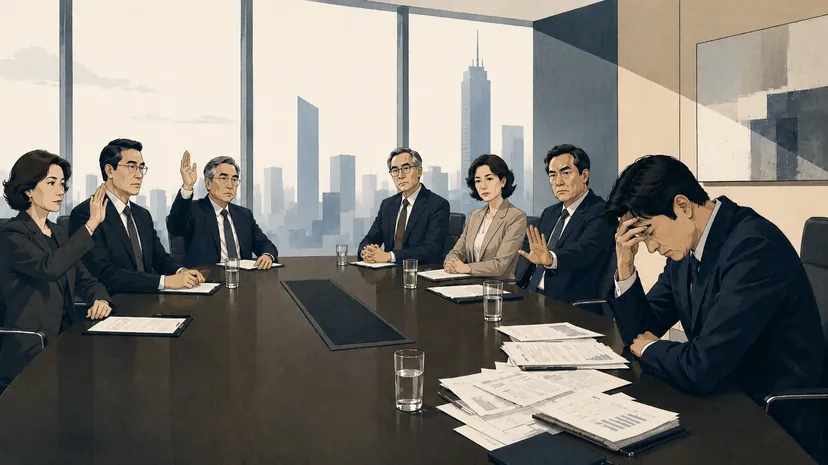
Investment Recovery via Differential Paid-in Capital Reduction
The cleanest solution is for the company itself, which actually received the investment, to resolve the issue. This involves the company conducting a capital reduction (differential capital reduction) targeting specific investors' shares rather than reducing all shareholders' equity proportionally, and paying them for it (paid-in). The investors turn over their shares to the company to recover their investment, and the company retires those shares.
This is legally distinct from the company paying off CEO Shin’s personal debt. It is a structure where the company settles the investment relationship with the investors, thereby also resolving the debt issue claimed against CEO Shin personally.
CEO Shin’s side argues that because the 9 billion won investment remains in the OGQ account, buying back the investors' shares based on a fair value calculated by an external agency is the most direct solution. However, a differential capital reduction cannot be implemented solely by a board resolution. A reduction of capital is a matter requiring a special resolution at a general shareholders' meeting. Under the Commercial Act, a special resolution requires the approval of at least two-thirds of the voting rights of shareholders present, and those approving must hold at least one-third of the total issued shares. After the reduction, one must also go through creditor protection procedures. This process takes at least 6 to 10 weeks.
BraveNew Investment and Vision Creator, the general partners (GPs) of the investment union that are the creditors, stated they do not oppose differential capital reduction itself. The GP side told BizHankook, “We agree to recovering the investment through differential capital reduction.” The appellate court ruling also noted that the investor side had first proposed repayment through differential paid-in capital reduction to OGQ in May 2023.
However, both sides offer conflicting accounts on why the capital reduction has not proceeded. CEO Shin’s side claims they requested the investors' consent after the board resolution but received no reply for a long time, and that the investors only expressed an intention to consent after forced liquidation procedures began. Conversely, the investor side countered that they “never received a notice of a board resolution for paid-in capital reduction or a notice to convene a shareholders' meeting from the company,” and that there was no such thing as them not consenting.
There is another variable. According to CEO Shin’s side, SOOP (formerly AfreecaTV), which holds about a 3% stake, sent a certification of contents in early July stating they oppose the differential capital reduction and indicated that they could sue the board members for breach of trust if it were implemented.
SOOP’s stake alone cannot unilaterally block a special resolution. However, in a situation where the possibility of criminal charges is raised, it is not easy for the board to push the procedure forward. This is because disputes are expected over whether the capital reduction price is fair, whether the company suffers losses, and whether the company's assets can be seen as being used to resolve CEO Shin’s personal debt. Ultimately, the first method requires overcoming other hurdles: the shareholders' meeting and controversy over breach of trust, even if the target investor agrees.
The ‘Prior Consent Right’ Blocking Personal Share Sales
The second method is for CEO Shin to resolve it with his own assets. CEO Shin holds approximately 32% of OGQ shares, and their value based on external evaluation standards is over 80 billion won. CEO Shin’s side explains that even selling a portion would allow him to repay the 12 billion won while maintaining his status as the largest shareholder and management control. Of course, the valuation of unlisted stock does not guarantee the actual sale price. There must be a buyer, and one must account for minority discount and taxes. Nevertheless, since company funds are not leaving, there is no controversy over breach of trust, and it does not harm other shareholders waiting for an IPO. Among the three methods, this has the fewest side effects.
The problem is the prior consent right in the investment contract. Venture investment contracts often include clauses requiring a founder to obtain consent from existing investors when disposing of their shares. It is a device to prevent the largest shareholder from selling off their stake and leaving, or from shaking up management control.
However, the contract does not distinguish between a sale to leave the company and a sale to repay debt while staying with the company. The decision to consent depends on the investor’s judgment, and often there is no duty to provide a response deadline or explain reasons for refusal.
Prior consent rights are different from voting at a shareholders' meeting based on share percentages. Because they are granted individually in each investment contract, a deal can be blocked if even one investor among many does not agree. It is a structure that is effectively close to unanimity.
BizHankook asked Naver and SOOP if they have any intention to consent to the sale of CEO Shin’s personal shares. Neither company clearly stated their position on consent or opposition.
Naver stated, “We are in continuous discussions with OGQ shareholders regarding this matter,” and remained cautious.
SOOP stated, “No one other than the parties involved knows exactly what is happening between the creditor and debtor and how it will proceed in the future,” adding, “We also have a risk of failing our fiduciary duty to our shareholders if we make a wrong judgment, so we have no choice but to follow the publicly released Supreme Court ruling for now.” They added, “We hope that the discussions between the creditor and the debtor are concluded as soon as possible.”
The attitude of wanting to make a judgment after confirming sufficient facts as a shareholder of a listed company is understandable. The problem is that the forced liquidation procedure is proceeding simultaneously. While the confirmation of consent is being delayed, CEO Shin’s voluntary sale of shares is stalled, but the forced execution continues.
Consent carries judgment and responsibility, but non-response carries no cost. If there is no deadline to respond and no obligation to explain the reason for non-consent, simply withholding a judgment can effectively act as a veto power.
Method of a Third Party Acquiring Investors' Shares
The third method is for a third party to acquire the OGQ shares held by the investment union. The investor can recover their investment without using the company's or CEO Shin’s money.
CEO Shin’s side claims that a subsidiary of a listed company expressed an intention to purchase the investors' shares for the principal amount of 9 billion won in 2024, but the investor side did not respond. They explained that this was because the interest and legal costs according to the judgment were not guaranteed, not just the principal.
The GP side countered that this was not a concrete proposal. The GP side stated, “Information about the buyer and the price was only offered verbally in June 2026, about 5 years after the investment, and we only received a letter of intent without legal effect,” adding, “We never even received a draft of a sales contract, so we never expressed a lack of consent.” Furthermore, the GP side conveyed to BizHankook that they also agree to the plan of recovering the investment through a third-party share sale.
However, even if there is a willing buyer, time is needed for negotiations. Due diligence, price negotiations, and coordination of contract terms usually take several months. In the meantime, the forced liquidation procedure for CEO Shin’s shares and the delayed interest on the judgment continue to accumulate.
Not Answering is Also a Form of Decision-Making
The three methods are different, but they have one thing in common: voluntary resolution requires the decisions of other parties, and forced execution does not stop while those decisions are delayed. CEO Shin’s side requested that the GP side join them in drafting a petition to the court for a stay of forced execution, arguing that they would pursue the repayment of the investment. Regarding this, the GP side stated to BizHankook that there is no way to stop the court’s forced execution procedure other than the actual repayment of the investment.
Differential paid-in capital reduction or third-party share acquisition might fall short of the debt or investment recovery amount the GP side is entitled to. Regarding this, CEO Shin’s side maintains the position that they will sell some of their personal shares to cover the shortfall. Therefore, existing shareholders' prior consent is essential for all three methods.
Differential capital reduction is decided by the shareholders' meeting. The sale of CEO Shin’s personal shares is controlled by the existing investors who hold prior consent rights. The sale of the investors' shares must be chosen by the GP, who is the creditor. CEO Shin has the assets, but he does not hold the sole power to dispose of them.
There is a crucial asymmetry here. Because prior consent rights are promises between the parties to the contract, they can block CEO Shin from selling his shares voluntarily, but they cannot block the court’s seizure and special monetization procedures.
The path of paying off debt by selling as many shares as needed through a voluntary sale requires the consent of existing shareholders. On the other hand, in forced execution, depending on the procedure, the possibility is raised that the entire 32% stake held by CEO Shin could become the target for monetization. However, the actual scope of the sale and the method of settling excess value depend on the court’s judgment and the execution procedure.
Prior consent rights are not a system that should be abolished. They are a legitimate device to prevent founders from damaging investors' rights or leaving the company unilaterally. However, the OGQ case shows what kind of gridlock can occur when there is no response deadline or accountability for this right. No one has acted explicitly illegally, but no solution works. While everyone blames the inaction of the other, the debt and interest grow, and the possibility of voluntary resolution shrinks.
Systems and contracts are complex, but the common-sense conclusion is not that complicated. Since this did not happen due to founder misconduct like embezzlement or breach of trust, the common sense solution is for CEO Shin to protect management control while resolving the debt, and for the investors to recover their investment smoothly. There is money in the company and the founder has shares, so it is not physically impossible. But the system is blocking the road to that common sense. It has now been confirmed where and how the two devices—the "interested party" clause that founders almost always sign upon receiving investment, and the prior consent right—malfunction. This is why there are so many voices calling for it to be fixed as soon as possible.