

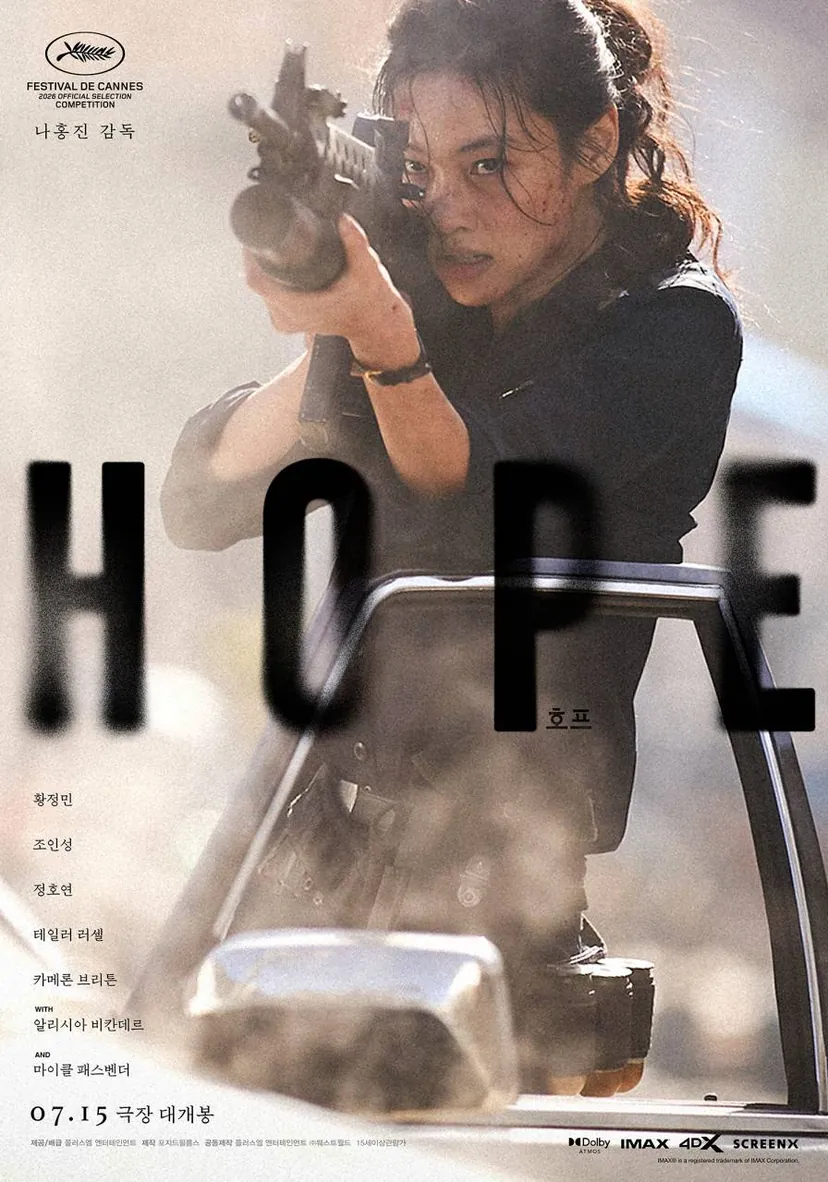
[비즈한국] While the film ‘Hope’ is based on a strange experience felt in Europe 15 years ago, it is said to have been formally planned 10 years ago. Ten years ago would be before the COVID-19 pandemic. The situation of the Korean film industry at the time likely played a role in making a film like ‘Hope’ possible.
Before the pandemic, the Korean film industry was enjoying its absolute golden age. The number of moviegoers exceeded 200 million for consecutive years. Films like ‘Train to Busan’ (2016) and ‘A Taxi Driver’ (2017), as well as ‘Extreme Job’ (2019), which drew 16.26 million viewers, surpassed ten million ticket sales every year, and the domestic market share even outperformed foreign films. The return on investment for commercial films reached nearly 9%, and with its international status at an all-time high, Director Bong Joon-ho’s film ‘Parasite’ even won the Palme d’Or and the Academy Award.
Perhaps due to this atmosphere, the scale of works trended toward blockbusters. The average production cost for 40 commercial films with a net budget of over 3 billion won reached 10.34 billion won. Furthermore, the situation was encouraging because the film ‘The Admiral: Roaring Currents’ had previously mobilized 17 million people, recording the top spot in the overall domestic and international box office.
The production cost of ‘The Admiral: Roaring Currents’ was about 20 billion won, but it recorded 135 billion won in revenue, making the return on investment more than double. Director Kim Han-min’s Admiral Yi Sun-sin trilogy stemmed from the confidence of the Korean film industry. It was originally planned as a trilogy of Yi Sun-sin’s three major battles, and due to the success of the first installment, ‘The Admiral: Roaring Currents’, the second installment, ‘Hansan: Rising Dragon’, was produced as a blockbuster with 31 billion won, increasing the budget by 1.5 times. However, the situation after the pandemic resulted in outcomes that fell far short of previous works.
In this context, Director Choi Dong-hoon’s ‘Alienoid’ was being produced. While it was indeed a blockbuster film, its structure differed from the past, as it was divided into parts 1 and 2. Part 1 cost 34 billion won and Part 2 cost 37 billion won, totaling 70 billion won, but if marketing costs are included, the investment amounted to 80 billion won. In other words, they made one film with an 80 billion won budget and split it into two. Of course, both parts were filmed simultaneously, and the post-production for Part 2 was completed after the release of Part 1. However, the box office performance of Part 1 was much lower than expected.
This was inevitable; although it was planned and produced before the COVID-19 pandemic, the theatrical release date was July 2022, when the wounds of the pandemic had not yet fully healed. Because of the box office hit taken by Part 1, the delay of Part 2 was unavoidable. The break-even point was around 7.3 million viewers, but the cumulative audience was only 1.54 million. Part 2, released in 2024, also needed to attract over 7 million viewers, but it ended with a cumulative audience of 1.4 million. It means that even the audience who saw the first part did not all watch the second. If the first part had been interesting, more viewers should have flocked to the second, but the result was the opposite. Even though 2024 was a time when the COVID-19 pandemic was transitioning into an endemic phase, the results were disastrous.
While there are factors inherent to the content itself, the change in the media consumption environment was also a reason for the failure. Looking at the content, although it combined the concept of aliens, it was closer to a fusion fantasy genre crossing between modern and traditional society rather than science fiction. In particular, it seems more appropriate to define the aliens as yokai (spirit/monster) characters. It is the same as how ‘Game of Thrones’ is not considered science fiction. At the time of planning, the concept of a "worldview," led by K-pop, stood out as novel, but by the time of its release in 2024, the trend had already passed. It had a disadvantage in terms of box office performance because it made an adventurous attempt with entirely new settings and characters without relying on familiar figures.
Looking at external factors, above all, the theater was no longer a trendy space after the endemic. Previously, spending time with family at a multiplex could be considered "hip," but it faced a decisive turning point while going through the pandemic crisis. Existing underlying problems—screen monopolies, the disappearance of diversity, price, the enjoyment of OTT, and changes in leisure culture—coincided and exploded.

The film ‘Hope’ was planned as a multiplex-style blockbuster amid the boom of Korean cinema, but it was produced during the COVID-19 pandemic and the resulting atmosphere of contraction in the theater industry. Perhaps because of this, it differs from the works mentioned earlier. Like the Yi Sun-sin trilogy, it was planned as a split project, but it is not a method like ‘Alienoid’ where Parts 1 and 2 are planned and filmed at the same time. It is a method where Part 2 is produced based on the box office results of Part 1, which can still be considered adventurous. The film ‘Alienoid’ could have fit the drama genre. This is because the worldview and content format were a bit too heavy to be handled in two parts. Attempting a seasonal system with 10 episodes might have been fine.
In contrast, the film ‘Hope’ appears to fit the film format because it is very simple. A creature suddenly appears in a village, and the villagers step up one and all to strike back at it. Of course, it is unknown whether the villagers could respond in unison if such an event occurred in actual reality. Perhaps it reveals the communal sensibility of the past that we have lost.
That is why, even if it is a fictional village inside the Demilitarized Zone, the background is reminiscent of the 1970s or 80s. As the word "anti-communism" appears throughout the village, it seems to reflect the organizational culture where unity and cohesion were stronger during the authoritarian era. However, the film does not dwell in the past. This is because multiculturalism is incorporated. The aliens, who were considered invaders, turn out to have certain stories and reasons. If they can find hope and solve the problem, it becomes hope for the villagers as well.
If the storyline is properly structured in the second part, someone’s hope can become hope for someone else. The Cannes Film Festival nominated this work in the competition section. An unfinished work at that. If so, when it is completed with the second part, the Cannes Film Festival will be able to invite this work and make a proper judgment and evaluation. That rests entirely in the hands of the Korean audience.
The same goes for popular choice. Director Na Hong-jin stated in an interview that he really doesn't know about a sequel, which is a high-level strategy and signifies that we have entered an era where, if there are many viewers who want to see it, the audience themselves chooses whether to continue the story. Whether blockbuster films can survive as they did before COVID-19 ultimately depends on the voices and hands of the audience.
The author, Kim Heon-sik, has been walking through or clearing paths in the forest of pop culture phenomena since his 20s, with the expectation that there is a way to make the world a better place through culture. In the 21st century, where artificial intelligence and quantum computers are active, he continues on the same path with the same belief.