

[비즈한국] Amid ongoing controversy that single-stock leveraged exchange-traded funds (ETFs) based on Samsung Electronics and SK Hynix are exacerbating market volatility, a policy seminar was held at the National Assembly to discuss directions for institutional improvement. Alongside criticisms from politicians regarding the product's introduction, experts offered practical suggestions for supplementing investor protection mechanisms.
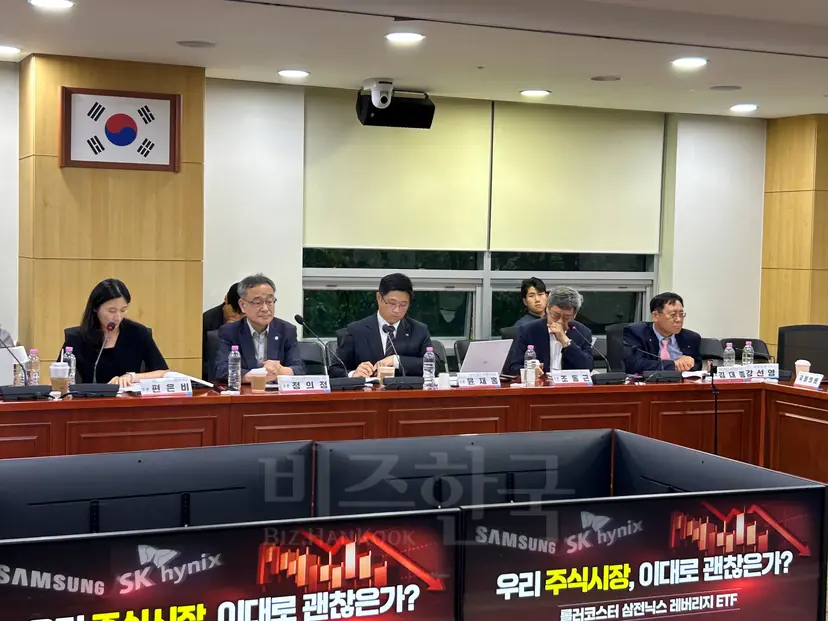
People Power Party lawmakers Park Soo-young, Lee Jong-wook, and Kim Jang-gyum hosted a policy seminar on the 21st at the National Assembly titled, “Is Our Stock Market Okay Like This? The Rollercoaster Samsung/Hynix Leverage ETFs.” Attendees included People Power Party Leader Jang Dong-hyuk, as well as representatives from academia, the securities industry, the National Assembly Research Service, and investor groups, all seeking to explore the market impact of single-stock leverage ETFs and directions for institutional reform.
During the seminar, speakers pointed out that recent supplementary measures announced by financial authorities—such as raising the minimum deposit requirements and temporarily suspending new listings—have limitations in protecting investors, calling for more effective institutional improvements.
Kim Dae-jong, a professor of business administration at Sejong University who led the presentation, stated, "Simply raising the deposit requirement has limited effects on investor protection. We need to consider making leveraged products cash-only transactions and restricting margin or credit trading." He added, "We must develop a regulatory framework and investor protection mechanisms tailored to the characteristics of high-risk financial products."
Moderator Cho Dong-keun, professor emeritus of economics at Myongji University, suggested that since the market for these products has already grown, a phased soft-landing approach should be considered rather than an immediate delisting. Professor Cho remarked, "It is not easy to abolish products with active trading all at once," and proposed alternatives such as gradually lowering the tracking multiplier from the current 2x to 1.1x–1.2x and tightening requirements for market entry.
Some argued that while single-stock leverage ETFs have indeed amplified market volatility to some extent, the growth of the overall ETF market must also be taken into account. Yoon Jae-hong, a senior research fellow at the Mirae Asset Securities Research Center, emphasized the need for regular and practical investor education, noting, "Current one-time mandatory training is insufficient to fully convey the risks of these products."
He also mentioned that since similar products are traded in the U.S., Hong Kong, Singapore, and the U.K., a review of the system is necessary that includes not only domestic products but also overseas alternatives, and that setting investment limits based on individual asset size could also be considered.
Pyeon Eun-bi, a legislative researcher at the National Assembly Research Service, stated, "While the government's intent in reviewing the system—aimed at resolving regulatory asymmetry with overseas markets and expanding domestic investment opportunities—is understandable, there should have been more thorough prior review and explanation regarding the impact on the domestic market and individual investors." Pyeon pointed out, "Although it is difficult to perfectly predict market impact, it is crucial during the policy-making process to design a system in advance that allows for a phased response once certain thresholds are crossed."
Jung Eui-jung, representative of the Korea Stock Investors Union, argued, "If immediate delisting is difficult, a phased abolition process must be followed. We should first consider implementing 30-minute call auctions and banning credit and margin trading."
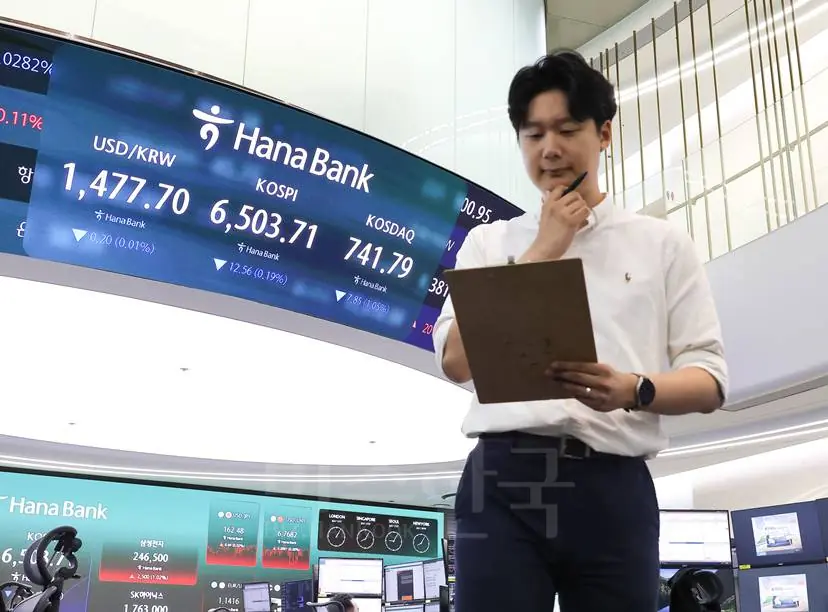
On the 16th, financial authorities announced supplementary measures, including a temporary suspension of new single-stock leverage ETF listings and an increase in the minimum deposit requirement from 10 million won to 30 million won. However, as trading volumes have remained high even after these announcements, the need for further institutional safeguards is being raised. President Yoon Suk Yeol also instructed financial authorities during a cabinet meeting that day to "develop supplementary measures quickly and faithfully, and take bold follow-up actions where necessary."
Within political circles, criticism is growing that single-stock leverage ETFs have exacerbated market volatility and increased losses for individual investors, leading to calls for a comprehensive re-evaluation of the system.
People Power Party Leader Jang Dong-hyuk, who attended the seminar, pointed out, "Currently, capital is concentrated in a few large semiconductor stocks, single-stock leverage ETFs, and credit trading. I question whether the government sufficiently examined the potential for capital concentration, increased volatility, and losses for individual investors." He further stated, "We must transparently disclose who decided to introduce these products and through what discussions. For the sake of market stability and investor protection, we need to re-examine the entire system."
At the event, criticism toward the government continued, with some attendees mentioning the need for verification of the introduction process, parliamentary investigations, or even a special counsel.
Lawmaker Park Soo-young noted, "Sidecars were triggered 38 times in the first half of this year alone. It has truly become a rollercoaster, casino-like market." Lawmaker Lee Jong-wook also emphasized that the impact on the market and investor losses following the introduction of single-stock leverage ETFs must be assessed, and that effective investor protection measures must be established.