

[비즈한국] The US expansion of the osteoarthritis cell-gene therapy "TG-C (formerly Invossa)," which Kolon Group Honorary Chairman Lee Woong-yeul has spent 25 years nurturing while calling it his "painful fourth finger," is on the verge of collapse. Kolon TissueGene announced on the 20th that, based on the top-line results of its US Phase 3 clinical trial, it failed to secure statistical significance compared to the placebo group.
Arguing for a "half-success"… Eyeing a turnaround with the second Phase 3 results in October
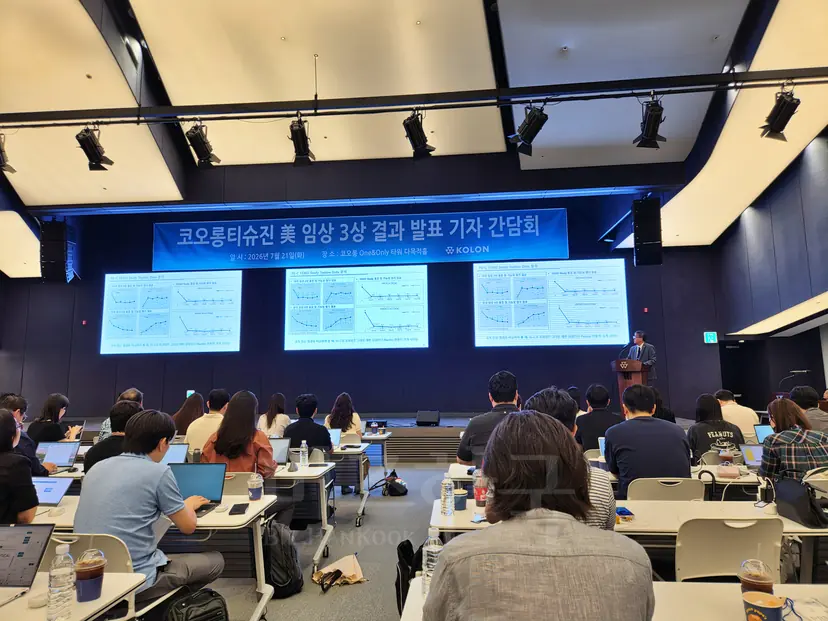
Looking at the actual disclosed primary efficacy endpoint data (at 12 months post-administration), both the pain assessment index (VAS) and the joint function index (WOMAC total score) failed to prove statistical significance due to a strong placebo effect observed in the control group.
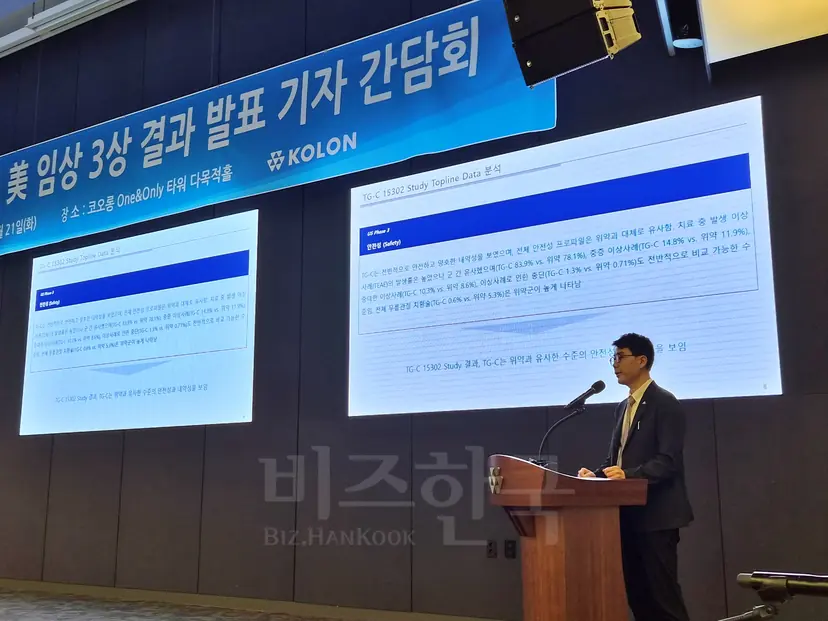
Specifically, the average reduction from baseline in VAS at 12 months was -38.7 for the TG-C group and -39.2 for the placebo group, showing similar results (p=0.8322). The WOMAC total score also showed no significant difference between the TG-C group (-27.61) and the placebo group (-26.54) (p=0.5701). Consequently, Kolon TissueGene failed to secure statistical differentiation in both primary endpoints. On the other hand, the 104-week safety evaluation reaffirmed the treatment's safety, as no serious adverse reactions or new safety signals appeared in the entire subject group.
Kolon TissueGene held a press conference at the Kolon One & Only Tower in Gangseo-gu, Seoul, on that day to actively refute the market's view that the results represent a clinical failure.
Roh Moon-jong, CEO of Kolon TissueGene, emphasized, "I do not doubt the efficacy of TG-C at all, and I believe it is far superior to the results obtained in previous clinical trials." He added, "The treatment group showed improvements of about 40 points in the pain index (VAS) and about 65 points in the functional index (WOMAC), with effects lasting up to 24 months." He explained, "However, the control group (placebo) also showed exceptionally strong and long-lasting improvement effects, similar to the treatment group, which prevented us from demonstrating statistical differentiation." He added that safety was verified just as it was in previous US Phase 2 trials.
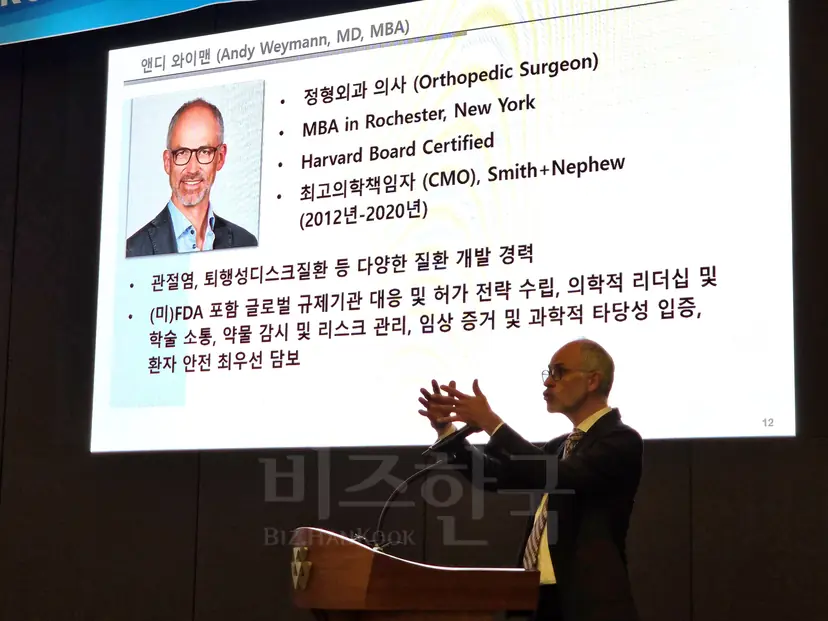
Dr. Andy Weymann, who joined Kolon TissueGene as CMO earlier this year after serving as CMO at Smith & Nephew, one of the "Big 4" global orthopedic medical device companies, also described this placebo effect as unusual.
CMO Weymann explained, "Looking at literature reviews or the placebo effect cases in other osteoarthritis clinical trials I have participated in, we are still at a stage where we cannot draw a conclusion," adding, "There is a hypothesis that when patients start with a relatively high baseline VAS score of over 40, the placebo effect can be slightly higher."
He firmly stated, "Our top priority right now is to thoroughly investigate why the Phase 3 clinical results turned out differently than expected. We will conduct a thorough analysis of the raw data to uncover the clear reasons and return TG-C to the patients."
Jeon Seung-ho, CEO of Kolon TissueGene, also strongly refuted the market's perception that this result is a clinical failure. "This is by no means a clinical failure, but rather a half-success and a growing pain," said CEO Jeon. "While I feel sorry and apologetic to the shareholders that the results were different from our expectations, this is not the end, and we are still on the journey. I ask that you keep watching, taking this into account."
He added that a meaningful signal was identified in the rate of knee total knee arthroplasty (TKA), which implies disease-modifying osteoarthritis drug (DMOAD) potential. In fact, only 2 out of 310 patients in the TG-C group underwent surgery, whereas 8 out of 151 patients in the placebo group did, showing a large difference of about 8.8 times in ratio. CEO Jeon stated, "This data will be very useful in future discussions with regulatory authorities or in insurance economic evaluations after commercialization. We plan to announce the results of the second Phase 3 clinical trial sometime in October."
Kolon TissueGene intends to focus on investigating the causes and analyzing follow-up data after receiving the official report on these clinical results in the fourth quarter. Along with this analysis, it plans to discuss future commercialization procedures, such as Biologics License Application (BLA) submissions, with regulatory authorities based on the top-line results of the second US Phase 3 clinical trial scheduled for announcement in October.
Kolon TissueGene, Life Science, and Biotech: The fear of "chain collapse" caused by vertical integration
Despite the company's active explanation and promise of transparent communication, the capital market is on high alert regarding the risk of a chain collapse spreading across all of Kolon Group's bio affiliates.
In fact, this harsh market assessment was directly reflected in the stock prices. Since the 20th, when the results were announced, the stock prices of Kolon TissueGene, Kolon Life Science, and the holding company Kolon have been on a downward trend. All three hit the daily lower limit again that day. Due to this, some shareholders even argued with company officials to gain entry to the press conference.
Kolon Life Science holds other pipelines, such as the next-generation gene therapy candidate "KLS-2031." However, the symbolism and capital weight of TG-C in Kolon Group's bio business are absolute.
As the vertical integration framework—stretching from Kolon Life Science (next-gen R&D and funding), Kolon Biotech (production), to Kolon TissueGene (US clinical trials and commercialization)—has relied on a single asset, TG-C, the ripple effect is highly likely to spread to all affiliates.
Kolon TissueGene, which led the clinical trials, is the one immediately facing a crossroads for its survival. Although it received hundreds of billions of won from Kolon Group and others over the past five years, prospects are emerging that massive investment repayment pressure and the recognition of large-scale impairment losses are inevitable as the value of its core new drug wavers. While the company drew a line regarding future fundraising, stating, "We are not currently considering a paid-in capital increase allocated to shareholders, and we will proceed with thorough consultations with the largest shareholder as soon as a thorough analysis of the cause is obtained," market anxiety over the risk of being delisted is high.
CDMO firm Kolon Biotech is also facing a liquidity crisis, as it must pin its hopes on the additional clinical results to be announced in October. Given its high reliance on revenue from Kolon TissueGene and Kolon Life Science, any setback in TG-C commercialization would lead to significant burdens, including the suspension of operations and maintenance costs for the Chungju Plant 1, which was built with massive investment.
Kolon Life Science, which has been providing around 10 billion won annually to cover Kolon Biotech's deficits, is not only losing the justification to continue funding, but is also facing concerns about the deterioration of its own fundamental business. With the loss of market trust due to the new drug's failure, it has also been suggested that external financing for new R&D could be blocked.
A "scar" for Honorary Chairman Lee Woong-yeul; Vice Chairman Lee Kyu-ho's leadership under test
It is predicted that this incident will also deal a major blow to the leadership of the Kolon Group owner family. TG-C is a symbol of the Kolon Group's bio business, which Honorary Chairman Lee Woong-yeul has led since the late 1990s. The 25-year perseverance of the Honorary Chairman, who was aiming for a reputation recovery following the Ministry of Food and Drug Safety's permit revocation in 2019 due to the ingredient mix-up, is at risk of running aground once again.
It is also a painful situation for Kolon Group Vice Chairman Lee Kyu-ho, who has begun the group's fourth-generation management in earnest. Vice Chairman Lee took on major responsibilities for the group's bio business earlier this year and was suddenly appointed as an internal director of Kolon TissueGene. However, just months after joining, the core pipeline is on the verge of collapse, disrupting his plans to prove his management capabilities and accelerate the group succession. He is now faced with a crisis-management test, where he must restructure a business portfolio heavily skewed toward TG-C and block the financial risks spreading across the entire group.
CEO Jeon Seung-ho, who stepped up while envisioning a global sales blueprint, is also in an embarrassing situation. Although he joined in March with a mission for commercialization, he has immediately taken on the role of identifying the cause of the data discrepancy. CEO Jeon expressed his bewildered feelings, saying, "I joined the company to lead the commercialization, and I was confident in doing so. Even until two days before the announcement, I was continuing meetings with companies for immediate commercialization."
Kim Jung-in, CFO of Kolon TissueGene, met with our reporters after the press conference and denied the impact on the group, stating, "Since the company holds other pipelines in addition to this one, this result does not change the company's fundamental business value or investment value."