

[비즈한국] Since the launch of the James Webb Space Telescope (JWST), a new mystery has emerged in the astronomical community: the "Little Red Dots" (LRDs). Faint yet distinct red specks can be found in every corner of the images captured by Webb. They are too far away, too small, and too red. LRDs are generally found in the very distant, early universe, when the cosmos was only about 1 billion years old.
They are incredibly small, with some appearing to be on the scale of just a few hundred light-years. These characteristics make it difficult to dismiss LRDs as merely typical infant galaxies of the early universe. Consequently, astronomers have begun to propose a range of dramatic and diverse hypotheses to explain these baffling objects. These range from the relatively mundane—suggesting they are active galaxies shrouded in thick, dense dust—to the possibility that they are supermassive primordial black holes formed by the sudden collapse of massive gas clouds in the early universe. There is even the concept of "black hole stars," where a black hole hides inside a giant star. However, none of these theories provide a perfect explanation.
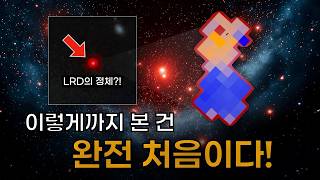
If an LRD were a galaxy full of stars, those stars would need to be packed with an almost absurd level of density—cramming a number of stars comparable to our Milky Way into a space only a few hundred light-years across. It is also ambiguous whether there is an active black hole at the center. If it were a rapidly growing black hole, one would expect to see X-rays, yet they are absent. LRDs are clearly red, but they seem to have far less dust and X-ray emission than expected.
The biggest reason it is difficult to identify LRDs is that, until now, we could not determine exactly how massive the black hole at their center might be. We need to know if the black hole inside is truly a supermassive one, an intermediate-mass black hole still in its early stages, or if a black hole even exists there at all, to understand the true state of an LRD.
In relatively nearby galaxies, black hole mass can be measured. By looking at a galaxy’s spectrum, one can observe broadened emission lines, which indicate how fast gas material is swirling around the black hole. Through this, we can calculate the black hole's gravity and mass. This method is widely used for the nearby universe. However, it is not yet certain if this relationship can be applied to the early universe, less than a billion years after the Big Bang.
The spectrum of an LRD is different from that of a typical active galactic nucleus. Therefore, some astronomers hypothesize that the emission lines in LRDs may not be due to actual rapidly moving gas, but rather a type of optical illusion caused by the scattering of electrons within. It is possible that the black hole is not actually that heavy and the surrounding gas is moving much slower, but because of scattering effects we hadn't accounted for, the spectral lines appear excessively broad, leading us to overestimate the central black hole's mass by up to 100 times.
This misunderstanding could lead us to misinterpret the identity of LRDs entirely. If this is the case, unlike what we initially thought, LRDs might be much lighter and more peaceful places. We cannot rule out the possibility that they are not mysterious celestial bodies harboring giant primordial black holes, but simply dense clusters of stars with slightly higher density.
Recently, there was finally an attempt to "directly" measure the mass of a black hole inside an LRD. This study did not rely solely on estimating black hole mass based on spectral emission lines. Instead, it measured how the gas material actually moves at the center. This remarkable attempt took place at Abell 2744-QSO1, located behind the Abell 2744 galaxy cluster, also known as the Pandora Cluster. Abell 2744 is a massive galaxy cluster filled with countless galaxies and dark matter. Thanks to this, it acts as a massive natural lens, bending the light from the background universe—a phenomenon known as gravitational lensing.
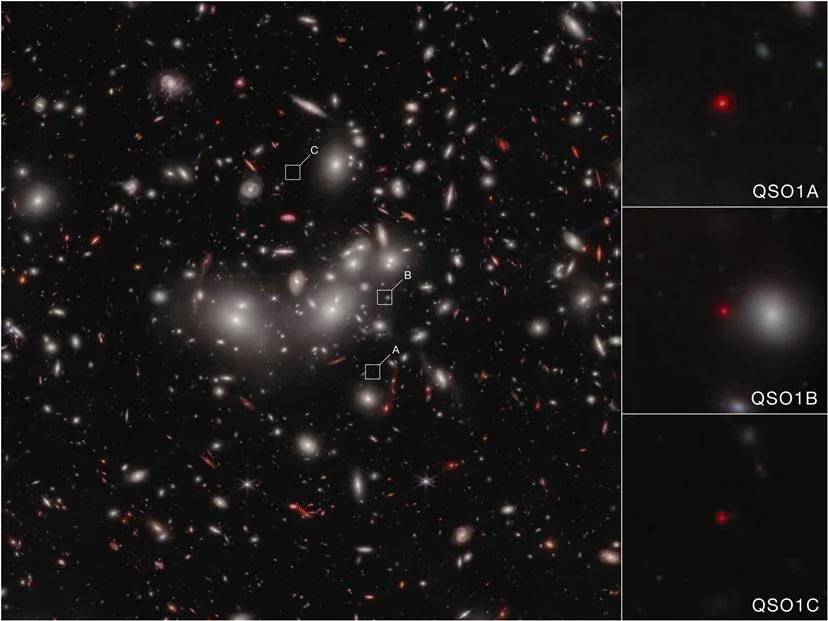
Due to the extreme and exquisite gravitational lensing, the background QSO1 appears as three phantom images. This region shows the universe as it was when it was only 700 million years old. Gravitational lensing amplifies the light of dark celestial bodies that would otherwise be difficult to see. It stretches and distorts the light, magnifying it into a shape with area and size rather than a mere point. This allowed for the observation of a much clearer spectrum of the distant QSO1.
The spectrum in the infrared range was observed using Webb’s NIRSpec instrument. Crucially, the researchers did not simply aggregate all the light from QSO1 to obtain the spectrum; they were able to observe in detail how the spectrum changed depending on the position within the object. This allowed them to map out which gas material in QSO1 was moving toward us, which was moving away, and how that velocity was distributed spatially.
This study specifically focused on the Hα line, which has relatively narrow emission lines. The Hα emission lines of QSO1 are spread over a range of approximately 600 light-years. The team confirmed how the velocity of hydrogen-bearing gas changed from the center of QSO1 toward the outer edges. In essence, they mapped a rotation curve—showing how the rotational speed changes from the center to the periphery—for this distant galaxy!
If an object is a diffuse star cluster or a galaxy, the rotation curve is relatively gentle as you move from the center outward, because the central mass is spread over a wide radius. Our Milky Way is an example of this. Conversely, if almost all the mass is concentrated at a single point at the center, the velocity drops significantly as you move away from the center. This is akin to our solar system, where the orbital velocity decreases drastically from the inner planets to the outer planets because almost all the mass is concentrated in the Sun. This is called Keplerian rotation.
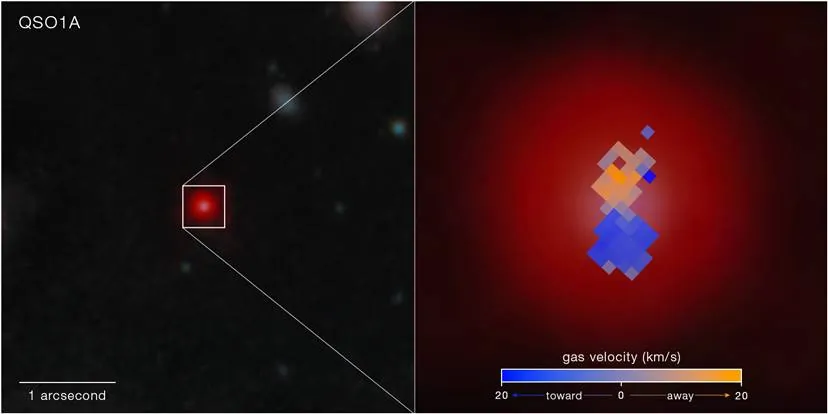
The observation results showed that the movement in QSO1 matches a distribution where mass is concentrated at a single point in the center rather than a diffuse star cluster. In other words, it is more natural to assume there is a very heavy black hole at the center. Adding precise 3D motion analysis, the study concluded that the central black hole is approximately 50 million times the mass of the Sun! This is truly massive. Sagittarius A*, located at the center of our Milky Way, is about 4 million times the mass of the Sun. The black hole in QSO1 is more than 10 times heavier than that!
This means a primordial galaxy that existed when the universe was only 700 million years old harbors a black hole significantly larger than our own mature Milky Way, which is well over 10 billion years old! It is a "subversion" of black hole mass hierarchy. It is baffling that such a young galaxy possessed a black hole 10 times heavier than ours. It directly contradicts the previous expectation that as the universe aged, the mass of black holes within galaxies would gradually grow heavier.
The mass of the stars alone surrounding the black hole in QSO1 was also measured separately. Even with the most conservative estimates, the stellar mass does not exceed 20 million solar masses. In other words, if QSO1 is indeed a celestial body with a giant black hole at its center surrounded by stars, the central black hole is twice as heavy as the total mass of all the stars combined.
This is a type of galaxy never seen in our nearby universe. No matter how heavy a galactic central black hole is, its proportion relative to the entire galaxy's mass is usually very small—typically around one-thousandth. However, in QSO1, it appears that a black hole heavier than the total sum of all stars is hiding at the center. This completely defies our conventional wisdom.
How should we view this perplexing QSO1? Astronomers describe it as a "naked" giant black hole. We usually see black holes buried at the center of galaxies composed of hundreds of billions of stars. This leads us to think that stars and dust formed first, and then matter gathered and kneaded at the center to create the black hole.
However, the existence of QSO1 strongly suggests the exact opposite. It looks like the black hole was there first, and not enough stars had grown around it yet. It is essentially an infant galaxy that has just given birth to a black hole and hasn't yet put on a fancy "outfit" made of stars. Perhaps it remains naked, having not yet been adorned with the brilliant dress of hundreds of billions of stars.
Whether QSO1 represents the most common appearance of the many LRDs or if it is just a rare, coincidental discovery remains to be seen. If we are lucky enough to have the help of exquisite gravitational lenses for more LRDs in the future, we can attempt similar analyses. At the very least, looking at QSO1 alone, it is difficult to explain LRDs as high-density star clusters that do not harbor black holes at their centers. The motion of gas in QSO1 can only be explained if an enormous amount of mass is concentrated at almost a single point.
However, QSO1 has not solved all the secrets. There are still strange aspects left. A black hole this huge appears too quiet. The Eddington ratio is an index that compares how intensely a black hole could theoretically devour surrounding material versus how actively it is currently feeding. Currently, the Eddington ratio of QSO1 is only at the 0.01 level. For its size, it is eating very little—only about 1/100th of what it could. It is like an ultra-heavyweight athlete eating only a single grain of corn every day. This is effectively a dormant state.
This leads to the question: how did it grow so large while "nibbling" so little? If it had been eating as it does now since it was born, it would be impossible to reach 50 million solar masses in just 700 million years. Therefore, even though it is practically fasting now, it must have had a period of "violent eating" right after it was born. Otherwise, a huge seed must have been formed in its entirety from the beginning. This leads to the so-called "heavy seed" problem.
Currently, two hypotheses are clashing in the astronomical community to explain giant black holes in the early universe. One is the "direct collapse black hole" model. It explains that a massive primordial cloud in the early universe collapsed directly into a black hole without creating a single star, forming a huge black hole all at once. In this case, one can create a "seed" black hole weighing 10,000 to 1,000,000 solar masses from the start. Since the black hole is born as a very heavy "super-sized baby," it does not need to eat violently every day during its subsequent growth process.
However, the direct collapse black hole hypothesis also has limitations. This model usually requires strong ultraviolet light around the black hole. This is necessary to hinder star formation by continuously scattering small doughy clumps of matter that are trying to become stars as the gas cloud contracts and collapses, leaving only a black hole at the center. But there are no traces of such strong ultraviolet light sources around QSO1. There are no signs of the violent starbursts or UV flares that might have played such a role in the past.
A more speculative hypothesis is the "primordial black hole." This suggests that black holes were formed directly from density fluctuations in the early universe immediately after the Big Bang. But this hypothesis is also not perfect. The area around QSO1 shows a very primitive chemical composition, consisting of almost nothing but hydrogen and helium. There are almost no heavy elements. This shows that the environment has never been "contaminated" by stars being born and supernovae exploding nearby. This strongly supports the sequence that the black hole was born first and the stars (galaxy) were created later.
However, the mass of the black hole in QSO1 is too heavy. It exceeds the level that the general primordial black hole hypothesis can reproduce. Ultimately, even if we follow the primordial black hole hypothesis, rapid and violent "stormy growth" after the black hole's formation is required to explain its heavy weight of 50 million solar masses.
The discovery of QSO1 provides important clues to the identity of LRDs, which had remained unknown. But at the same time, it leaves behind another mystery. The journey of getting closer to the past of the universe immediately after the Big Bang with the James Webb Space Telescope is like finally starting to dig the ground with a shovel in the vast forest of the cosmos. Until now, we were just looking down at the forest of the universe, admiring the beauty of the leaves exposed on the surface, or at most, watching what was revealed on the ground.
Finally, through Webb, we have looked at a small sprout rising from the forest floor. And we have started to peel back the soil to meet the "Little Red Seed," the LRD, which had been sleeping underneath. To us, who only knew the flowers and trees growing above ground, the seed beneath is completely new and strange. It is difficult to understand where that tiny seed popped out from, and how such a small seed could ever form such huge flowers and trees. Though it remains a strange and perplexing existence to us, we have now planted that small seed in our hearts and begun to grow the sprouts of a new cosmology.
Reference
https://www.nature.com/articles/s41586-026-10579-4
https://academic.oup.com/mnras/article/548/1/staf2109/8607050
https://esawebb.org/news/weic2609/
https://iopscience.iop.org/article/10.3847/2041-8213/ae4bd0
Who is the author Ji Woong-bae? He loves cats and the universe. After watching 'Galaxy Express 999' as a child, he dreamed of sharing the beauty of the universe. He is currently an assistant professor at the College of Liberal Arts, Sejong University, and is engaged in various science communication activities such as lectures and writing. He has authored books such as 'On the Uselessness of Astronomers,' 'We Are All Born as Astronomers,' and 'Strange Questions That Come to Mind When Looking at the Universe,' and has translated books including 'How I Killed Pluto,' 'Quantum Life,' and 'UFO.'