

[비즈한국] Some critics describe the period setting of the film Hope as being somewhere in the 1970s or 1980s. However, for car enthusiasts, there is a definitive clue: the car that shares the most scenes in the film, the ‘Stella.’
Although the Stella was first released in 1982, the model appearing in the film is the 1986 APEX version, which features a late-model facelift. Hyundai Motor Company launched the first-generation ‘Sonata’ in 1985 as a high-end version of the Stella, characterized by its chrome-trimmed headlamps and radiator grille. As the Stella also attempted to move upmarket, the APEX version ended up with a design virtually identical to the Sonata.
At the time, the development code for the Sonata was ‘Y1 Sonata 1800,’ and some even joked that the Stella APEX was essentially a ‘Y1 Sonata 1500.’ A police car used in the film is currently on display in Namchang-ri, Bukpyeong-myeon, Jeollanam-do, and the emblem on it reads ‘STELLAR.’ As an aside, the name ‘Sonata,’ which was used at its launch, was later renamed ‘Sona-ta’ (in Korean spelling) to avoid the mockery of it sounding like ‘a car that carries a cow.’
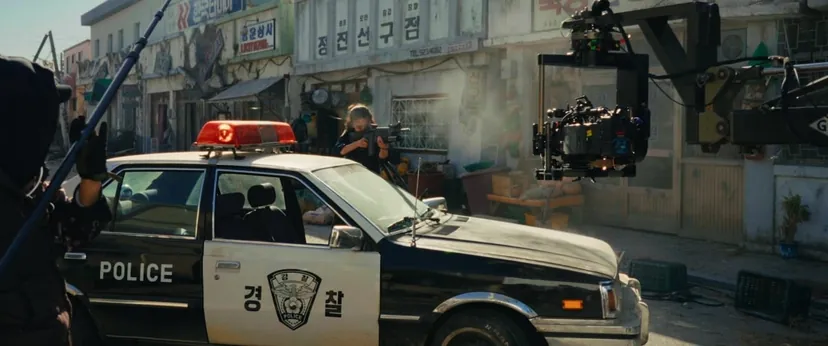
Although the Stella was discontinued in 1992, LPG-powered taxis were sold until 1997, and since the car could still be used as a government vehicle after it was discontinued, the film is definitely set sometime after 1986. While the atmosphere captured in the film might feel like the 70s, it is actually a more modern perspective. Military enthusiasts would also be able to deduce the year based on the M16 rifles issued to the police station.
Despite being an old car, the Stella’s appearance in the film is akin to that of a modern rear-wheel-drive sports car. One might wonder, ‘Is that even possible with a Stella?’ But it’s not impossible. Because the Stella is rear-wheel drive, drifting and ‘J-turns’ are feasible. The Stella was the last Hyundai car before the company switched to making all vehicles, starting with the ‘Excel,’ front-wheel drive. At the time, front-wheel drive was even touted as an innovative technology. Today, all internal combustion passenger cars bearing the ‘Hyundai’ badge are front-wheel drive. Rear-wheel drive has become a symbol of luxury cars, now exclusively found in the ‘Genesis’ brand.
A J-turn is a maneuver that performs a U-turn using only one lane of oncoming traffic. Normally, a U-turn requires two to three opposing lanes, but a J-turn slides the rear wheels to change the car’s direction within a single lane. If you watch on YouTube, even professional racers find it difficult to perform a J-turn in one go because the horsepower and slippage characteristics vary from car to car. Since a J-turn requires powerful rear-wheel force, it is usually attempted with BMW ‘M’ series cars. Given that the Stella’s curb weight is 1,000kg, agile movement is not impossible if its 1.5-liter engine is in prime condition.
In the film, when the ‘monster’ changes direction to flee, the police car must also pivot, but the rural road is not wide enough. In such high-stakes action scenes, repeatedly reversing and shifting forward to turn the car would ruin the flow. A quick J-turn is necessary to keep the momentum going.
Another impressive aspect is the performance of actress Jung Ho-yeon, who drives the car in these scenes. Typically, when filming car scenes, the vehicle is often mounted on a carrier. This often breaks the immersion, as it makes the audience think, ‘This isn’t real.’ Instead, the camera captures the angle from slightly above the car to show both the actress driving and the rear wheels touching the ground, and then—they drift. The actress performed a racer-level drift herself. While a professional stunt driver likely handled the scenes where the driver is not visible, whether or not a body double is used for key moments significantly impacts the cinematic reality.
The car scenes alone show how the film obsessed over detail, and the same meticulous direction is applied to the ‘mechanical devices,’ the firearms. Unlike in Rambo movies where bullets seem infinite, here they constantly swap magazines and discard the guns once the spare magazines are exhausted. The characters are also seen doggedly clutching heavy bags filled with magazines throughout the film. In the final scene, when the four survivors abandon the car, they divide the heavy bags of ammunition and run; a gun without bullets is not a weapon, after all. During the firearm action sequences, the actors even go as far as to manually rack the bolt after swapping magazines. Any man who has served in the military would certainly recognize and appreciate that detail.
I watched the film in ‘Dolby Atmos,’ and even the gunfire sounds were flawless. Gun action that simply pumps up the volume is boring; the impact of the gunshots here was spot on. For the first hour, this is a film where you can simply sit back and enjoy the action. While opinions on the second half may be divided, the meticulous direction of the cars and firearms in the first half alone is enough to get the adrenaline pumping.