

[비즈한국] If you use generative AI frequently, you may have felt that there are times when, despite using the same model, the responses are exceptionally slow. You might be working in the morning, where the AI quickly writes text and analyzes data, but suddenly it fails to provide an answer for a long time or displays an error message. Is there a "rush hour" for AI, just as there is for commuters?
When you align the working hours of major global regions with Korea Standard Time (KST), the time most likely to have the highest AI usage is around 10 PM. At this time, Europe is in the middle of its afternoon work, and the U.S. East Coast is beginning its morning shift. In Korea and Japan, it is the time when individual users are using AI for writing, searching, translating, and generating images after finishing their workday.
However, there is no official statistic stating that 10 PM is the global peak for AI usage. Major AI companies like OpenAI, Google, and Anthropic do not disclose specific user counts or server loads by country or time zone. There is also no consolidated data on the global hourly usage of ChatGPT, Claude, and Gemini.
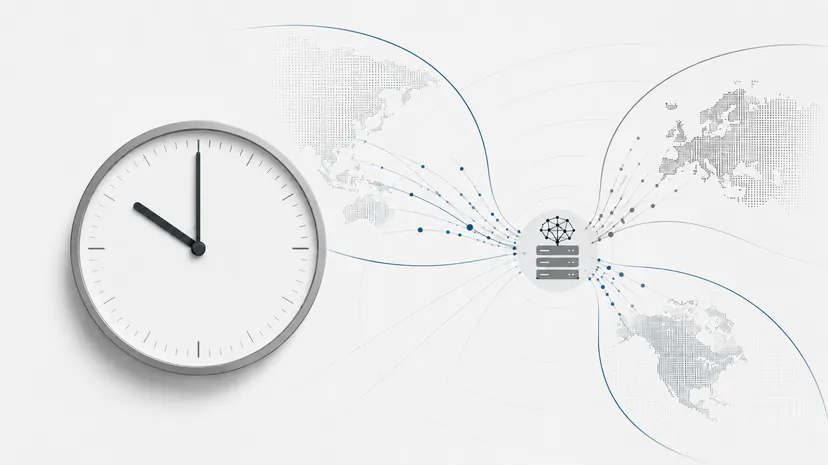
Nevertheless, there is evidence that AI usage follows human daily routines. According to the "Anthropic Economic Index" released in June 2026, the usage of Claude followed real-world work and life cycles quite faithfully. Business emails and document drafting peaked between 10 AM and 11 AM local time. Questions related to news were frequent at 7 AM, and requests for recipes increased by 2.3 times the hourly average at 6 PM.
This means that AI is not used at a constant rate in an independent digital world; rather, it moves in sync with the times when people start work, eat, and head home.
10 PM, users from three continents meet
At 9 AM KST, Korea and Japan begin their workdays. At 1 PM, workers in East Asia return from lunch, and demand continues from China and Southeast Asia. By 4 PM, Europe joins in. Based on daylight saving time, 4 PM KST is 8 AM in the UK and 9 AM in Germany and France.
From 9 PM, the day begins on the U.S. East Coast. 10 PM KST is 9 AM in New York, 2 PM in London, and 3 PM in Paris and Berlin. Nighttime usage in Asia, afternoon work in Europe, and morning work in the U.S. East Coast overlap simultaneously. Considering only the working hours of the world's major AI markets, it is highly likely that this time is close to the peak of global demand.
However, not all users flock to the same server. AI companies distribute users across data centers in various regions around the world and increase computing resources to meet demand. If there are many users in the U.S., it does not necessarily mean that AI in Korea will slow down. Server operation structures also differ depending on the model and service.
Speed can be more influenced by the "weight" of the query than the number of users. The computational power required for translating a short sentence is completely different from that required for analyzing a report of hundreds of pages. Agent-based tasks that simultaneously require web searching, file analysis, code execution, or tasks where the AI performs multiple steps on its own use significantly more computing resources.
Anthropic's analysis also showed that conversations involving app development consumed more than three times the number of tokens than the median for all conversations. Conversely, tasks generating general explanations used only about one-fifth of the median. Conversations related to marketing management used about 2.5 times more tokens than editing tasks. In short, the more complex the judgment and execution assigned to the AI, the greater the burden on the server.
At 10 PM, reports, emails, and coding tasks are just beginning in the U.S., while long-running tasks started in the morning continue in Europe. In Asia, requests for writing and image generation from individual users who have finished their work are added to the mix. It is possible for high-computational tasks to pile up alongside the high volume of users.
Slow speed is not always due to traffic
The reason AI slows down is not always because of an increase in global users. The same phenomenon occurs if available computational resources are reduced due to server or network failures. If the selected model performs complex reasoning or uses external functions like web searching and file analysis, the response may be delayed.
Speed can also drop if a single chat window is used for too long. Generative AI processes not just the new query, but also the necessary context, including previous conversations and attached materials. As the conversation history grows, the amount of information the model must read also increases.
Calculating global working hours in reverse, the time when AI is likely to be relatively quiet in Korea is between 5 AM and 8 AM. Europe has finished its workday, and North America has either completed its afternoon work or is entering the evening. Korea and Japan are still before the start of their formal workdays.
Ultimately, only the companies operating these services know the exact "rush hour" for global AI. However, based on the analysis of Anthropic’s usage patterns and the working hours of major regions, it is highly likely that the period around 10 PM KST is the most congested.